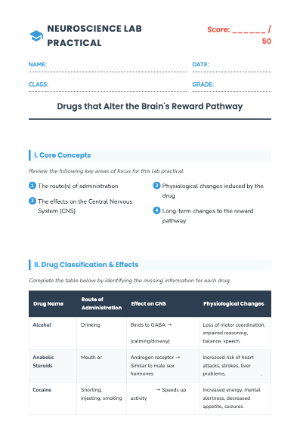
These 11th grade others science worksheets give teachers a ready set of resources for the elective and specialized topics that sit outside the biology-chemistry-physics core — astronomy, geology, forensic science, environmental science, and Earth systems science. Each worksheet targets a discrete skill or concept and prints cleanly without layout distortion across devices or operating systems.
What's Inside the Set
The worksheets span five subject areas. Astronomy tasks include interpreting Hertzsprung-Russell diagrams, identifying electromagnetic spectrum regions by wavelength, and working through distance calculations using the inverse square law for luminosity. Geology worksheets cover rock cycle identification, applying the principles of superposition and cross-cutting relationships to stratigraphic columns, and reading geologic time scale comparisons in ways that push students beyond rote labeling. Forensic science exercises ask students to reason from physical and chemical evidence — blood typing, fingerprint ridge classification, soil composition — toward logically bounded conclusions. Environmental science worksheets present seasonal dissolved oxygen data, human impact calculations, and energy flow through trophic levels. Earth systems worksheets tie plate tectonics, the carbon cycle, and climate feedback loops into integrated questions rather than treating each as a separate memorization event.
Student Error Patterns Worth Knowing Before You Assign
The forensics worksheets surface one of the most consistent errors in 11th-grade science: students confuse exclusion with identification. When a blood type on a worksheet matches the suspect's, students write "this proves it was him" — a logical step the evidence does not support. Blood typing excludes suspects; it does not identify them. The worksheet forces that distinction explicitly, but front-loading the reasoning before students attempt the analysis questions helps, because the error reappears even after initial correction.
Geology brings a different problem. Students can label the Cambrian Period on a time scale without any real sense of the proportional difference between 541 million years and 3.8 billion years. Both numbers register as simply "very old." Stratigraphic column worksheets that ask students to calculate the ratio of one interval to another — not just name it — expose this gap quickly. A parallel confusion appears in astronomy: students understand intellectually that a light-year measures distance, but under time pressure they revert to treating it as a unit of time. Expect to see sentences like "that galaxy is two million light-years old" in first drafts even from strong students.
How to Work These Into Your Lesson Planning
Astronomy and forensics worksheets work well as pre-assessment tools at the start of a unit. Distribute a worksheet before instruction begins and ask students to complete what they can. What they skip or get wrong tells you where to spend instructional time — and saves you from re-teaching material the class already understands. For the H-R diagram worksheet specifically, a mid-lesson check during a 10-minute independent work block gives real-time data on who grasps the relationship between luminosity and surface temperature before the lesson moves into stellar evolution. Teachers running a block schedule will find the environmental science data analysis worksheets useful for the second half of a longer period, when students need structured work that does not require a lecture setup. When using 11th grade others science worksheets as low-stakes formative checks rather than graded assessments, student willingness to show partial work increases — and partial work is often where the most useful diagnostic information lives.
Adjusting the Set for a Range of Student Readiness
Before assigning 11th grade others science worksheets to the whole class, identify which tasks are primarily recall-based and which require data interpretation or multi-step reasoning. That split alone guides most differentiation decisions. For students who struggle with the geology worksheets, providing a printed geologic time scale as a reference strip removes the memorization barrier and lets the actual reasoning task — relative dating and stratigraphic interpretation — become the focus. Without that reference, students at lower readiness levels spend their energy reconstructing the time scale from memory and never reach the analytical work the worksheet targets. English language learners face a specific challenge across all five subject areas: astronomy, geology, and forensics vocabulary is built almost entirely from Greek and Latin roots, and a brief root word reference posted in the classroom pays dividends well beyond these worksheets. For students ready for more depth, the forensics worksheets extend naturally — ask them to write a short evidence report that states explicitly what the data supports and what it cannot conclude. That writing task pushes scientific reasoning into territory most 11th-grade science worksheets do not reach.
Standard Alignment
These worksheets align with several NGSS disciplinary core idea clusters for high school. Astronomy content maps to HS-ESS1 (Earth's Place in the Universe), covering stellar classification, the electromagnetic spectrum, and orbital mechanics. Geology and Earth systems worksheets connect to HS-ESS2 (Earth's Systems), addressing rock cycles, plate tectonics, and biogeochemical cycles. Environmental science tasks align with HS-ESS3 (Earth and Human Activity), including energy use comparisons, resource analysis, and ecosystem data interpretation. The forensic science worksheets reinforce the NGSS crosscutting concepts of cause and effect and patterns, and support the Science and Engineering Practice of constructing explanations from evidence — a skill that threads through all four NGSS disciplinary domains. Teachers in states that mandate earth science or integrated science coursework at the junior level will find the geology and Earth systems worksheets a direct match for those course requirements.
Frequently Asked Questions
What subjects count as "others science" at the 11th-grade level?
The category covers specialized or interdisciplinary science electives that fall outside the standard biology-chemistry-physics sequence. At 11th grade, that typically includes astronomy, geology, forensic science, environmental science, and Earth systems science. These subjects appear as standalone electives at many high schools, as components of an integrated science course, or as capstone units within a standard course. The worksheets in this set address all five areas.
Can individual worksheets be used without building a full unit around them?
Yes. Each worksheet stands on its own. A forensics worksheet on blood typing does not require you to have completed a preceding worksheet on fingerprint analysis — the task is self-contained. Teachers who pick up one or two worksheets to fill a gap in an existing unit, supplement a textbook chapter, or give students independent practice before a lab will find the format works equally well for that purpose.
Do the worksheets include answer keys?
The set includes answer keys for every worksheet with a discrete correct answer. Open-ended analysis questions — the type that appear in several forensics and environmental science worksheets — include model responses rather than single-answer keys, which gives teachers a benchmark for evaluating student reasoning rather than just checking right or wrong. For the 11th grade others science worksheets set as a whole, the answer materials are formatted to make self-assessment practical for advanced or independent learners.















 Interactive Worksheet Maker
 Quiz Maker
 Word Search Maker
 Crossword Puzzle Maker
 Word Scramble Generator
 Sentence Scramble Generator
 Handwriting Worksheet Generator
 Name Tracing Generator
 Fill In The Blank Generator