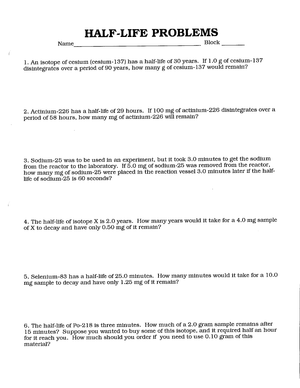
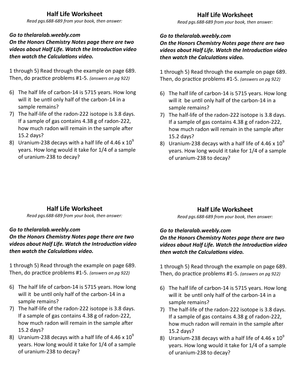
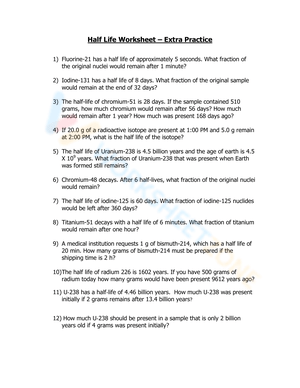
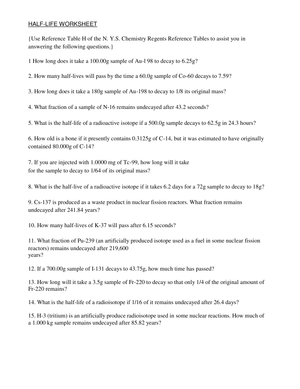
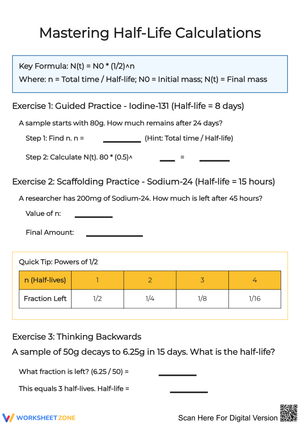
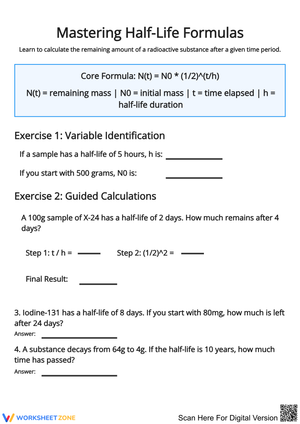
These half life worksheets for 11th grade give chemistry teachers a targeted bank of nuclear decay problems that move students from intuitive ratio reasoning into formal exponential calculation. The set covers sequential halving, formula-based decay problems using N(t) = N₀(1/2)^(t/T), decay curve graphing, and real-world contexts including carbon-14 dating and medical isotope applications. Each worksheet focuses on a single skill cluster, so teachers assign selectively rather than working straight through the set.
What Each Worksheet Covers
Nuclear chemistry arrives in 11th grade after students have spent the year working with electron configurations, bonding, and stoichiometry — none of which required exponential thinking. The shift to decay calculations is a genuine conceptual change, and half life worksheets for 11th grade address it by distributing the mathematical load across distinct problem types rather than front-loading the formula all at once.
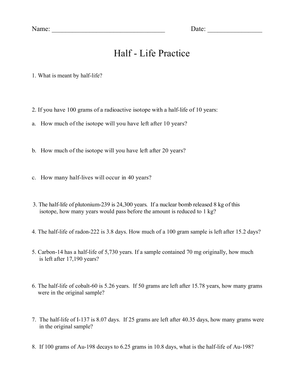
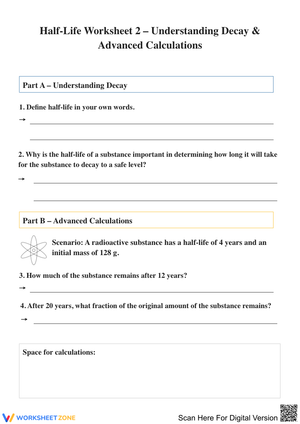
- Whole-number sequential halving — students divide a starting mass by two for each half-life interval, building an intuitive sense of the process before any algebra enters
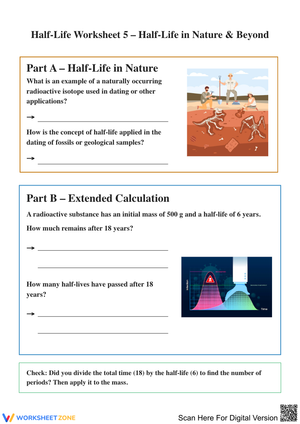
- Formula application — problems using N(t) = N₀(1/2)^(t/T) ask students to solve for remaining mass, initial mass, or elapsed time given two of the three variables
- Logarithmic problems — finding an unknown number of half-lives when time and half-life period are both provided, requiring log base 2 or change-of-base conversions
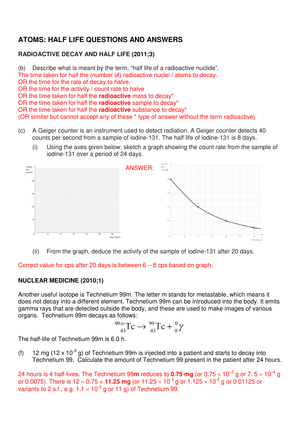
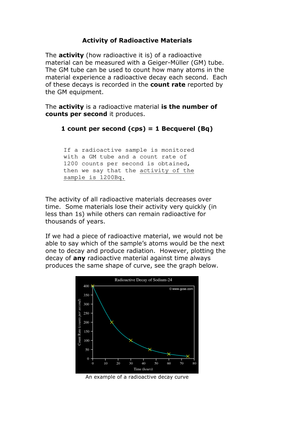
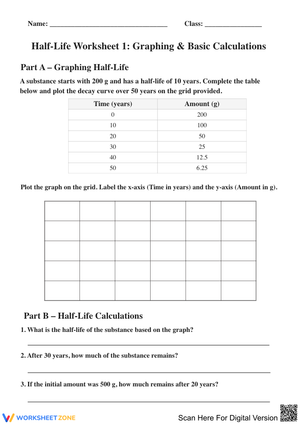
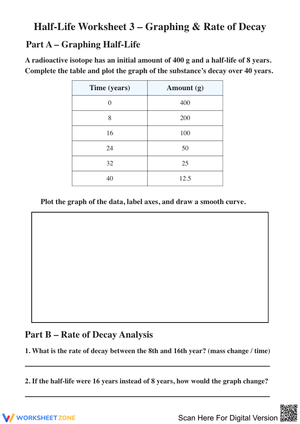
- Decay curve graphing — students plot provided data points and read off the half-life visually, connecting algebraic and graphical representations of the same process
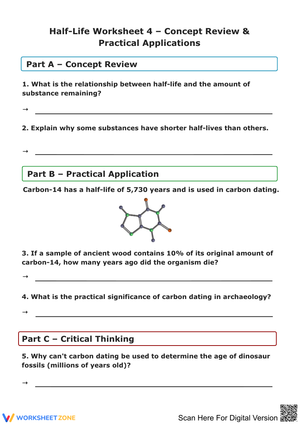
- Application problems — carbon-14 dating scenarios using the 5,730-year half-life, technetium-99m medical imaging problems with a 6-hour half-life, and uranium-238 geological dating contexts
Mistakes Students Make That Are Worth Catching Early
The most persistent error we see in student work is conflating the amount that has decayed with the amount remaining. A student who starts with 80 grams and correctly determines that 60 grams have decayed will write 60 g as the final answer. Each multi-step problem in the set asks students to label "mass decayed" and "mass remaining" as separate lines in their work, which intercepts that inversion before it becomes a reflex.
Unit mismatches cause a different category of failure. When a problem gives elapsed time in days and the half-life in hours, many students skip the conversion entirely and calculate as if the units already match. They aren't being careless — they genuinely don't recognize the mismatch as a blocking issue. The worksheets mark unit alignment as a required first step in the problem setup, building the habit during practice rather than leaving it to surface on an assessment.
A third trouble spot: students who use sequential halving correctly for whole-number half-lives will sometimes try to extend it to fractional ones by estimating. A student told that 1.5 half-lives have passed might halve once and then halve again "a little bit." The worksheets make the boundary between whole-number and formula-based approaches explicit, so students know when to switch methods rather than improvising.
Building These Worksheets Into Your Nuclear Chemistry Sequence
Half life worksheets for 11th grade work best when treated as formative check-ins rather than summative exercises. Assign the decay curve graphing worksheet on the third or fourth day of the unit — before students have time to develop false confidence in the formula. A student who draws a straight diagonal line instead of a curve is still thinking subtractively, and catching that on day three beats catching it during a test review by a wide margin.
The sequential halving and formula-based worksheets hold up well as Monday warm-ups after a weekend away from the material. One problem, 8 minutes, then a two-minute partner comparison consistently surfaces more useful confusion than a longer silent problem set. Students who solved it differently often discover their own error through comparison before the teacher says a word — that's low-stakes retrieval doing its job.
The application problems around carbon-14 dating and medical isotopes work well as anchoring activities mid-unit, once students have formula fluency but before the unit assessment. They pair naturally because the context generates real discussion — students often disagree about which variable to solve for first, and that disagreement is productive.
Standard Alignment
NGSS HS-PS1-8 asks students to develop models of nuclear processes and explain the quantitative relationship between nuclear decay and atomic stability — exactly what the formula-based and graphing problems address. On the mathematics side, CCSS HSF-LE.A.2 covers constructing exponential functions from tables and graphs, the same skill students exercise when reading a half-life off a decay curve. Most 11th-grade chemistry teachers place the nuclear unit in the second semester, after thermodynamics but before organic chemistry, which means students have completed algebra II but may not yet have covered logarithms in their concurrent math course. The logarithm-based problems in the set are flagged separately so teachers can sequence them once students have the math background or defer them to honors sections.
Differentiating the Set Across Student Entry Points
Using half life worksheets for 11th grade in a mixed-ability class means sequencing the problem types by cognitive demand rather than assigning the same worksheet to everyone at once. Students who need more time with the concept start on the sequential halving worksheets — arithmetic only, no formula, no exponents. Once they can reliably get the right answer through repeated division, the formula becomes a faster tool rather than an abstraction disconnected from what they already understand.
Students comfortable with algebra but not yet familiar with logarithms handle problems using log base 2 directly — no natural log or calculus required. Those enrolled in AP Chemistry or a concurrent pre-calculus course work the extension problems, which ask them to derive the decay constant λ from a given half-life and rewrite the decay function in continuous form. That connection carries directly into what they encounter in AP Chemistry and eventually in university physics.
One honest limitation worth naming: students who freeze when a problem introduces an unfamiliar element symbol or an application context they haven't seen before sometimes benefit from stripping the isotope name and framing the same problem as "substance X." The real-world context helps some students and blocks others, and adjusting for that is straightforward once you know which students are in which group.
Frequently Asked Questions
Do students need to know logarithms before using these worksheets?
No. The set is organized so that whole-number and formula-based problems come first, and logarithmic problems are clearly marked as extensions. Most 11th graders use these worksheets before logarithms come up in their math course. The sequential halving and N(t) = N₀(1/2)^(t/T) problems require only algebra and exponent rules. The logarithm problems are there for classes that have already covered them or for advanced students working ahead of the unit pace.
How do the worksheets handle the confusion between amount decayed and amount remaining?
Each multi-step problem includes a labeled workspace with separate lines for "initial amount," "amount remaining," and "amount decayed." This is deliberate — the single most common error in half-life calculation is reporting the decayed quantity as the final answer. Requiring students to write both values during practice builds the distinction into their procedure before it matters on a graded assessment.
Can these worksheets work in a course that covers nuclear chemistry briefly rather than as a full unit?
Yes. Because each worksheet targets a single skill area, teachers in courses with limited time on nuclear chemistry pull the most essential worksheets — typically the sequential halving, formula application, and one application problem worksheet — and leave the logarithm extensions for honors sections or skip them entirely. The set doesn't assume a four-week nuclear chemistry block, and nothing is lost by using only part of it.












 Interactive Worksheet Maker
 Quiz Maker
 Word Search Maker
 Crossword Puzzle Maker
 Word Scramble Generator
 Sentence Scramble Generator
 Handwriting Worksheet Generator
 Name Tracing Generator
 Fill In The Blank Generator