


























1 / 7
0
Views
0
Downloads

0.0
0
Save
0 Likes
Share
Solving Half-Life Problems
0 Views
0 Downloads
Paste this activity's link or code into your existing LMS (Google Classroom, Canvas, Teams, Schoology, Moodle, etc.).
Students can open and work on the activity right away, with no student login required.
You'll still be able to track student progress and results from your teacher account.
Information
Description
What It Is:
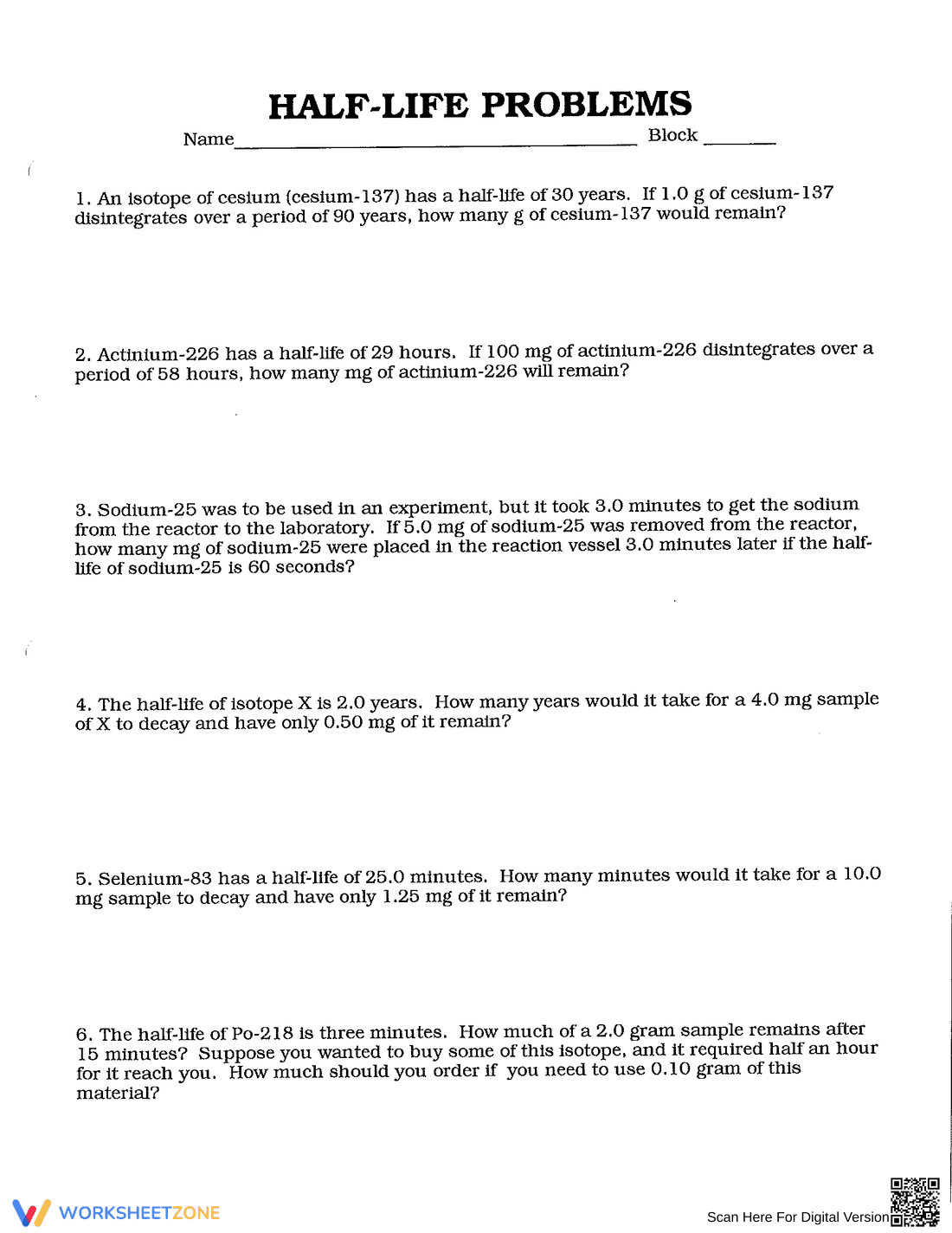
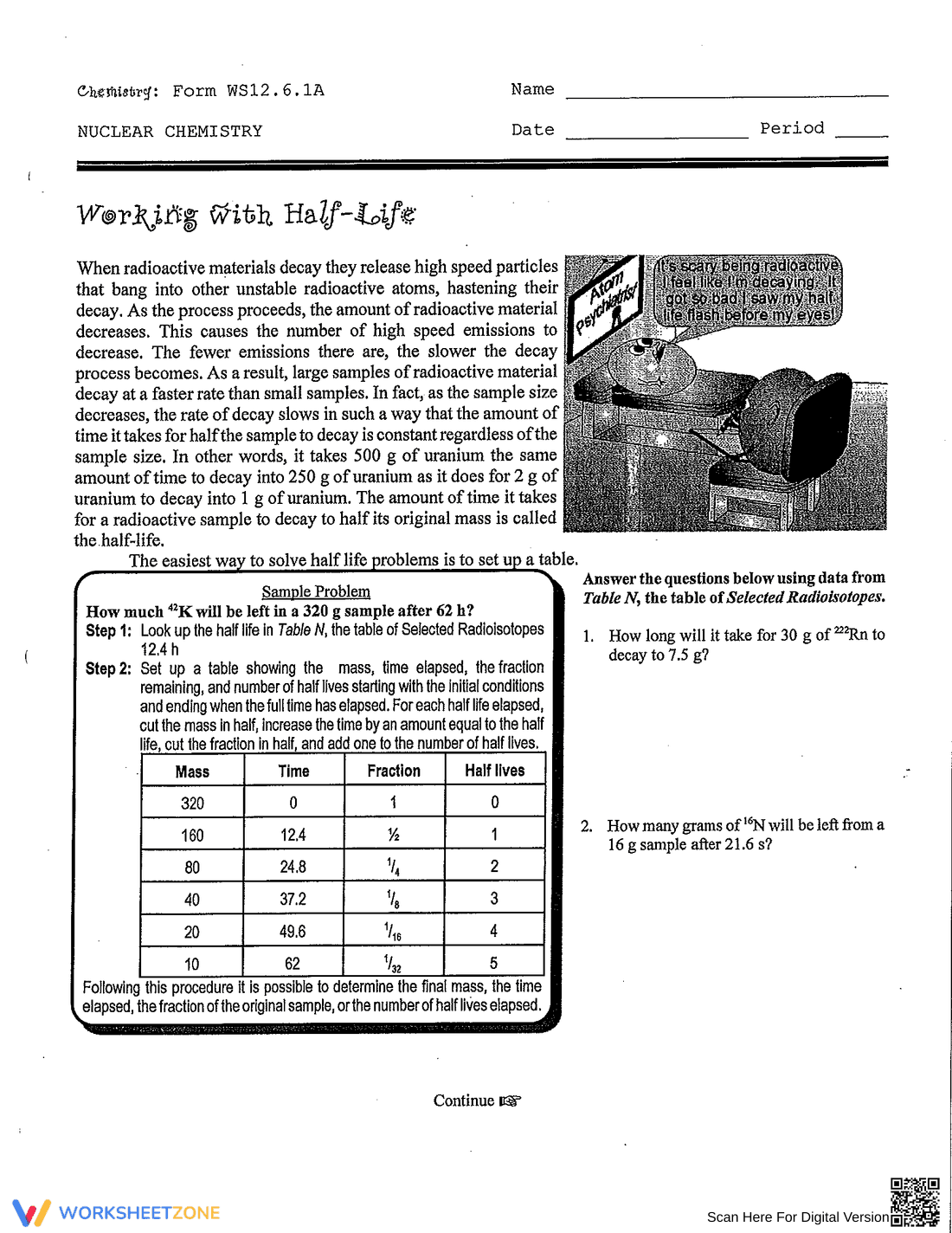
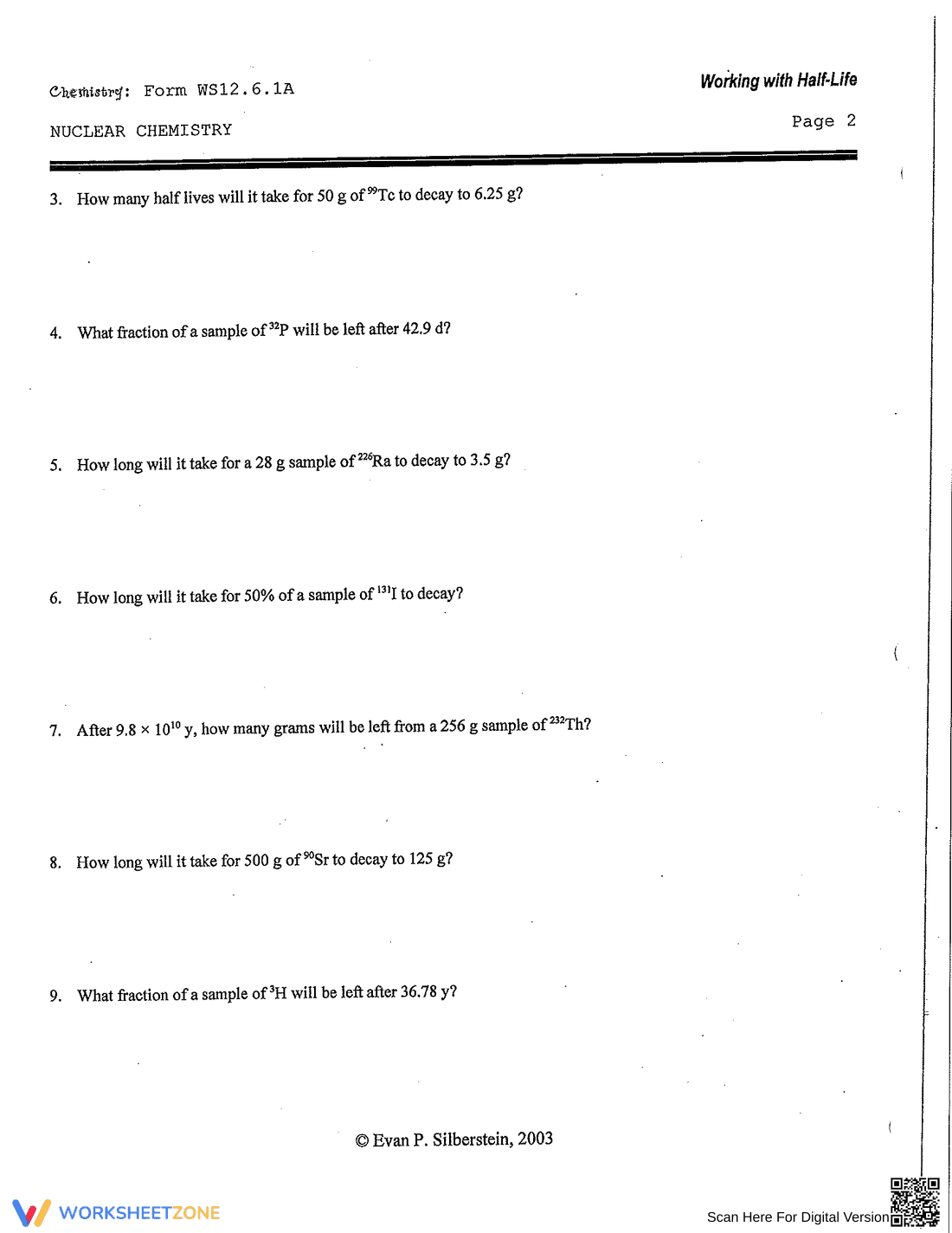
This is a worksheet titled 'Half-Life Problems.' It contains six word problems related to radioactive decay and half-life calculations. The problems involve calculating the amount of a radioactive isotope remaining after a certain period, given its half-life, and some problems ask to calculate the time required for a sample to decay to a specific amount. The isotopes mentioned include Cesium-137, Actinium-226, Sodium-25, Isotope X, Selenium-83, and Polonium-218. The worksheet has space for the student's name and block.
Grade Level Suitability:
This worksheet is suitable for high school students, specifically grades 11-12, studying chemistry or physics. The problems require understanding of exponential decay, unit conversions (years to minutes, etc.), and applying the concept of half-life to solve quantitative problems.
Why Use It:
This worksheet helps students practice and reinforce their understanding of radioactive decay and half-life calculations. It provides real-world scenarios to apply the concept and develop problem-solving skills in nuclear chemistry. It also helps in understanding the concept of exponential decay and its applications.
How to Use It:
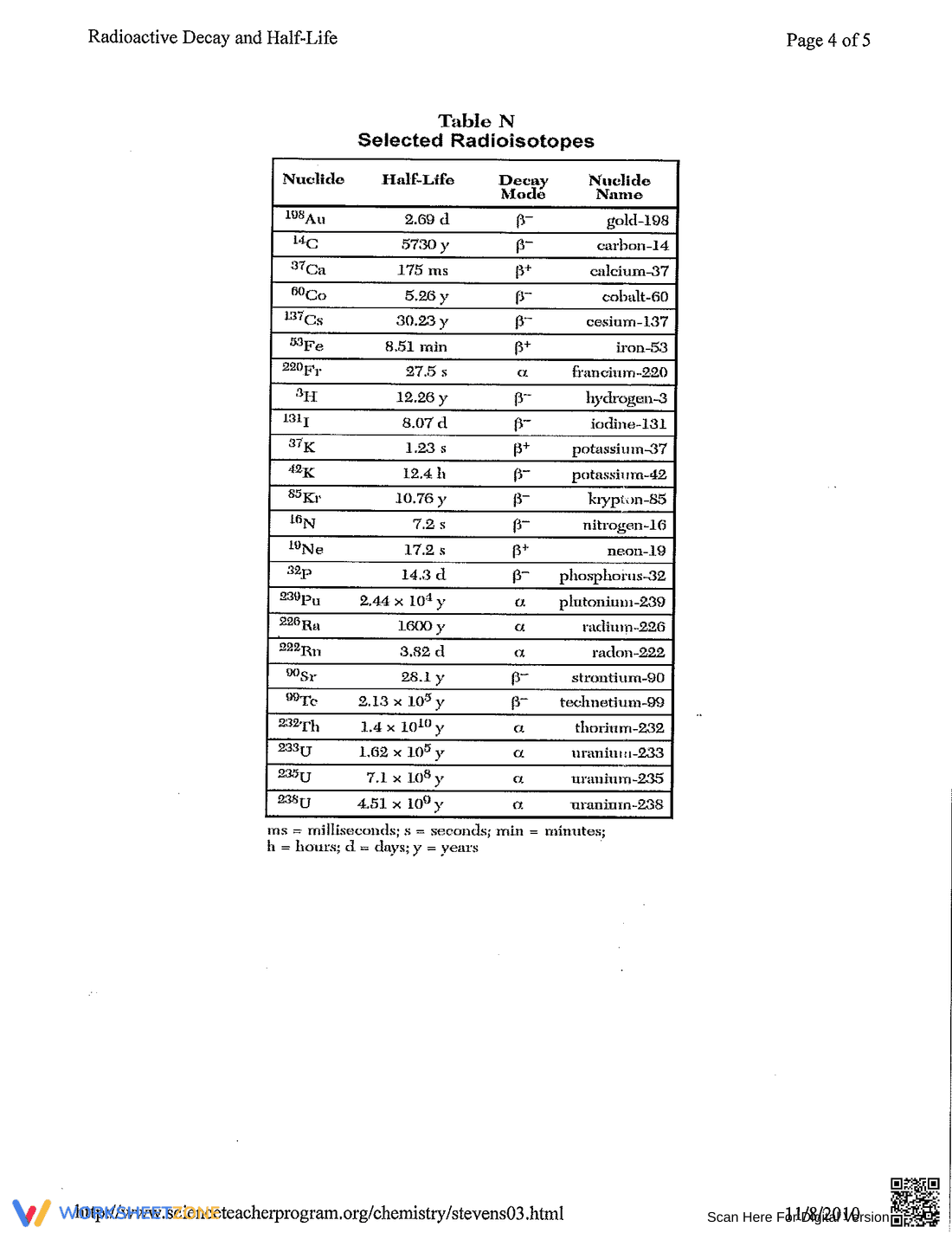
Students should read each problem carefully, identify the given information (initial amount, half-life, time elapsed), and apply the half-life formula to calculate the remaining amount of the isotope or the time required for decay. They should show their work and include appropriate units in their answers.
Target Users:
The target users are high school students taking chemistry or physics courses, particularly those learning about nuclear chemistry and radioactive decay. It can also be used by teachers as a practice assignment or assessment tool to evaluate students' understanding of half-life concepts.
This is a worksheet titled 'Half-Life Problems.' It contains six word problems related to radioactive decay and half-life calculations. The problems involve calculating the amount of a radioactive isotope remaining after a certain period, given its half-life, and some problems ask to calculate the time required for a sample to decay to a specific amount. The isotopes mentioned include Cesium-137, Actinium-226, Sodium-25, Isotope X, Selenium-83, and Polonium-218. The worksheet has space for the student's name and block.
Grade Level Suitability:
This worksheet is suitable for high school students, specifically grades 11-12, studying chemistry or physics. The problems require understanding of exponential decay, unit conversions (years to minutes, etc.), and applying the concept of half-life to solve quantitative problems.
Why Use It:
This worksheet helps students practice and reinforce their understanding of radioactive decay and half-life calculations. It provides real-world scenarios to apply the concept and develop problem-solving skills in nuclear chemistry. It also helps in understanding the concept of exponential decay and its applications.
How to Use It:
Students should read each problem carefully, identify the given information (initial amount, half-life, time elapsed), and apply the half-life formula to calculate the remaining amount of the isotope or the time required for decay. They should show their work and include appropriate units in their answers.
Target Users:
The target users are high school students taking chemistry or physics courses, particularly those learning about nuclear chemistry and radioactive decay. It can also be used by teachers as a practice assignment or assessment tool to evaluate students' understanding of half-life concepts.


