




























Views
Downloads

Printable Dichotomous Key Worksheet | Grade 7 Science

Paste this activity's link or code into your existing LMS (Google Classroom, Canvas, Teams, Schoology, Moodle, etc.).
Students can open and work on the activity right away, with no student login required.
You'll still be able to track student progress and results from your teacher account.
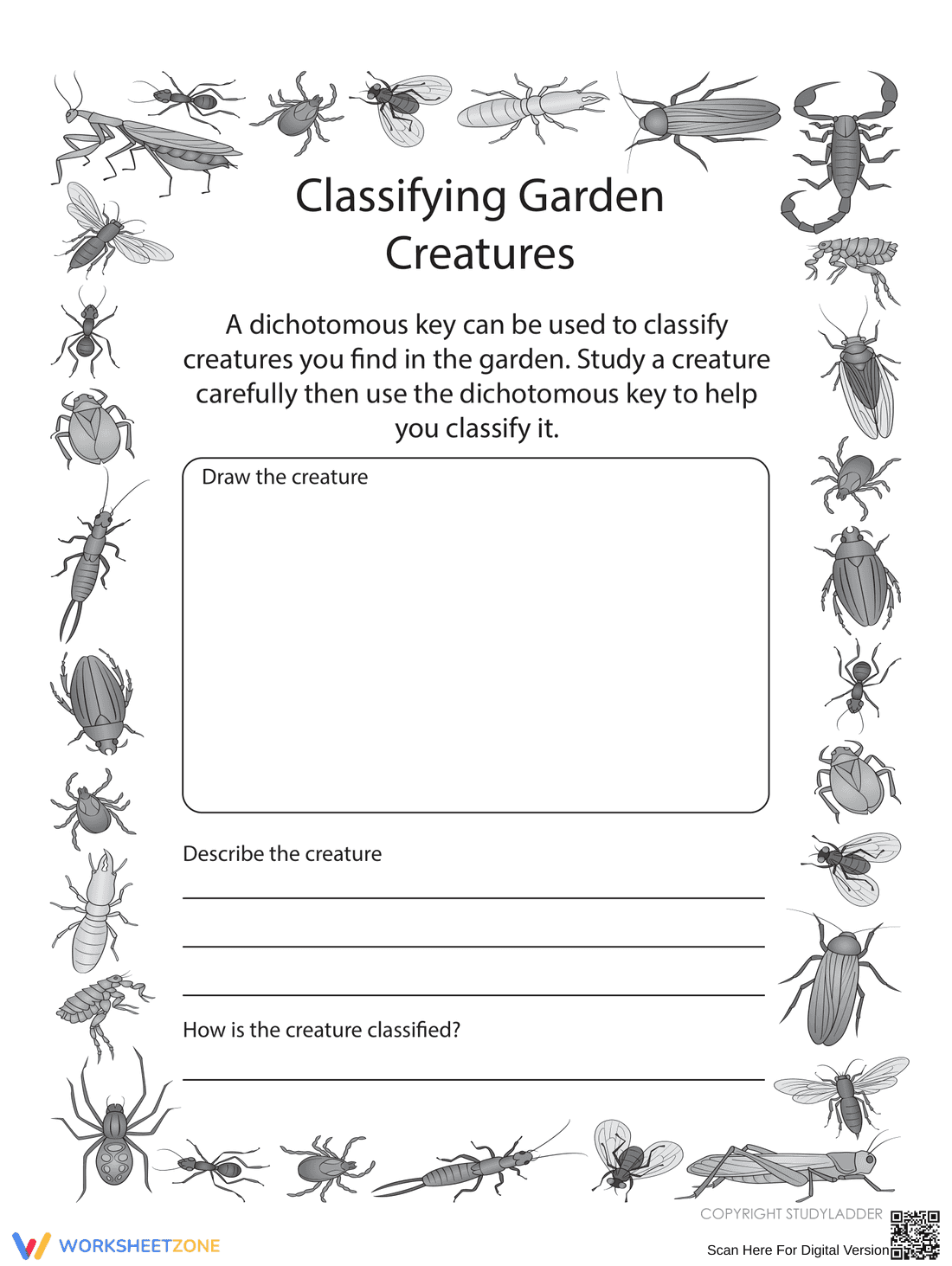
This Grade 7 science worksheet provides students with a hands-on opportunity to practice biological classification. By observing garden creatures, students will apply their understanding of physical traits to identify organisms. This activity reinforces observational skills and demonstrates how scientists categorize the natural world using structured identification tools.
At a Glance
- Grade: 7 · Subject: Science
- Standard:
MS-LS4-2— Identify anatomical similarities and differences among organisms- Skill Focus: Using a dichotomous key
- Format: 1 page · 3 problems · No answer key required · PDF
- Best For: Independent practice or outdoor learning
- Time: 15–20 minutes
Inside this single-page resource, students will find a straightforward layout. The worksheet features a border of garden insects to inspire choices. It includes three task areas: space to draw a creature, lines for a physical description, and a prompt to record classification. Because it relies on student-selected specimens, no answer key is needed.
This resource offers a simple workflow:
- Print (1 minute): Generate copies from the PDF.
- Distribute (1 minute): Hand out pages and a basic dichotomous key.
- Review (2 minutes): Explain instructions and let students begin.
Total teacher preparation time is under two minutes. This is an excellent option for an outdoor nature walk or a reliable science sub plan.
This activity aligns with MS-LS4-2, which asks students to apply scientific ideas to construct an explanation for the anatomical similarities and differences among modern organisms. By requiring students to describe physical traits and use those traits for classification, the worksheet reinforces core biological concepts. Both standard codes can be copied directly into lesson plans, IEP goals, or district curriculum mapping tools.
Teachers can integrate this worksheet during a broader unit on taxonomy and classification. It works exceptionally well as an outdoor learning activity where students find real insects in a school garden. Alternatively, it can be used inside the classroom by providing students with plastic insect models or high-resolution photographs to classify. As students work, teachers can use this as a formative assessment by observing how accurately they translate visual traits into written descriptions. Expect students to complete the entire process in 15 to 20 minutes.
This resource is primarily designed for middle school science students in grades 7 through 9 learning about biological classification. It offers natural differentiation, as students can choose creatures with varying levels of complexity to classify. Visual learners benefit greatly from the drawing component, while analytical thinkers will enjoy the structured classification process. Pair this worksheet with a comprehensive lesson on taxonomy or a visual anchor chart explaining how to read a dichotomous key.
Effective science instruction requires students to actively engage with scientific practices rather than passively receiving information. The MS-LS4-2 standard emphasizes the ability to identify anatomical similarities and differences among organisms, a foundational skill for understanding evolutionary biology and taxonomy. According to a ScienceDirect TpT Analysis, instructional materials that combine visual observation with structured writing prompts significantly improve student retention of complex biological concepts. By asking students to draw, describe, and classify a specific organism, this worksheet bridges the gap between abstract taxonomic rules and concrete, observable phenomena. This multimodal approach ensures that learners process the information through multiple cognitive pathways, reinforcing their understanding of how scientists categorize the natural world. Providing students with brief, focused tasks like this one supports sustained attention and builds confidence in applying scientific tools independently.


