




























Views
Downloads



Printable Dichotomous Key Worksheet | Grade 7 Science

Paste this activity's link or code into your existing LMS (Google Classroom, Canvas, Teams, Schoology, Moodle, etc.).
Students can open and work on the activity right away, with no student login required.
You'll still be able to track student progress and results from your teacher account.
This dichotomous key worksheet provides students with hands-on practice identifying organisms based on physical traits. By working through paired statements, learners develop critical observation skills and learn how scientists classify the natural world. The complete packet includes engaging activities to build foundational biology concepts.
At a Glance
- Grade: 7 · Subject: Science
- Standard:
TEKS 5.10A— Compare structures and functions of different species- Skill Focus: Using dichotomous keys
- Format: 9 pages · 12 problems · Answer key included · PDF
- Best For: Guided practice and lab activities
- Time: 45–60 minutes
What's Inside
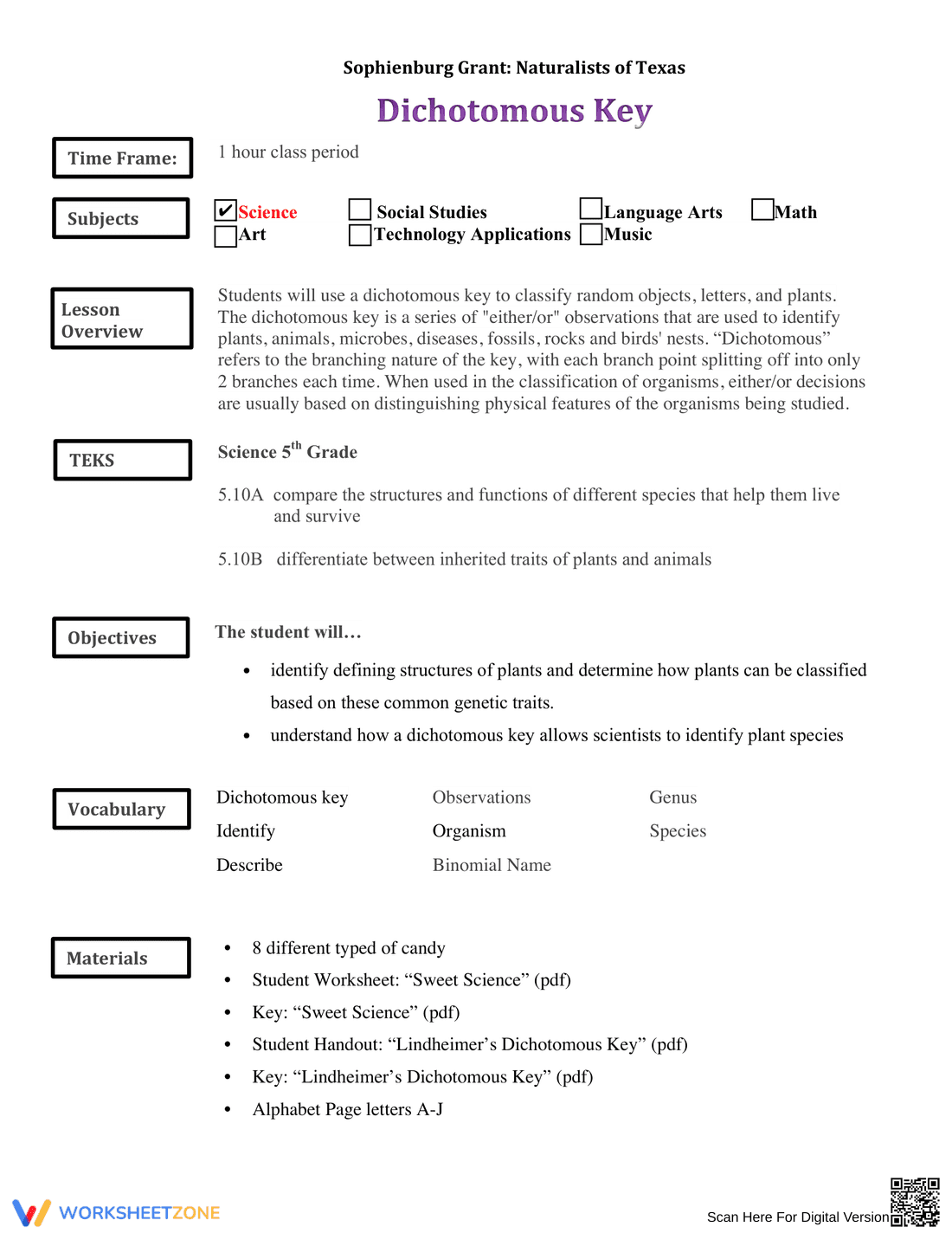
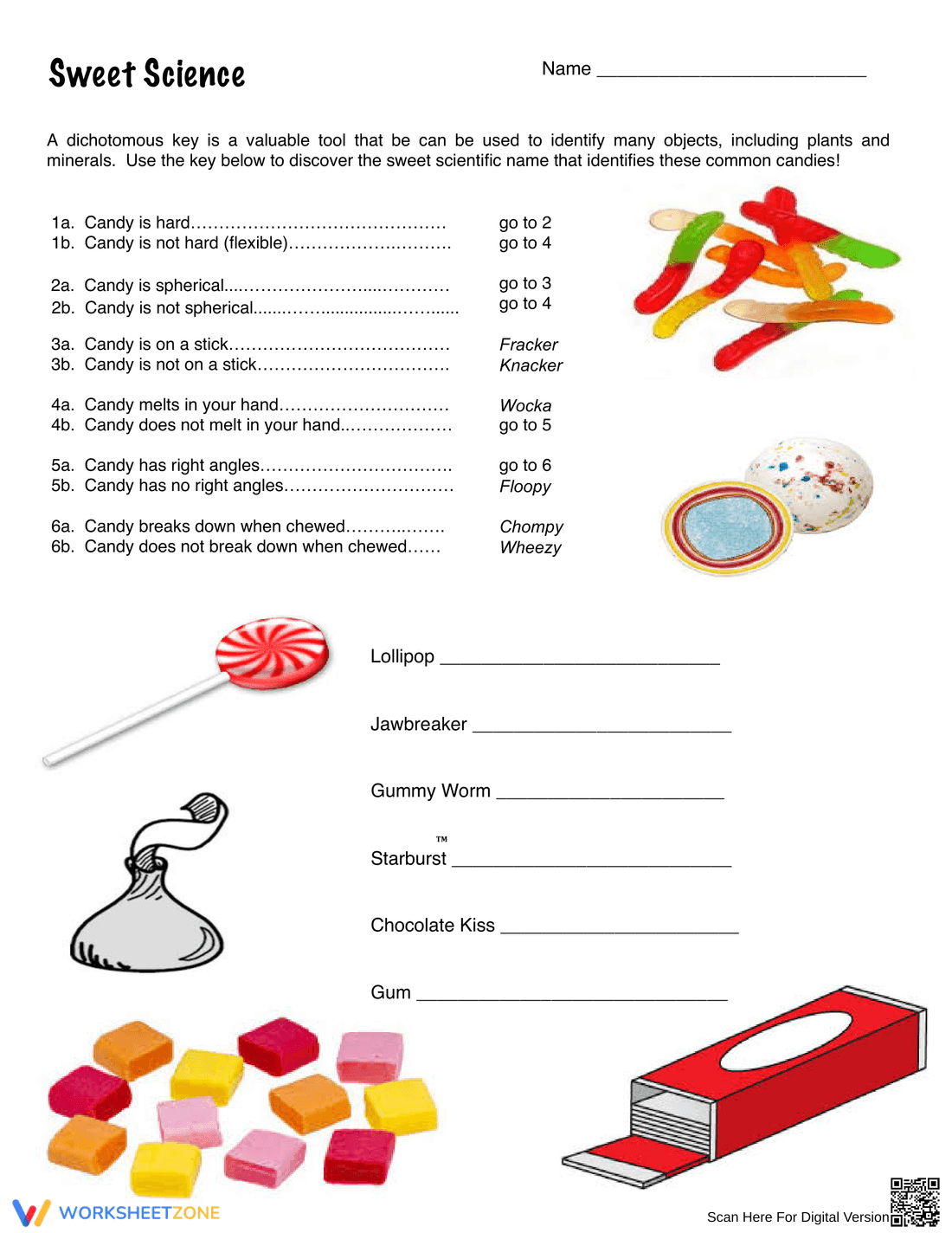
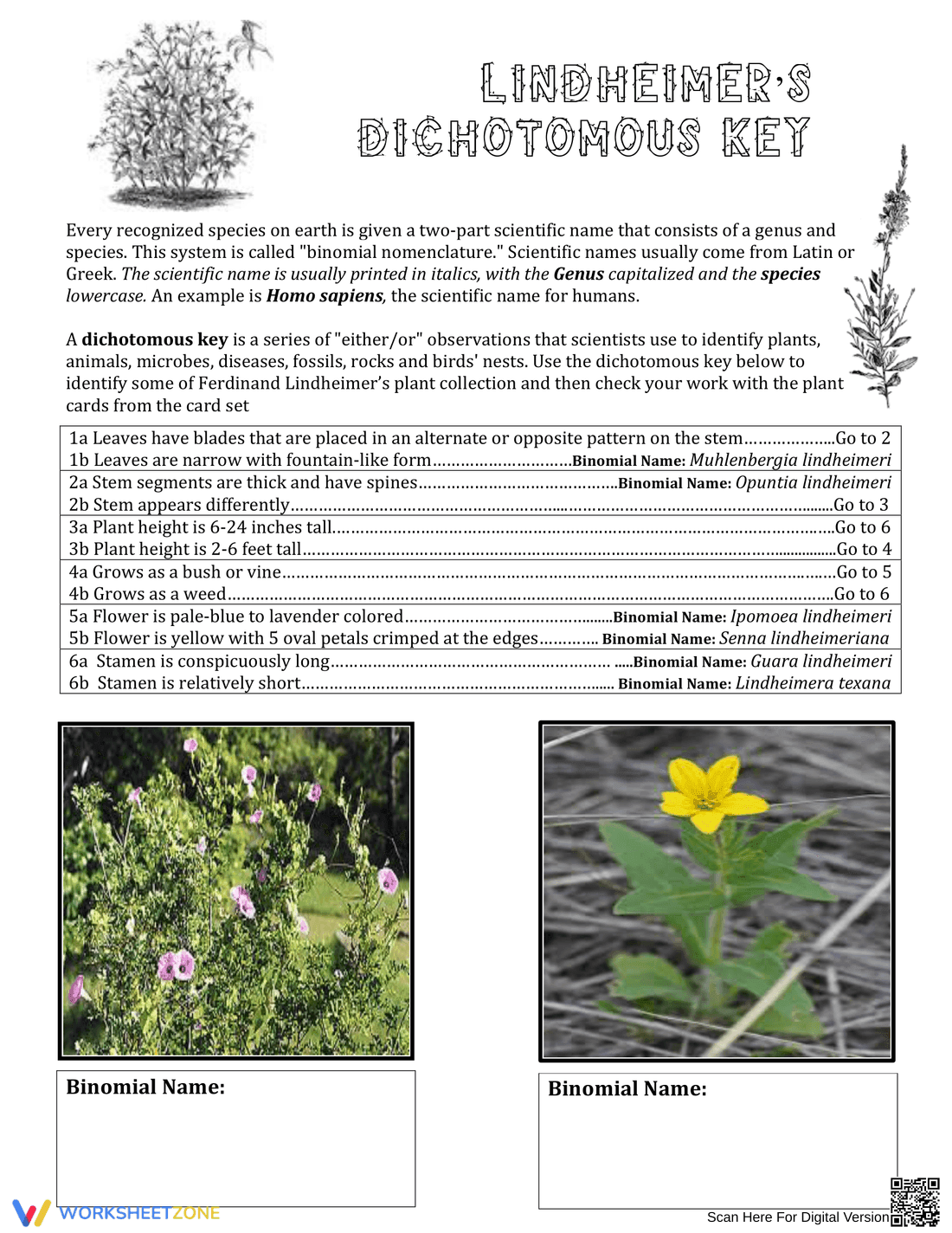
This 9-page packet features a detailed teacher lesson plan, two identification activities, and full answer keys. Students begin with a "Sweet Science" activity classifying six candies using a provided key. Next, they apply skills to "Lindheimer's Dichotomous Key," identifying six native Texas plants using binomial nomenclature. The resource also includes an evaluation activity where students build a classification system using alphabet cards.
Skill Progression
- Guided practice: The lesson begins with a familiar, low-stakes subject—candy. Teachers can model the first few steps of the "Sweet Science" key, demonstrating how to choose between paired statements.
- Supported practice: Students transition to the plant identification task in pairs, using observable traits like leaf shape and stem structure to find the correct binomial name for six different species.
- Independent practice: For the final evaluation, students work independently or in small groups to create their own dichotomous key for alphabet letters, proving their mastery of the classification process.
This gradual-release approach ensures students confidently grasp the mechanics of biological classification through an I Do, We Do, You Do model.
Standards Alignment
Aligned to primary standard TEKS 5.10A: Compare the structures and functions of different species that help them live and survive. It also supports TEKS 5.10B by having students differentiate between inherited traits of plants. Both standard codes can be copied directly into lesson plans, IEP goals, or district curriculum mapping tools.
How to Use It
This resource is ideal for introducing taxonomy during a middle school biology or life science unit. Use the candy activity as a highly engaging hook before direct instruction on Linnaean classification. The plant identification section serves as an excellent formative assessment; as students work, teachers can observe whether they are correctly restarting at step one for each new organism or getting lost in the branches. Expect the entire lesson sequence to take 45 to 60 minutes.
Who It's For
Designed primarily for middle school life science students, this packet offers built-in scaffolding by starting with everyday objects before moving to scientific specimens. The visual nature of the plant cards supports English Language Learners and visual learners. It pairs perfectly with an introductory anchor chart on binomial nomenclature or a hands-on nature walk where students collect their own leaves to classify.
Mastering classification through tools like a dichotomous key is a fundamental step in scientific literacy. By addressing TEKS 5.10A to compare structures and functions of different species, students learn to systematically organize complex information. According to a ScienceDirect TpT Analysis, explicit instruction in classification frameworks significantly improves students' ability to categorize novel information and recognize patterns in the natural world. When learners actively engage in both using and creating dichotomous keys, they transition from passive observers to analytical thinkers. This structured practice not only reinforces specific biological concepts but also builds the deductive reasoning skills required for advanced STEM coursework. Providing clear, step-by-step identification tasks ensures that all students can successfully master biological taxonomy and build lasting confidence in their scientific observation capabilities.


