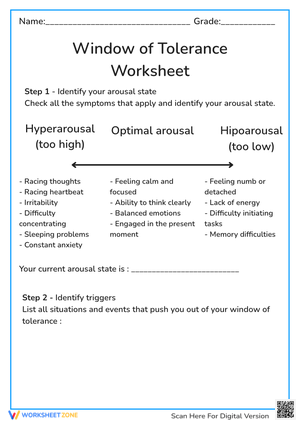
Window of tolerance printable worksheets for 11th grade give counselors and advisory teachers a direct, usable framework for one of the most common problems juniors walk in with: the inability to name what is happening in their bodies when stress tips past manageable. Dr. Dan Siegel's three-zone model — optimal arousal, hyper-arousal, and hypo-arousal — translates cleanly into worksheet activities because it gives students a vocabulary that replaces vague complaints like "I'm freaking out" or "I just feel nothing" with something they can actually locate and act on. These resources work best when introduced before high-stakes periods, not during them.
What Each Worksheet Targets: The Three-Zone Framework
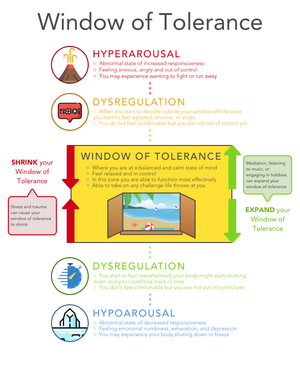
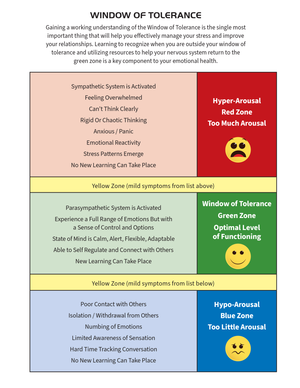
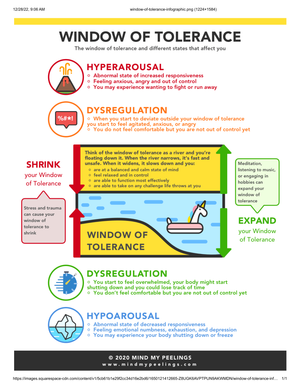
The core skill across the set is zone identification — students learn to distinguish between the three states and, more importantly, to recognize which zone they occupy at any given moment. That sounds straightforward, but juniors are often surprised by how little they notice their own physiological signals until they slow down and map them explicitly on paper.
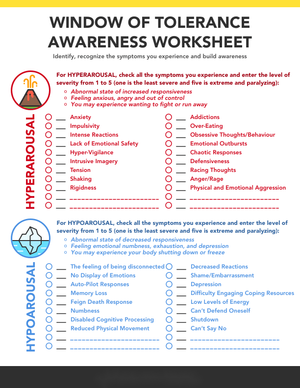
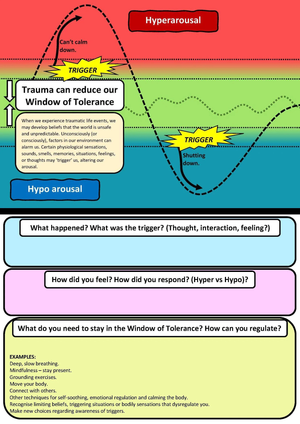
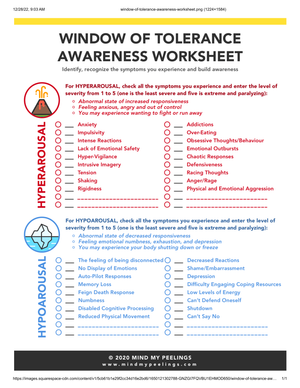
Each worksheet builds toward a personal arousal map that includes:
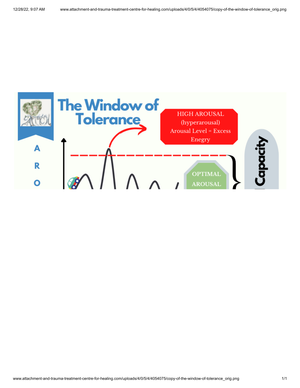
- Optimal zone markers — the physical and cognitive signals that a student is grounded: steady breathing, the ability to follow a multi-step problem, willingness to ask a question in class without spiraling beforehand
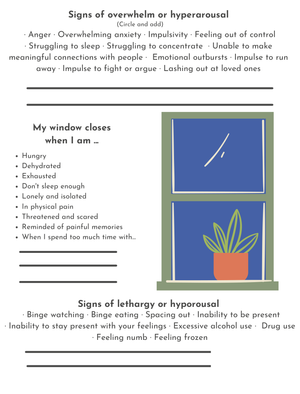
- Hyper-arousal signals — racing thoughts, a clenched jaw, restlessness, the specific feeling of a timed test tipping into panic
- Hypo-arousal signals — the heavy flatness that sets in after weeks of poor sleep or emotional overload, the dissociation that looks like boredom from the outside but is actually shutdown from the inside
- Trigger mapping — students identify which academic or social situations reliably push them out of their optimal zone and, critically, in which direction
- Strategy sorting — students categorize regulation tools by zone, recognizing that a slow breathing technique is appropriate for hyper-arousal but actively counterproductive when a student is already flat and frozen
That last distinction matters more than most students expect. A student in hypo-arousal who tries deep breathing often sinks further into the shutdown state. The worksheets address this directly, prompting students to match strategies to states rather than defaulting to one universal "calming" technique for every difficult moment.
How to Work These Worksheets Into Your Counseling and Advisory Schedule
Window of tolerance printable worksheets for 11th grade land best when introduced in early fall — ideally before the November SAT administration, when pressure is building but has not yet peaked. A single advisory period is enough to establish the three-zone model using the first worksheet in the set. After that introduction, the remaining worksheets function well as individual counseling tools, small-group check-ins, or brief warm-ups during the stress-heavy weeks of January and March when second-semester workloads and college decisions collide.
One structure that works consistently: introduce the framework in a group setting, then have each student complete the personal trigger mapping worksheet independently before a one-on-one counseling conversation. The student walks into that appointment with a concrete artifact already in hand, which lowers the barrier for students who go quiet under direct open-ended questioning. The counselor starts from something written rather than from "how are you doing?"
For advisory teachers without counseling backgrounds, the worksheets carry enough built-in explanation that a teacher who understands the three zones can run the activities with confidence. The area that benefits most from adult preparation is hypo-arousal — teachers sometimes misread a flat, withdrawn student as disengaged or uncooperative rather than neurologically shut down. A pre-read of the hypo-arousal section before delivering the lesson changes how teachers respond in the room when they see that student staring at the wall.
The worksheets also include a section on discrete in-the-moment regulation strategies — techniques students can use during a standardized test without drawing attention. Tactile grounding (pressing both feet firmly into the floor, gripping the edge of a desk) and silent sensory countdowns leave no visible trace. Students who have practiced these on a worksheet beforehand use them automatically when panic sets in during a major exam; the physical memory is already there.
Misconceptions That Surface Consistently in Student Work
The error that appears most reliably: students conflate hypo-arousal with calm. They see "low energy" and "relaxed" as the same state, which leads them to mislabel shutdown episodes as rest. On the worksheet, this shows up when a student places "lying on my bed staring at the ceiling for two hours, not sleeping, not doing anything" in the optimal zone rather than recognizing it as a freeze response. The distinction between restorative rest and nervous system shutdown requires direct instruction — the worksheet prompt alone does not resolve it.
A second consistent pattern is resistance to the biological framing. The idea that test panic is a threat-detection response rather than a character flaw should reduce shame, and for many juniors it does. But some students hear the neuroscience and push back, interpreting it as an excuse they are not permitted to use. They need to hear explicitly that understanding the mechanism does not remove agency — it increases it. The worksheet section on the amygdala-prefrontal cortex interaction is reliably where this conversation surfaces, and it is worth building five minutes of discussion time around it.
Finally, students routinely build regulation toolboxes that are entirely hyper-arousal focused. They list breathing techniques, progressive muscle relaxation, and slow-tempo playlists — all appropriate for calming an overactivated nervous system — and leave the hypo-arousal column nearly blank. A specific prompt helps: "What do you do when you have been staring at a blank essay for forty minutes and feel absolutely nothing?" That framing opens the column in a way the generic worksheet question often does not.
Standard Alignment
These worksheets address CASEL competencies in self-awareness and self-management — the two domains most directly tied to emotional regulation at the secondary level. Self-awareness is built through zone identification and personal trigger mapping; self-management is practiced through strategy development and the regulation toolbox activity. Many districts embed CASEL competencies into 9–12 advisory or student support documentation, making these resources a natural fit for programs that need to show alignment to SEL standards.
For districts working within state health or mental wellness frameworks, the content aligns with expectations around stress management, coping strategies, and the mind-body connection — language that appears in health education standards in states including California (Health Education Framework, Chapter 4) and New York (Health, Physical Education, and Home Economics Standards, Standard 1). The window of tolerance model also supports Tier 1 universal prevention work under Multi-Tiered Systems of Support, which means it can be delivered in a whole-advisory setting rather than reserved only for pull-out intervention.
Adjusting the Resources for Different Levels of Student Readiness
Window of tolerance printable worksheets for 11th grade assume a workable baseline of emotional vocabulary — students who can name more than two or three emotional states move through the zone-identification sections with noticeably more fluency. For students with limited vocabulary in this area, pairing the worksheets with a feelings chart or emotion wheel before the activity gives them the raw material they need before they attempt the self-identification prompts.
Students who process written language more slowly benefit from completing each worksheet across two shorter sessions rather than one long block. The trigger-mapping section in particular asks for sustained introspection, and rushing it produces shallow responses that do not hold up in a follow-up counseling conversation. Splitting the worksheet across two consecutive advisory periods costs nothing and substantially improves the quality of what students produce.
For students who already have some exposure to mindfulness or CBT-based frameworks, the set can be extended by adding a brief daily log — students track zone shifts over one full week and look for patterns. Some students reliably drop into hypo-arousal every Sunday evening; others spike into hyper-arousal during any class period immediately before lunch. That longitudinal layer surfaces what a single snapshot misses, and it is where window of tolerance printable worksheets for 11th grade shift from a one-session introduction into a genuine ongoing self-monitoring practice.
Frequently Asked Questions
Can these worksheets be used in a general advisory class, or are they better suited to individual counseling?
Both settings work, with some adjustment. In a whole-class advisory context, make the deepest personal disclosure prompts optional — some students are not ready to map their nervous system responses in a room of thirty peers they do not fully trust. Zone identification and strategy sorting run well as group activities. Trigger mapping and the personal regulation plan are better suited to individual counseling or small groups where there is established relational safety. The worksheets hold up in either environment; the teacher or counselor just needs to read the room before deciding how far to go.
What if a student discloses something concerning while completing one of these worksheets?
The prompts stay at the level of everyday stress and routine dysregulation, but students sometimes use hypo-arousal language — shutdown, numbness, disconnection — to describe something more serious than ordinary fatigue. Any disclosure that points toward persistent dissociation, extreme withdrawal, or hopelessness should move immediately into a referral conversation rather than a worksheet debrief. These resources support prevention and skill-building; they are not a substitute for clinical assessment.
How much time does a typical worksheet in this set require?
Zone identification and signal recognition take most students roughly twelve to fifteen minutes. Trigger mapping and strategy sorting run closer to twenty to twenty-five minutes, especially for students doing this kind of self-reflection for the first time. Counselors who use the worksheets in fifty-minute sessions typically move through one complete worksheet per session with enough time left for a brief discussion of what the student noticed.
Do students need any prior knowledge of neuroscience or mindfulness to use these worksheets effectively?
No prior knowledge is needed. Each worksheet introduces the framework from the ground up, starting with simple physical descriptions of each zone before introducing any theoretical language. Students who have never encountered Dan Siegel's model orient quickly because the framework maps onto physical experiences they already recognize — the racing heart before a presentation, the hollow flatness after a hard week of insufficient sleep.












 Interactive Worksheet Maker
 Quiz Maker
 Word Search Maker
 Crossword Puzzle Maker
 Word Scramble Generator
 Sentence Scramble Generator
 Handwriting Worksheet Generator
 Name Tracing Generator
 Fill In The Blank Generator




 BACK TOSCHOOL