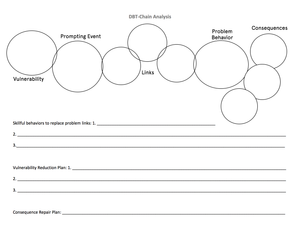
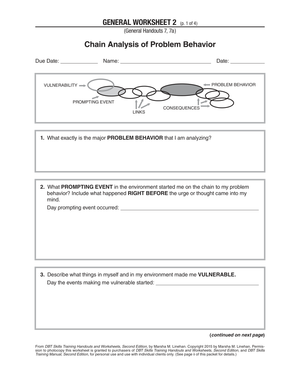
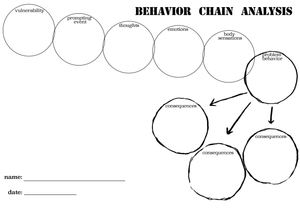
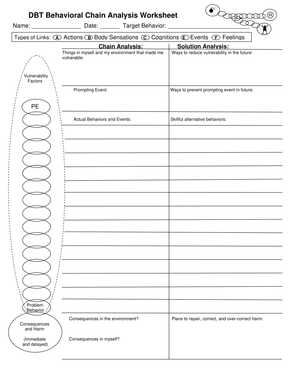
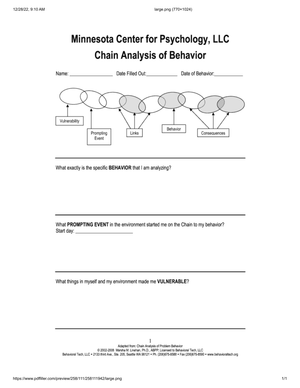
These dbt chain analysis pdf worksheets for 11th grade give teachers, counselors, and intervention staff a tool that organizes behavior reflection without turning a hallway conference into an open-ended conversation that drifts. Each worksheet walks a student through the full sequence — from triggering event to consequence — naming vulnerability factors, thought patterns, and body signals along the way. What teachers actually get is something they can place in front of a student in the eight minutes before a restorative conversation begins.
The Components Each Worksheet Targets
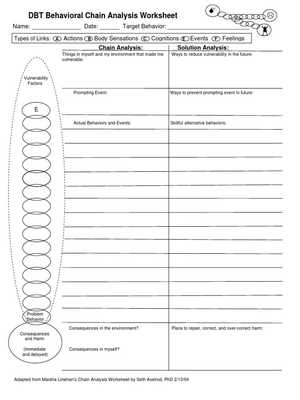
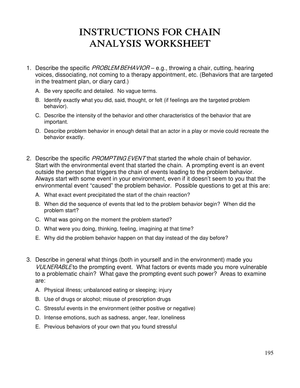
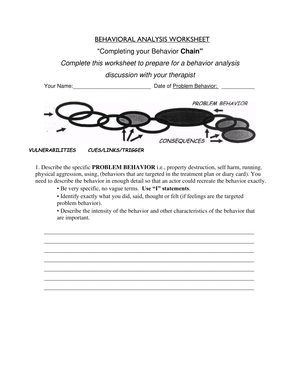
Sections on each worksheet move in a deliberate order. The prompting event section asks students to name what happened immediately before the chain started — not every stressor from the past month, just the specific moment. Vulnerability factors come next: conditions that made self-regulation harder that day, whether short sleep, an earlier argument, ongoing family stress, or weeks of cumulative pressure heading into finals. Students then trace the chain links in sequence — what they noticed in their body, what they assumed, what they said, what they did — until they reach the problem behavior and its consequences. The final section pushes toward action: a concrete coping strategy, a support request, or a repair step with an actual plan attached.
The vulnerability factors section carries particular weight at this grade level. Eleventh graders are often managing part-time employment, college applications, shifting friendships, and family obligations simultaneously. A student who escalated in third period may have been running on three hours of sleep and received a difficult text between classes. That context belongs in the chain — not as an excuse, but as the earliest data point for identifying where a reset was possible.
Building These Worksheets Into Your Intervention and Reflection Routines
The most important framing decision when introducing dbt chain analysis pdf worksheets for 11th grade is how the adult sets up the task. When students believe the goal is to produce a confession — to write down what they did wrong so it can be documented — responses become short, defensive, or formulaic. "I made a bad choice" fills every box. The worksheet produces nothing useful. When the adult reframes the task as decision-tracing — mapping the path from trigger to behavior in order to find the earliest reset point — students are more likely to give honest, specific detail. That reframe is not a small thing; it determines whether the tool functions at all.
These worksheets fit several structures in the school day without requiring extended class time:
- After a classroom conflict: Give the student quiet time to work through the worksheet before sitting down for a restorative conversation. The completed sections give both parties a concrete starting point that isn't blame.
- During check-in/check-out support: Complete one section per day over the course of a week to track patterns across multiple incidents rather than analyzing a single event in isolation.
- In counseling groups: Model the structure with a neutral sample scenario — a fictional student in a recognizable teen situation — before asking anyone to reflect on a real experience.
- In behavior intervention planning meetings: Completed worksheets from several incidents often reveal the same vulnerability factors repeating, which gives the team a specific target rather than a general instruction to "work on emotional control."
One boundary worth naming explicitly: if a student's responses suggest higher-risk concerns, the worksheet should lead to a counselor referral rather than continued classroom processing. These resources support coping reflection; they are not clinical assessment instruments.
Mistakes Students Make That These Worksheets Help Teachers Catch
The most consistent pattern in first-time chain analysis is compression. A student writes the prompting event, jumps directly to the problem behavior, and leaves every chain link section blank. When asked what happened in between, they say, "I just got mad." That compression is not laziness — it usually means the student has never traced a moment-to-moment sequence before and genuinely doesn't know what belongs in that space. The step-by-step structure of the chain links section slows that automatic response down and makes each intermediate step visible.
The replacement skills section produces its own predictable problem. Students write "make better choices" or "walk away" without specifying when to walk away, where to go, or what they'll say to make that happen. These responses look like plans but function as placeholders. Adults reviewing a completed worksheet should treat any replacement step that lacks a specific action, location, or sentence as incomplete and prompt a second pass. A workable plan reads more like "ask Ms. Rivera for a hallway pass and text the counselor" than "remove myself from the situation."
A third pattern: students list consequences as only external — what a teacher did, what the dean said, what the parent was told — without naming any self-consequences: the class time missed, the relationship friction, the loss of trust with a teacher they actually like. Prompting students to include both sides of the consequences section produces a more complete picture, and usually a stronger internal motivation to try a different approach next time.
Standard Alignment
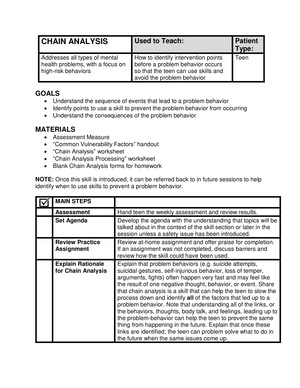
These worksheets align most directly to the CASEL SEL framework's Self-Awareness and Self-Management competencies — specifically, identifying emotions in context, understanding how thoughts and feelings shape behavior, and demonstrating emotion regulation strategies. Within multi-tiered support systems, they support Tier 2 and Tier 3 PBIS intervention planning by giving teams a structured data source for identifying recurring behavioral patterns. Several state SEL standards frameworks, including California's and Illinois's, include explicit 11th-grade benchmarks for analyzing the antecedents and consequences of behavior, which is exactly what a completed chain analysis worksheet produces on paper.
Adjusting These Worksheets Across a Range of Student Needs
For students who need more support, the most effective adjustment is adding sentence starters to each section — not to simplify the thinking, but to reduce the blank-page paralysis that leads to avoidance. "Right before this happened, I noticed..." or "My body was telling me..." gives a student a foothold without removing the cognitive work. dbt chain analysis pdf worksheets for 11th grade can also be completed verbally with an adult scribing, which works well for students who write slowly, students with written expression accommodations in their IEPs, or students who are too activated to write in the moment but can talk through what happened.
For students who move through the chain quickly and have done this kind of reflection before, the extension is metacognitive: ask them to identify not only the earliest reset point, but why they didn't take it — what belief, assumption, or interpretation kept the chain moving forward. That question shifts the work from behavioral mapping into genuine cognitive self-analysis, which is appropriate for many 11th graders and often produces the most honest responses anywhere in the worksheet.
Frequently Asked Questions
How long does it typically take a student to complete one of these worksheets?
Most 11th graders finish a standard chain analysis worksheet in twelve to twenty minutes when working independently without significant avoidance. A shorter version with fewer prompts can be done in eight to ten minutes, which fits inside a typical check-in window or near the end of a counseling session. If a student is still highly activated, completing even the prompting event section may take longer — in that case, returning to finish the remaining sections after a cooling period produces better results than pushing through while emotions are still elevated.
Can these worksheets be used with a full class, or are they intended for individual students?
They work best individually or in small counseling groups where students are not expected to share personal incidents publicly. In a whole-class SEL context, the chain analysis structure transfers well to hypothetical scenarios — a fictional peer in a realistic situation — where students practice the thinking without the pressure of self-disclosure. Using dbt chain analysis pdf worksheets for 11th grade this way also builds familiarity with the format, so when a student completes one in an individual intervention context, the process doesn't feel entirely foreign.
When should a completed worksheet lead to a counselor referral instead of continued classroom processing?
If a student's responses mention self-harm, hopelessness, significant trauma, or unsafe behavior outside the original school incident, the worksheet has surfaced something that belongs with a mental health professional. The form handles coping reflection, not acute mental health concerns. Having a clear referral protocol in place before distributing these worksheets means adults already know where the line is, rather than making that judgment call in the middle of a session.












 Interactive Worksheet Maker
 Quiz Maker
 Word Search Maker
 Crossword Puzzle Maker
 Word Scramble Generator
 Sentence Scramble Generator
 Handwriting Worksheet Generator
 Name Tracing Generator
 Fill In The Blank Generator




 BACK TOSCHOOL