


























0
Views
0
Downloads

0.0
0
Save
0 Likes
Share
Utilizing the Window of Tolerance: Practice
0 Views
0 Downloads
Paste this activity's link or code into your existing LMS (Google Classroom, Canvas, Teams, Schoology, Moodle, etc.).
Students can open and work on the activity right away, with no student login required.
You'll still be able to track student progress and results from your teacher account.
Information
Description
What It Is:
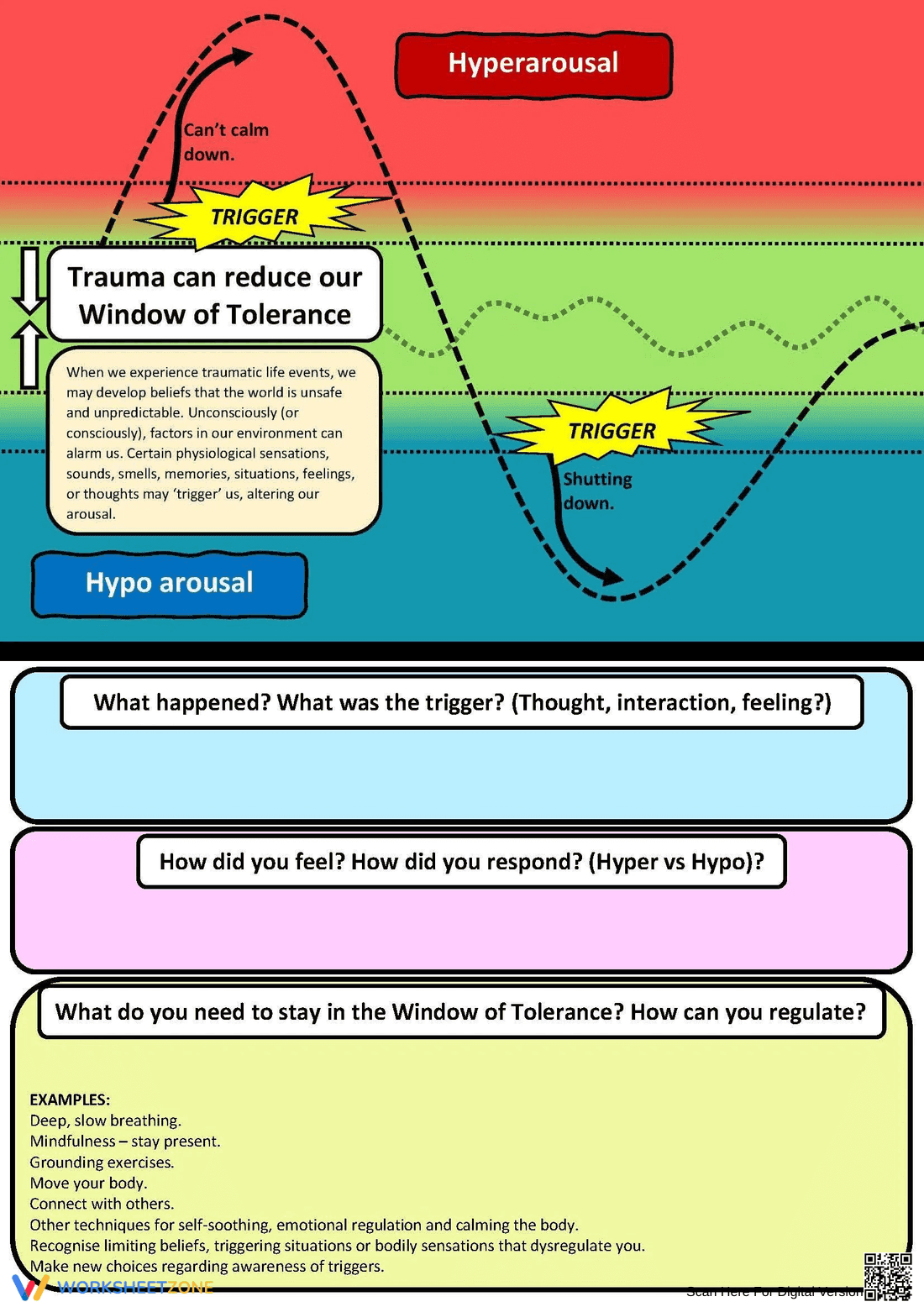
This is a worksheet about trauma, hyperarousal, hypoarousal, and the 'Window of Tolerance.' It includes a diagram illustrating how trauma can reduce the window of tolerance, with arrows indicating movement towards hyperarousal (red zone) and hypoarousal (blue zone) triggered by specific events. The worksheet prompts the user to reflect on what happened, the trigger, how they felt (hyper or hypo), and what they need to stay within the window of tolerance, offering examples like deep breathing, mindfulness, grounding exercises, and connecting with others.
Grade Level Suitability:
This worksheet is suitable for high school students and adults. The concepts of trauma, hyperarousal, hypoarousal, and emotional regulation are complex and require a level of maturity and understanding of psychological concepts.
Why Use It:
This worksheet helps individuals understand the impact of trauma on their emotional regulation and identify triggers that lead to hyper- or hypoarousal. It promotes self-awareness, emotional regulation skills, and coping strategies to stay within the window of tolerance, fostering emotional well-being.
How to Use It:
First, review the diagram and information about the window of tolerance, hyperarousal, and hypoarousal. Then, reflect on a recent event or situation that triggered an emotional response. Answer the questions in the provided spaces, focusing on what happened, the trigger, your feelings (hyper or hypo), and what you need to stay regulated. Refer to the examples provided for self-soothing techniques.
Target Users:
This worksheet is designed for individuals who have experienced trauma or are struggling with emotional regulation. It can be used by therapists, counselors, educators, or individuals seeking to improve their understanding of trauma and develop coping mechanisms.
This is a worksheet about trauma, hyperarousal, hypoarousal, and the 'Window of Tolerance.' It includes a diagram illustrating how trauma can reduce the window of tolerance, with arrows indicating movement towards hyperarousal (red zone) and hypoarousal (blue zone) triggered by specific events. The worksheet prompts the user to reflect on what happened, the trigger, how they felt (hyper or hypo), and what they need to stay within the window of tolerance, offering examples like deep breathing, mindfulness, grounding exercises, and connecting with others.
Grade Level Suitability:
This worksheet is suitable for high school students and adults. The concepts of trauma, hyperarousal, hypoarousal, and emotional regulation are complex and require a level of maturity and understanding of psychological concepts.
Why Use It:
This worksheet helps individuals understand the impact of trauma on their emotional regulation and identify triggers that lead to hyper- or hypoarousal. It promotes self-awareness, emotional regulation skills, and coping strategies to stay within the window of tolerance, fostering emotional well-being.
How to Use It:
First, review the diagram and information about the window of tolerance, hyperarousal, and hypoarousal. Then, reflect on a recent event or situation that triggered an emotional response. Answer the questions in the provided spaces, focusing on what happened, the trigger, your feelings (hyper or hypo), and what you need to stay regulated. Refer to the examples provided for self-soothing techniques.
Target Users:
This worksheet is designed for individuals who have experienced trauma or are struggling with emotional regulation. It can be used by therapists, counselors, educators, or individuals seeking to improve their understanding of trauma and develop coping mechanisms.


