11th Grade Boundaries worksheets
These 11th grade boundaries worksheets resources give teachers a structured entry point into some of the most consequential conversations juniors will have—about romantic relationships, first jobs, digital pressure, and self-advocacy. The set covers five boundary domains: physical, emotional, intellectual, digital, and time-based, with scenario-driven tasks that ask students to identify, analyze, and practice assertive communication rather than simply read about it.
What Each Worksheet Asks Students to Do
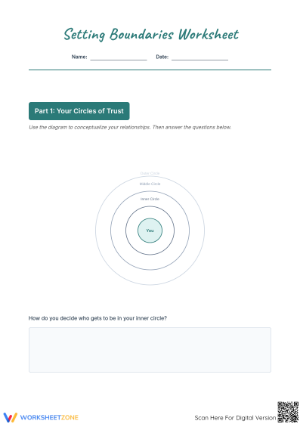
The tasks are concrete and scenario-based throughout. Students underline violations in written dialogues, rewrite passive or aggressive responses using I-statements, sort relationship behaviors into categories, and annotate scenarios with notes on what a healthier reply would look like. One format that produces particularly strong engagement at this grade is what might be called the "advice columnist" frame: rather than asking a junior to roleplay their own conflicts directly—which can feel exposing in front of twenty peers—each worksheet presents a letter from a fictional student describing a social or professional situation, and students draft a response. The psychological distance matters. Juniors who shut down when a scenario feels personally close will write productively when they're advising someone else.
Romantic relationship worksheets ask students to identify consent signals, distinguish between a negotiated limit and a flat refusal, and write a script for reopening a conversation after a limit has been crossed. Workplace worksheets put students in realistic entry-level positions—answering phones at a nonprofit, stocking shelves, assisting at a summer program—and ask them to respond to a supervisor who texts after hours or schedules more hours than originally agreed. Digital wellness worksheets prompt students to track how much time they spend managing social expectations online and to draft a message explaining why they won't be immediately available.
Where Students Consistently Go Wrong
The most consistent error is conflating assertiveness with aggression. A student who can articulate a limit clearly in the abstract will still write "Stop doing that. I said no." when handed an actual scenario—because the firm register feels rude to them rather than clear. The worksheets address this directly: students compare their first-draft responses with I-statement models, then revise. That revision step is where the real shift happens, and pausing to share two or three class rewrites aloud usually accelerates it across the whole room.
A second pattern: students consistently miss slow-moving violations. They can identify an obvious boundary cross—a friend reading their phone without permission, a peer who keeps borrowing money and never repays it. But a limit that erodes gradually, where each individual step seems minor, goes unnoticed until students map a scenario across several weeks using a timeline worksheet. That longitudinal piece—recognizing the pattern before it becomes a crisis—is something a single discussion period rarely builds.
Fitting These Into the Weekly Lesson Flow
An 11th grade boundaries worksheets works best when it follows a short anchor activity rather than opening cold. Five minutes on a relevant news clip, a quote from a podcast transcript, or a quick anonymous poll about digital pressure gives students a shared reference point before they work independently. Without that anchor, the first ten minutes often disappear as students decide whether their experience is "normal enough" to write about.
The structure that consistently produces the best written responses is a three-beat approach: independent written response first, no discussion; then a small-group share where two or three students compare how they phrased similar limits; then a brief whole-class synthesis where the teacher pulls themes without attributing specific student responses. This protects privacy while building shared vocabulary. Health teachers who run this pattern regularly report that the language students develop in class—"that's an emotional limit, not just a preference"—starts appearing in advisory conversations and counselor referrals, which suggests the learning is actually transferring outside the classroom.
Standard Alignment
Each worksheet in an 11th grade boundaries worksheets set aligns directly with the CASEL framework's self-awareness and relationship skills competencies. Self-awareness tasks ask students to recognize their own values, trace emotional responses before they escalate, and articulate personal limits as connected to personal identity. Relationship skills competencies are addressed in the communication and conflict-resolution work, particularly the rewriting exercises where students move from reactive responses to assertive ones. Many states have incorporated SEL benchmarks into 9–12 health education requirements; this set maps well to those standards, especially in units addressing consent, communication, and interpersonal safety. Schools using Second Step or a similar structured SEL curriculum can position the worksheets as reinforcement practice after core instruction rather than as standalone introductions to new material.
Making the Work Accessible at Every Level
Students who struggle with abstract social reasoning benefit from having the scenario analysis broken into explicit steps—first, label who holds power in this interaction; then, identify what limit is being tested; then, draft a response. A structured response frame keeps those students moving rather than staring at a blank box while peers write fluently. On the other end, students who move quickly through the basic task can write a second response from a different cultural or family context than their own, which surfaces the genuinely complex question of how community norms shape personal limits. That extension also works well in whole-class discussion because it shifts the frame from "right versus wrong" to "context-dependent," which is more accurate and generates richer conversation. For English learners, the advice-columnist format is a natural fit: writing in the third person reduces both linguistic and emotional pressure compared to first-person disclosure.
Frequently Asked Questions
Can these worksheets be used in advisory, an English class, or a psychology elective—not just health?
Yes. Advisory periods work well for shorter single-scenario worksheets from the set—something students can complete in fifteen to twenty minutes with a brief discussion afterward. English classes can use the communication-focused worksheets alongside units on argument, voice, or memoir writing. A psychology elective running a unit on interpersonal relationships can integrate the full 11th grade boundaries worksheets set as a practicum component alongside theoretical readings on attachment or communication styles.
How should teachers handle a student who discloses a real situation through a scenario worksheet?
Establish classroom norms before distributing anything—students need to understand what you are and aren't required to report, and that written reflections are private unless they choose to share. If a student discloses something serious through written work, mandatory reporting procedures apply regardless of the activity format. For situations that are concerning but don't meet that threshold, the worksheets include a "next steps" prompt asking students to name a trusted adult they could talk to—which creates a natural opening for a private follow-up conversation without singling anyone out in front of the class.
How do you grade this work fairly without penalizing students for their specific personal limits?
Assess the quality of reasoning, not the content of the limit itself. Does the student correctly identify the relevant boundary domain? Is the I-statement grammatically and logically complete? Does the revised response shift from reactive to assertive without tipping into aggression? Those are observable, gradable criteria that have nothing to do with whether a student holds stricter or looser personal limits than a classmate. A short analytic rubric—four or five criteria, each rated on a simple three-point scale—keeps grading efficient and focused on the communication skill rather than the personal disclosure.
Clear All