11th Grade Trauma Timeline Worksheets
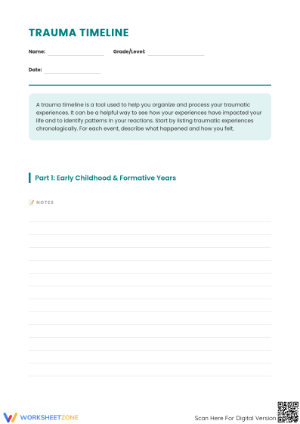
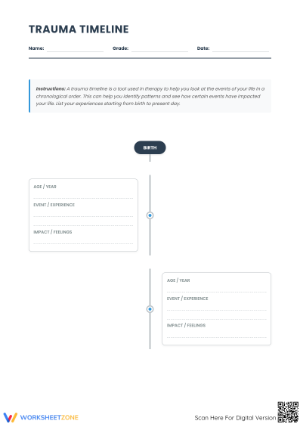
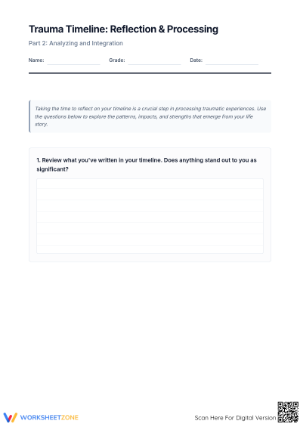
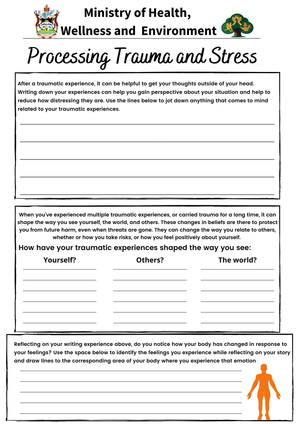
These trauma timeline printable worksheets for 11th grade give classroom teachers and school counselors a structured way to help students map significant life events, annotate the emotional weight of each, and trace connections between past experience and current behavior. The worksheets use visual metaphors — rivers, road maps, life chapters — that create enough psychological distance for 16- and 17-year-olds to engage honestly without feeling pressured into disclosure. Unlike open-ended journaling, each worksheet moves students through a defined sequence: place the event, name the feeling, identify the response, trace the thread forward.
What Each Worksheet Asks Students to Do
The core task across the set is externalization — placing an internal emotional history onto paper where it can be named and examined. Students using the "River of Life" worksheet draw a river representing their life journey, marking calm stretches for stable periods and rapids or rocks for disruption, then annotate each marker with an emotional label and a behavioral response. That pairing of event and response is structural. Without it, students produce a chronology rather than a reflective tool.
The "Life Chapters" worksheet takes a different approach. Students divide their personal history into named phases — a useful structure for students who have distinct before-and-after markers in their lives — and characterize each phase by its dominant emotional tone and the people present in their support network at that time. A third worksheet in the set focuses on trigger mapping: students trace specific sensory or situational cues back to past events, which separates the trigger from the event itself. That distinction is one most students have never made explicit before, and it consistently generates the most substantive conversation during a debrief.
Eleventh Grade, Identity Formation, and the Timing of This Work
Eleventh grade occupies a particular developmental position. Identity formation is actively in progress — students are constructing the story they tell about who they are — while simultaneously working through college applications that ask them to narrate personal growth explicitly and repeatedly. At 16 or 17, most students have enough cognitive distance from early childhood experiences to narrate them, but the emotional processing is often still live. That combination gives trauma reflection real traction at this grade level while also making the preparation steps non-negotiable.
The developmental case for using trauma timeline printable worksheets for 11th grade also rests on what is coming next. Within a year or two, most of these students will be navigating entirely new environments without the institutional support network they have had since kindergarten. Understanding which coping skills they already have — and which triggers they are still carrying — directly serves that transition in a way that no other SEL activity quite replicates.
How to Build These Worksheets Into a Trauma-Informed Lesson Plan
Before distributing any worksheet, two conditions must be in place: fully voluntary participation and a school counselor who is briefed and available during the session. Students need a genuine alternative assignment — a strengths inventory, a future goals map — with no social stigma attached to choosing it. These are not negotiable safety conditions.
The most effective classroom setup pairs the opening worksheet with a fictional completed model. Taking a literary character the class is already studying — Esperanza from The House on Mango Street, a historical figure from the current unit, or a public figure who has written openly about their own recovery — and building a sample "River of Life" map around them lets students analyze the process before applying it to themselves. Students identify where the rapids fall, what coping responses the character used, what their support network looked like at each point. That 15- to 20-minute analysis phase drops the personal anxiety noticeably before students pick up their own worksheets.
Timing matters. These activities are not appropriate for the 10 minutes before a school assembly or the Monday morning after a long weekend. Each worksheet needs a full, uninterrupted class period or counseling session, followed by a deliberate closing — a brief grounding exercise, or a written sentence completing a prompt like "one thing I want to hold onto from today is..." — so students leave settled rather than activated. Also state clearly at the start of any session that you are a mandated reporter. If a student discloses current abuse, neglect, or self-harm on a worksheet, reporting is not optional. Say it plainly and matter-of-factly, not as a warning that shuts the room down.
Errors Students Make That These Worksheets Help Surface
The most consistent pattern in student work is surface-level listing. Students write "parents divorced" or "grandmother died" in the same neutral, documentary tone they would use for a history timeline — no emotional annotation, no coping entry, no thread of reflection. The worksheet looks complete but has done none of the actual work. A brief teacher think-aloud before students begin — modeling a low-stakes personal event on the board and narrating the emotional label and behavioral response out loud — breaks that pattern before it takes hold across the class.
A second problem is conflating the traumatic event with the trigger. A student will write "car accident" as both the past event and the current trigger, when the actual trigger is the sound of brakes, or sitting in the back seat of an unfamiliar driver's car. Those are different things, and the distinction matters — help students trace the specific sensory or situational cue rather than restating the event category.
Students with strongly avoidant tendencies will fill every section with positive framing that bypasses the reflective task entirely. This is a protective response, not dishonesty, and it should not be pushed through. The alternative strengths-and-future-orientation worksheet handles those students better than any forced adaptation of the core activity.
Standard Alignment
The trauma timeline printable worksheets for 11th grade align with CASEL's Self-Awareness and Self-Management competency domains. At the 11th-grade level, Self-Awareness includes the ability to link current emotions to historical experiences and understand how personal history shapes present behavior — both explicit tasks in these worksheets. Self-Management is addressed through the trigger-identification and coping-strategy sections, which build the first cognitive layer needed for deliberate emotional regulation.
These are not introductory SEL activities. They sit toward the upper end of the Self-Awareness progression and assume students have already practiced basic emotion identification and can sustain personal reflection. They belong in an 11th-grade advisory period, a high school counseling curriculum, or an SEL-integrated English or history class — not as opening-week content for students new to structured emotional work.
Adjusting the Set for a Range of Student Readiness Levels
For students with limited written expression — including English language learners and students with IEPs that affect writing fluency — the visual-metaphor format substantially reduces the language load. Students draw rather than write, label with single words or symbols, and annotate in whatever code works for them. The reflective depth remains accessible without extended prose.
Students who are emotionally ready and have done prior SEL work can extend their timelines into future projection: mapping goals for senior year and beyond, identifying support structures they want to build before leaving high school, or writing a brief letter from their future self to the person they are today. That extension is the most demanding task in the set and should not be presented as a default — it belongs at the end of a session that has already gone well.
When deciding how to adapt trauma timeline printable worksheets for 11th grade for a student with complex trauma history or current high-level distress, the school counselor's guidance should come before any worksheet modification. For students in that situation, the referral is the differentiation.
Frequently Asked Questions
Can these worksheets be used in a general education classroom, or only in counseling sessions?
Teachers in advisory periods, SEL electives, and trauma-informed English or history classrooms have used these worksheets effectively. Classroom use demands the same preparation as a counseling context: voluntary participation, an available counselor, a genuine alternative assignment, and a clear debrief plan. The worksheet format does not reduce the emotional weight of what students may encounter while completing the activity.
What should I do if a student becomes visibly distressed during the activity?
Stop the worksheet and shift to a grounding exercise immediately. Have a plan in place before the session begins — the school counselor's direct contact, a cue word or signal with the student if possible — not assembled in the moment after distress is already visible. The worksheet can wait; a dysregulated student cannot.
How is this different from assigning an autobiography?
An autobiography captures what happened. A trauma-informed timeline captures what it felt like, what the student did with that feeling, and what they are still carrying forward. The structure explicitly asks for triggers, coping responses, and support networks — none of which appear in a standard autobiographical format. The purpose is understanding current behavior, not documenting the past.
Should students share the content of their completed worksheets with classmates?
Personal maps stay private. Any group discussion should remain at the level of process — what the activity felt like, what patterns students noticed in general terms — rather than individual disclosures. That boundary should be established as a ground rule before the session begins, and it applies equally to how the teacher handles and stores the worksheets afterward.
Clear All