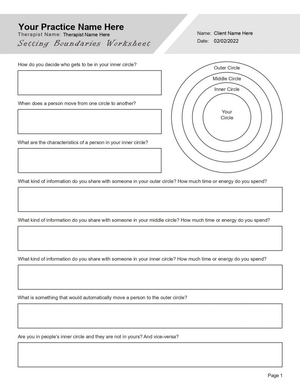
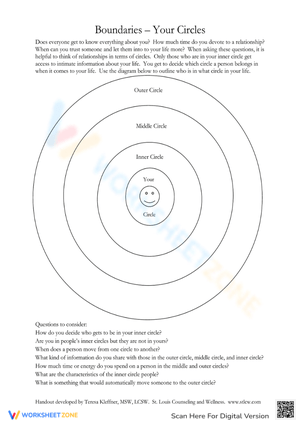
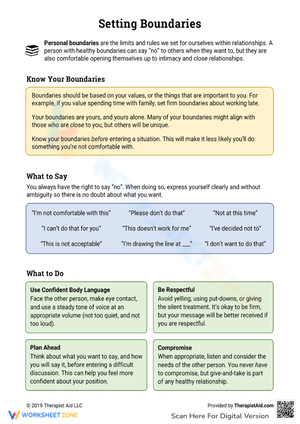
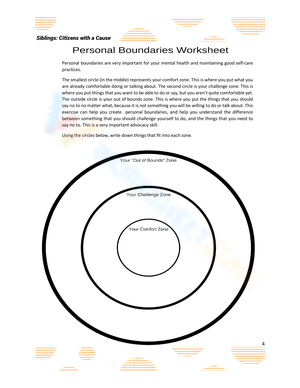
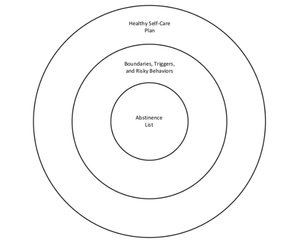
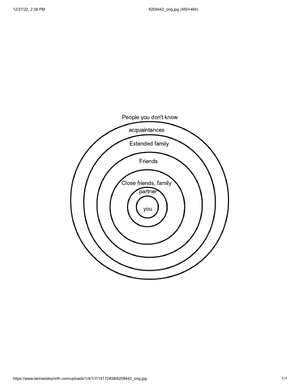
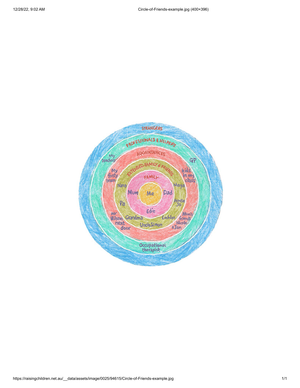
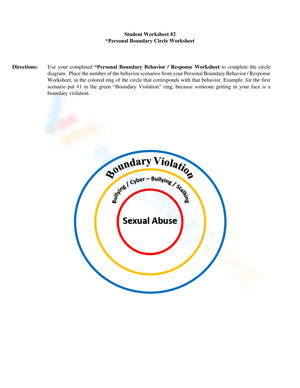
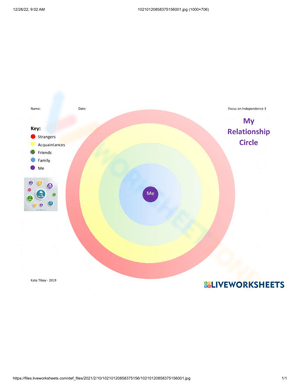
These 11th grade boundaries circle printable worksheets resources give SEL teachers and health educators a concrete visual framework for some of the most socially complex territory juniors navigate — professional internships, evolving romantic relationships, and digital networks that routinely blur the line between close contact and casual acquaintance. Each worksheet uses the concentric-circle model to help students assign real people in their lives to specific relationship tiers and define what disclosures, physical contact norms, and conversation topics fit each one.
The Relationship Tiers Students Work Through
The model centers on the Self and expands outward — typically through rings representing family, close friends, acquaintances, professional contacts, and strangers. What makes this territory genuinely challenging at 11th grade is that the middle rings demand real judgment. A classmate someone eats lunch with every day is not the same as a teammate they've confided in since eighth grade, even though both might initially seem to belong in the same tier. Getting students to articulate that difference — and to understand that the boundary shifts depending on history, trust, and context — is the real instructional goal here.
Students also work through what changes as a relationship moves across rings over time. An internship supervisor might feel like a mentor after a few months, but the professional ring still sets different expectations for self-disclosure than the close-friend ring does. That distinction is harder for 11th graders than it sounds. Many of them have watched adults treat workplace relationships as friendships and absorbed that model without recognizing why it creates problems.
Skills These Worksheets Build
- Categorizing relationships by trust level and relational context, not just emotional closeness
- Identifying appropriate self-disclosure by ring — what personal information belongs at each tier
- Applying physical contact norms to each relationship category, including professional settings
- Mapping digital contacts — followers, group chats, online-only connections — onto the ring model
- Recognizing when a relationship has shifted rings and adjusting behavior accordingly
- Analyzing written vignettes to evaluate whether a boundary has been crossed and what a reasonable response looks like
Fitting These Worksheets Into Your SEL Unit Plan
These work best when introduced after students have had at least one whole-group conversation about what a boundary actually is — not as a rule imposed from outside, but as an internal signal that something doesn't feel right. Without that foundation, students fill out the rings mechanically and miss the relational reasoning the activity builds. A short opening discussion, 10 to 12 minutes is usually enough, asking students to describe a moment they felt uncomfortable in a social situation gives them an anchor before they work individually.
The 11th grade boundaries circle printable worksheets format makes it straightforward to assign different worksheets to different parts of a unit. The personal relationship tiers work well early in the sequence, when students are building vocabulary for the model. The professional and digital worksheets land better mid-unit, after students have practiced the basic framework and are ready to apply it to less obvious territory. The scenario analysis worksheets function as strong unit closers — they require students to evaluate a situation and justify their ring placement, which serves as an informal assessment of whether the reasoning has actually stuck.
For classes that include career readiness content, pairing the professional-ring worksheet with a job shadowing debrief or an internship prep discussion adds immediate real-world weight. Students who are about to interact with adult supervisors for the first time are noticeably more receptive to this content than students who haven't yet crossed that threshold.
Errors and Misreadings Worth Catching in Student Work
The most consistent error is conflating emotional warmth with trust level. Students will place someone in the close-friend ring because they like that person — a new co-worker, a coach they just met, an online contact they've been messaging for a few weeks. Ring placement should be based on demonstrated trust over time, not current affection. When a student writes a brand-new supervisor's name inside the close-friend ring, that's worth pausing on in a one-on-one conference: what they're describing is hope about a relationship, not the relationship as it currently stands.
The digital section produces its own predictable error pattern. Students frequently assign online-only contacts to acquaintance-level rings when, by the actual criteria of the model, many of those people are strangers. A person who follows a student's public account and has exchanged a handful of comments with them has not demonstrated anything that earns acquaintance status — but students resist placing them in the stranger ring because it feels socially dismissive. This is exactly the kind of reasoning that makes teenagers vulnerable to oversharing with people who present themselves as familiar.
A subtler problem appears when students treat ring placement as permanent. They write a name in a tier and consider the exercise done. The more productive understanding is that rings describe a relationship's current state — and relationships can move outward just as easily as inward. A close friend who broke confidence may now belong two rings out. That possibility is worth naming explicitly before students begin.
Standard Alignment
These worksheets align with the CASEL core competency framework, particularly Social Awareness (understanding others' perspectives, recognizing appropriate social norms across contexts) and Relationship Skills (communicating clearly, maintaining healthy connections, resisting inappropriate social pressure). For districts using the CASEL 3.0 standards, the professional-ring and digital-boundary worksheets connect directly to the Responsible Decision-Making strand, which asks students to evaluate how personal choices affect themselves and others across varied social contexts.
Many districts have also mapped this content to their health education frameworks under personal safety and consent. If your school uses a structured SEL scope and sequence, these worksheets typically land within a healthy-relationships or boundary-setting unit inside health, advisory, or life skills courses at the junior level.
Adjusting the Set for Mixed-Ability Classrooms
For students who process abstract concepts more concretely — including students with IEPs or those newer to SEL vocabulary — the most effective adjustment is to work through one ring at a time rather than presenting the full model at once. Starting at the outermost ring (strangers) and working inward builds the framework in a direction that feels less exposing and less personally demanding. Students can identify general categories of people rather than specific names until they're comfortable with how the model's criteria actually function.
Students ready for more analytical work can move past categorization into argumentation. Ask them to write a short justification for a placement decision that a classmate might dispute, or to evaluate a scenario in which someone's behavior clearly doesn't match their stated ring. That kind of reasoning — defending a boundary judgment rather than just making one — keeps the exercise from feeling like a fill-in activity and reflects the social analysis 11th graders are genuinely capable of when pushed.
The 11th grade boundaries circle printable worksheets set also lends itself to culturally responsive adjustment. Ring norms vary significantly across families and communities — the level of disclosure expected within an extended family, or the physical greeting norms between acquaintances, are not universal. Rather than presenting the model as a fixed map, allow students to annotate each ring with notes about how their own context shapes what's normal in that tier. This makes the exercise more honest and more durable.
Frequently Asked Questions
Do these worksheets work for students who have experienced boundary violations or unstable relationships?
The personal relationship worksheets ask students to name real people in their lives and assign them to tiers, which can be uncomfortable for students whose relationships have involved harm. Before distributing these, give the class explicit permission to write in categories — "a family member," "someone from my last school" — rather than names. If you know the class includes students navigating difficult home situations, having a counselor available during the lesson is worth arranging ahead of time.
How do the digital worksheets connect to the in-person model?
The 11th grade boundaries circle printable worksheets resources focused on digital contacts ask students to apply the same ring criteria — demonstrated trust, shared history, context of the relationship — to their online connections. That transfer is not automatic. Students need a structured prompt that walks them through evaluating an online contact against the model's criteria rather than just asking them to "think about" where someone belongs.
Can these be used in a co-taught classroom?
The individual reflection worksheets work well in co-taught settings because both teachers can circulate and support students with different needs simultaneously. The scenario analysis worksheets are particularly strong in that format — one teacher can facilitate small-group discussion while the other works with students who need more time unpacking the scenario before they can make a defensible placement decision.
Are these appropriate for health class as well as SEL?
Health teachers use the professional and digital worksheets regularly within units on consent, communication, and personal safety. The professional-ring worksheet fits cleanly into career readiness or school-to-work transition content, which overlaps with health standards in many states at the junior level. The model travels well across both contexts because its underlying logic — that different relationships carry different expectations — is relevant to both personal and professional health.












 Interactive Worksheet Maker
 Quiz Maker
 Word Search Maker
 Crossword Puzzle Maker
 Word Scramble Generator
 Sentence Scramble Generator
 Handwriting Worksheet Generator
 Name Tracing Generator
 Fill In The Blank Generator




 BACK TOSCHOOL