


























0
Views
0
Downloads

0.0
0
Save
0 Likes
Share
The Window of Tolerance Worksheet
0 Views
0 Downloads
Paste this activity's link or code into your existing LMS (Google Classroom, Canvas, Teams, Schoology, Moodle, etc.).
Students can open and work on the activity right away, with no student login required.
You'll still be able to track student progress and results from your teacher account.
Information
Description
What It Is:
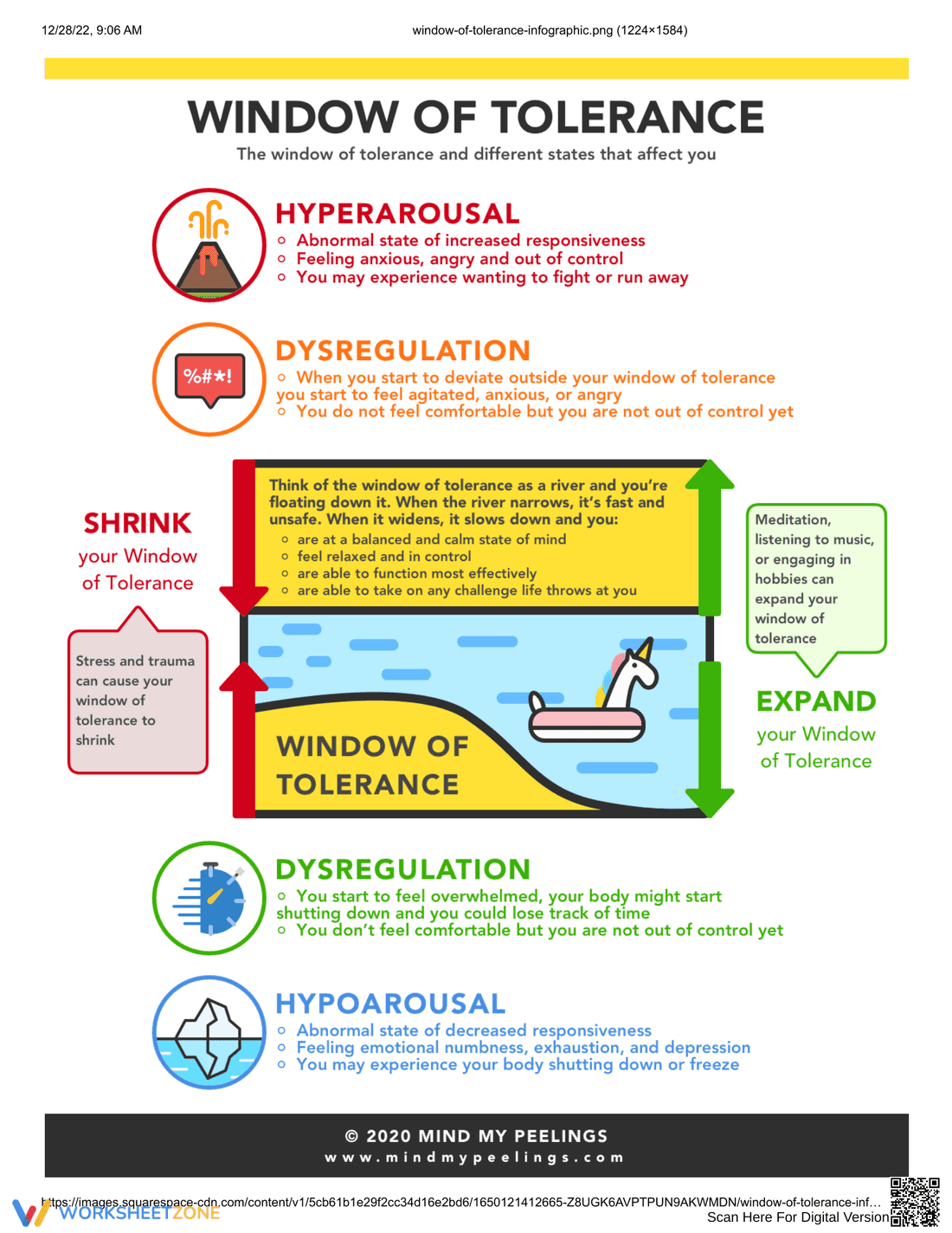
This is an educational infographic about the 'Window of Tolerance.' It explains different emotional states, including hyperarousal (feeling anxious and out of control), hypoarousal (feeling numb and depressed), and dysregulation (feeling agitated or overwhelmed). The infographic uses a river analogy to describe the window of tolerance, suggesting that being in the 'window' is like floating calmly down the river. It also shows how stress and trauma can shrink the window and how activities like meditation can expand it.
Grade Level Suitability:
This worksheet is suitable for upper middle school and high school students (grades 7-12). The concepts are somewhat abstract and require a certain level of emotional maturity to understand. The language is relatively straightforward, but the subject matter is best suited for older students.
Why Use It:
This infographic helps students understand their emotional states and how they can be affected by stress and trauma. It promotes self-awareness and provides strategies for managing emotions and expanding their window of tolerance. It can also help students develop empathy for others who may be experiencing emotional dysregulation.
How to Use It:
This infographic can be used as a classroom visual aid or as a handout for individual students. Teachers can use it as a starting point for discussions about emotional regulation, stress management, and mental health. Students can use it to reflect on their own emotional experiences and identify strategies for staying within their window of tolerance.
Target Users:
This infographic is beneficial for students, counselors, educators, and anyone interested in learning more about emotional regulation and mental well-being. It can be particularly helpful for individuals who struggle with anxiety, depression, or trauma.
This is an educational infographic about the 'Window of Tolerance.' It explains different emotional states, including hyperarousal (feeling anxious and out of control), hypoarousal (feeling numb and depressed), and dysregulation (feeling agitated or overwhelmed). The infographic uses a river analogy to describe the window of tolerance, suggesting that being in the 'window' is like floating calmly down the river. It also shows how stress and trauma can shrink the window and how activities like meditation can expand it.
Grade Level Suitability:
This worksheet is suitable for upper middle school and high school students (grades 7-12). The concepts are somewhat abstract and require a certain level of emotional maturity to understand. The language is relatively straightforward, but the subject matter is best suited for older students.
Why Use It:
This infographic helps students understand their emotional states and how they can be affected by stress and trauma. It promotes self-awareness and provides strategies for managing emotions and expanding their window of tolerance. It can also help students develop empathy for others who may be experiencing emotional dysregulation.
How to Use It:
This infographic can be used as a classroom visual aid or as a handout for individual students. Teachers can use it as a starting point for discussions about emotional regulation, stress management, and mental health. Students can use it to reflect on their own emotional experiences and identify strategies for staying within their window of tolerance.
Target Users:
This infographic is beneficial for students, counselors, educators, and anyone interested in learning more about emotional regulation and mental well-being. It can be particularly helpful for individuals who struggle with anxiety, depression, or trauma.


