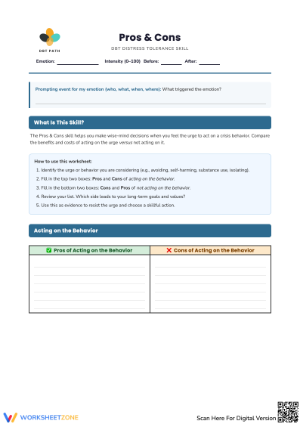
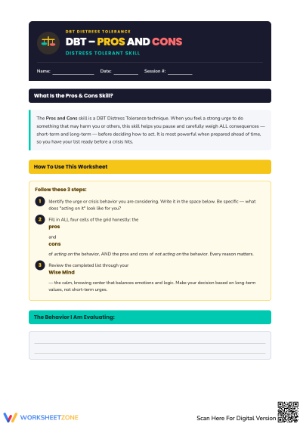
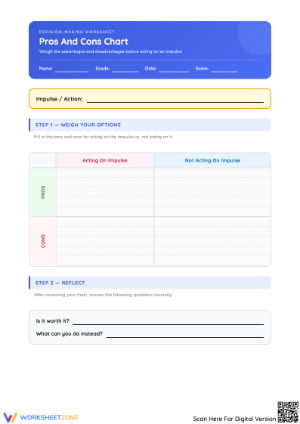
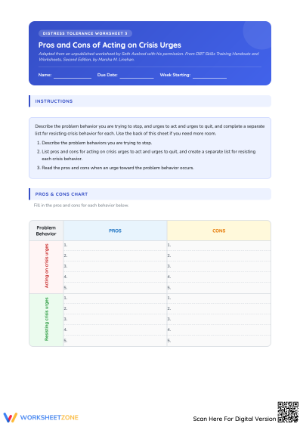
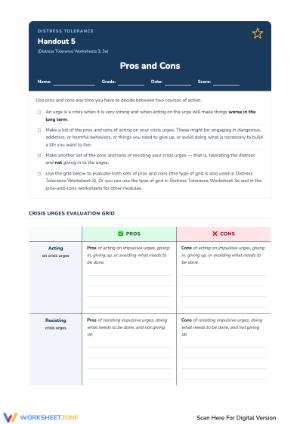
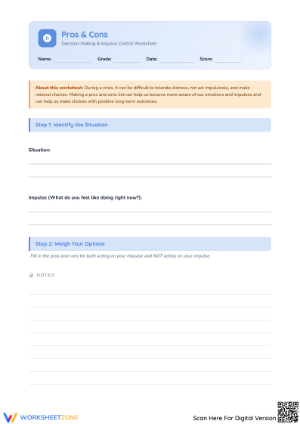
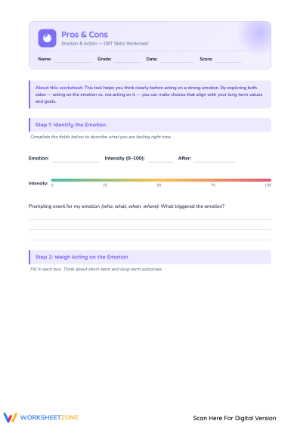
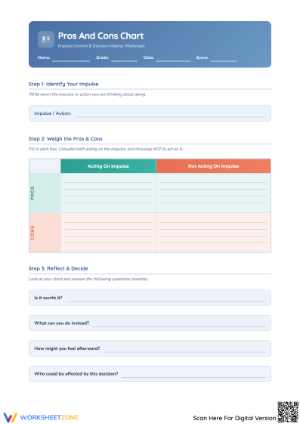
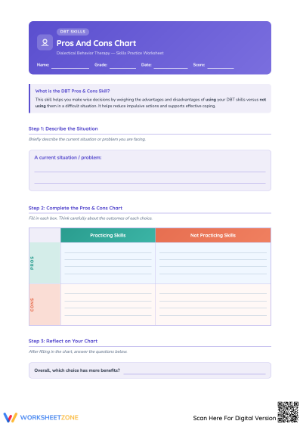
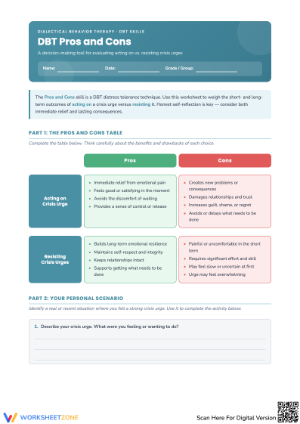
These dbt pros and cons printable worksheets for 11th grade give school counselors, advisory teachers, and health educators a structured tool for introducing distress tolerance to juniors — students who are navigating one of the most pressure-dense stretches of their K-12 experience. Each worksheet uses a four-quadrant grid rather than the two-column format most students already know, and that structural difference carries real instructional weight. The grid asks teenagers to examine what they gain and lose by acting on a destructive urge, and separately what they gain and lose by tolerating it.
What the Four-Quadrant Grid Asks Students to Do
Each quadrant targets a specific piece of the analysis. The first asks students to list the pros of acting on the urge — which is where many teachers feel initial resistance, because acknowledging that a harmful behavior offers something feels counterintuitive. It is not. Validating the short-term pull of an impulsive action is exactly what allows a student to engage honestly with the rest of the grid instead of dismissing the exercise as a lecture about doing the right thing.
The second quadrant covers the cons of acting — the downstream consequences that feel abstract in the moment but become concrete when written out. An 11th grader who feels the urge to skip class the morning before a difficult test might list: a grade drop, makeup work, a call home, and the compounding stress of sitting in every subsequent period knowing they have fallen further behind.
The third and fourth quadrants address the other side: what is gained by resisting the urge, and what tolerating it actually costs. The fourth quadrant — cons of resisting — is where the real work happens. Acknowledging that sitting through an anxiety-inducing class is genuinely hard and mentally taxing is not a concession to the urge; it is the honesty that makes the whole exercise credible to a sixteen- or seventeen-year-old. When that cost is written down and visible, students are in a position to weigh it against the long-term benefits in quadrant three rather than dismissing those benefits as abstract.
Building These Worksheets Into Your Lesson Plans
The timing question matters more than most teachers initially realize. A junior who picks up dbt pros and cons printable worksheets for 11th grade for the first time in the middle of an emotional episode does not have the cognitive bandwidth to fill out all four quadrants honestly. The prefrontal processing the grid depends on is precisely what goes offline under acute stress. These worksheets produce the most lasting benefit when students practice them during calm periods — with hypothetical scenarios, past events, or low-stakes situations — so the analytical habit is already established when a real crisis arrives.
Advisory periods are a natural entry point. A Monday morning warm-up using a deliberately mundane scenario — the urge to hit snooze when the alarm goes off — gives students a chance to learn the mechanics without any emotional stakes. Health class works well during units on stress management or peer conflict. Tier 2 SEL groups are where the worksheets do the most targeted work, because those students are already identified as needing more structured support with impulse control and benefit from repeated practice with real scenarios they bring in themselves.
One classroom management decision worth making early: frame the worksheets as preparation tools, not consequence documents. When students associate the grid only with disciplinary reflection after an incident, they resist it. When they use it proactively before a high-stakes week — final exams, a difficult conversation, a college application deadline — it functions as planning rather than punishment, and engagement is dramatically different.
Mistakes Students Make That These Worksheets Help You Catch
The most common error is completing only two of the four quadrants. The sections students most often skip are the cons of resisting — either they miss the instruction or they avoid acknowledging that tolerating distress has real costs. A quick formative check while circulating catches this immediately. When a quadrant is blank, the most productive prompt is not "finish this section" but "what is actually hard about not acting on what you want to do right now?"
A second pattern: students list consequences at a surface level and stop. "I might get in trouble" is not the same analytical work as "I would get a zero, lose eligibility for the senior trip, and have to explain it to my parents the same week I was already stressed about SAT prep." Specificity is what gives the grid its weight. When consequences stay vague, the emotional accumulation that is supposed to shift the student's thinking never happens, and the tool does not do what it is supposed to do.
A third error specific to juniors: students use the worksheet to rationalize a decision they have already made. The quadrant supporting the urge gets longer sentences, more persuasive phrasing, and visibly more care — while the resistance quadrants are thin and rushed. That asymmetry shows up clearly in the writing. When you see it, asking the student to spend two more minutes on the quadrants they skimmed is usually enough to break the pattern.
Standard Alignment
These worksheets align with the CASEL framework's core competencies in Self-Management and Responsible Decision-Making. Self-Management, as CASEL defines it, includes impulse control, stress management, and the ability to delay gratification — all three of which the four-quadrant exercise directly practices. Responsible Decision-Making involves evaluating the consequences of one's actions across multiple time horizons, which is the structural logic of the grid itself. For schools running CASEL-aligned SEL programming, the dbt pros and cons printable worksheets for 11th grade fit cleanly within both Tier 1 and Tier 2 delivery at the junior level.
For school counselors working within a Multi-Tiered System of Support, each worksheet functions as a Tier 2 intervention when used with small groups identified through behavioral data or counselor referral. At the classroom level, the same worksheets serve a Tier 1 prevention function when embedded in advisory or health instruction. The resource works at both tiers because the format does not assume clinical context — it assumes only that a student can read a scenario and write a sentence.
Differentiating These Worksheets Across Ability Levels
For students who struggle with reflective writing or have difficulty generating abstract scenarios, the most effective adjustment is to front-load the situation. Rather than asking students to name their own urge, present a fixed scenario — "You feel the urge to close the essay draft you haven't finished and watch videos instead" — and have them complete the grid from that starting point. Removing the scenario-generation step keeps the cognitive demand on the consequence analysis, where the learning actually lives.
For students who move through all four quadrants quickly and are ready to push further, add a synthesis requirement after the grid is complete: one sentence naming which quadrant's evidence they found most convincing and why. That step requires metacognitive reasoning — students have to evaluate their own analysis, not just produce it — and it separates surface completion from genuine internalization.
Students with anxiety who freeze at the first quadrant, uncomfortable naming the pros of acting on a harmful urge, sometimes need a brief explanation that listing a benefit is descriptive, not an endorsement. The quadrant is asking what is true, not what is right. Once that distinction lands, most students move through the rest of the exercise without difficulty.
Frequently Asked Questions
How is this different from a standard pros and cons list?
A regular pros and cons list evaluates a neutral choice — which elective to take, which college to apply to first. The DBT version is built for a specific psychological situation: when a student feels an impulsive urge toward a behavior that offers short-term relief but causes longer-term harm. The four-quadrant structure forces a double comparison — the appeal and cost of the urge, then separately the gain and cost of tolerating the discomfort instead. That structure is what makes it a distress tolerance skill rather than a general decision-making exercise.
Can teachers use these without clinical training?
Classroom teachers — particularly advisory and health educators — use dbt pros and cons printable worksheets for 11th grade regularly without any clinical background. The grid is an educational tool for impulse analysis, not a therapeutic protocol, and it is appropriate for Tier 1 classroom instruction. The boundary that matters: if a student's disclosures during the exercise suggest a mental health concern beyond the normal range of adolescent stress, the teacher's role is to connect that student with the school counselor or psychologist, not to extend the worksheet activity into clinical territory.
What do you do when a student refuses to engage with the grid?
Refusal usually signals one of two things: the student does not understand the purpose, or they are currently too activated to think analytically. For the first, returning to a low-stakes practice scenario — the snooze button, putting off a chore, skipping a club meeting — often breaks the resistance because the stakes feel manageable and non-judgmental. For the second, the honest answer is that the worksheet is not useful in that moment. Reconnecting with the student when they are calmer produces better results than pressing through during elevated emotion.












 Interactive Worksheet Maker
 Quiz Maker
 Word Search Maker
 Crossword Puzzle Maker
 Word Scramble Generator
 Sentence Scramble Generator
 Handwriting Worksheet Generator
 Name Tracing Generator
 Fill In The Blank Generator




 BACK TOSCHOOL