These dear man worksheets for 11th grade give students a way to plan difficult conversations on paper before they have them out loud — requesting a college recommendation letter with a short runway, telling a group project partner they need to contribute more, asking a part-time manager to adjust a shift schedule around finals. Each worksheet takes students through the full DEAR MAN sequence, from stating observable facts to offering a workable compromise, and includes a revision step that separates these from simple fill-in exercises.
What Students Work Through in Each Worksheet
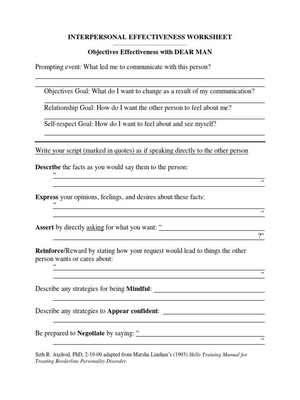
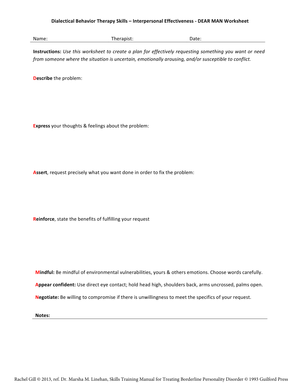
The core task is writing out what a student would actually say at each step of the DEAR MAN sequence for a scenario drawn from their real life. Students don't just label the components — they draft the specific words.
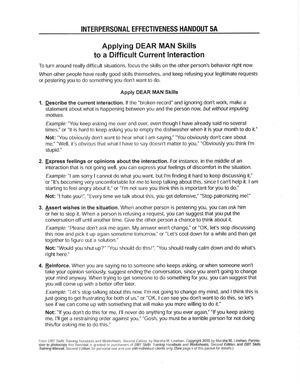
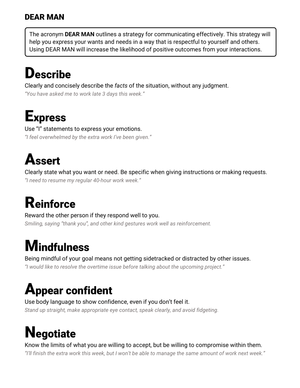
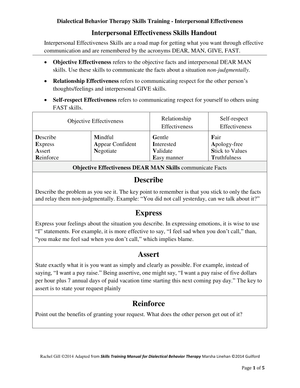
- Describe: State the facts of the situation without interpretation or judgment.
- Express: Name personal feelings or opinions using first-person language.
- Assert: Make the request or state the limit clearly and directly.
- Reinforce: Explain how meeting the request benefits both parties, not just the speaker.
- Mindful: Stay focused on the goal even when the other person deflects or circles back to an older grievance.
- Appear Confident: Use steady eye contact, a level tone, and open posture — neither aggressive nor apologetic.
- Negotiate: Offer an alternative if the initial request can't be met exactly as stated.
Several worksheets include a peer-feedback prompt and a revision field. Students write a first-pass script, share it with a partner who marks unclear or vague steps, then rewrite before role-playing. That loop — draft, mark, revise, speak — is where most of the actual learning happens.
Fitting These Worksheets Into Your Instructional Week
These fit cleanly into advisory periods, school counseling small groups, health classes, and SEL electives. The sequence that holds up in practice: ten to twelve minutes of direct instruction introducing the acronym, followed by teacher modeling of a complete script — working through each step aloud on the board using a class-suggested scenario — before students open their own worksheets. Skipping the modeling step produces scripts that are technically complete but generic, because students default to vague language when they don't have a specific example to anchor each step.
For counseling groups, the dear man worksheets for 11th grade in this set work especially well in the first weeks of fall, when college application stress makes self-advocacy feel immediately relevant. Students are more willing to write and rehearse a recommendation letter script in October than they would be in March. In a classroom setting, using one worksheet per week as a recurring warm-up across four to five weeks builds more durable recall than covering all seven steps in a single concentrated unit.
Student Mistakes Worth Knowing Before You Teach This
The Describe step produces the most consistent errors. Students who write "I feel" correctly in Express will still slip into interpretation in Describe — "she was dismissive" instead of "she looked at her phone while I was explaining my part." The distinction between observable fact and evaluation is genuinely difficult for 16-year-olds, and it needs direct instruction with multiple examples before students stop importing their read of a situation into what is supposed to be neutral factual ground.
The Reinforce step reads like bribery on first draft. Students write something like "I'll work harder if you give me more time," when what Reinforce actually asks for is an articulation of mutual benefit — why the outcome is better for both people. A student asking for a deadline extension doesn't offer future effort as a trade; they explain that three more days produces a submission that reflects actual understanding of the material, which serves the teacher's grading and the student's learning equally. That reframe takes most students at least one revision pass to get right.
The Mindful step gets misread as "stay calm." The actual skill is narrower: don't take the bait when the other person changes the subject, raises their voice, or drags in a past argument. Students who understand this distinction in theory abandon it immediately when a role-play partner goes off script, which is exactly why speaking the script aloud matters — the step has to be practiced under simulated pressure, not just written down once and considered done.
Standard Alignment
These worksheets address two CASEL core competencies directly: Relationship Skills — specifically communicating clearly, resolving conflicts constructively, and advocating for oneself and others — and Self-Management, particularly regulating emotions and impulses in interpersonal situations. In terms of instructional sequence, DEAR MAN fits after students have covered basic emotional vocabulary and active listening. Teaching it before that foundation exists produces scripts where the Express step stays superficial ("I feel bad") and the Mindful step is left blank, because students don't yet have the internal language those fields require to do real work.
Differentiating the Set Across Student Readiness Levels
When adapting dear man worksheets for 11th grade for students new to structured SEL practice, the most effective adjustment is narrowing the scenario to something low-stakes and concrete — asking a peer to stop borrowing belongings without returning them — and focusing the first session on only the DEAR steps. Adding the MAN steps once students are comfortable with what to say prevents the overload that comes from planning content and delivery simultaneously before they've internalized either one.
Students who move through the steps quickly are ready for scenarios with genuine ambiguity — a conflict where both people have a legitimate grievance, or a conversation with a teacher whose feedback felt hurtful even though it wasn't intended to be. These require students to clarify their own position before they can write a coherent Describe or Assert, which pushes the work into territory that simple low-stakes scenarios don't reach.
Students who think better out loud than in writing do well when a partner acts as scribe while they dictate each step. The written record still gets produced, and the student has worked through the full framework — just via their stronger processing channel rather than against it.
Frequently Asked Questions
Can classroom teachers run these lessons, or are they only for counselors?
Classroom teachers run these regularly in health classes, advisory blocks, and English courses where persuasion or communication already appears in the curriculum. The technique has clinical roots in Dialectical Behavior Therapy, but the skills it builds — stating facts objectively, naming feelings accurately, making a direct request, negotiating — translate cleanly to academic and social contexts. Teachers don't need a counseling background. They need a clear model and a scenario the class finds credible.
What scenarios actually work for 11th graders?
The strongest scenarios are ones where students feel a real stake in the outcome. Requesting a college recommendation letter from a teacher they haven't spoken to much, addressing a group partner who keeps missing shared work sessions, asking a part-time manager to swap a shift during midterms, and talking with a parent about curfew before a major event all produce engaged writing. Abstract or assigned-topic scenarios produce weaker scripts because students write around the emotional core of the exercise rather than through it, and the Reinforce and Mindful fields end up thin.
How much class time does one worksheet typically take?
A single worksheet with direct instruction, independent writing time, and partner role-play runs forty to fifty minutes. If the period is shorter, the role-play carries cleanly to the next day — students who have a written script but haven't spoken it yet will retain the steps better if they return to it the following morning rather than rushing through the verbal practice. Splitting the lesson across two days isn't a compromise; it uses spacing to advantage.
Do students need any background in DBT before using these worksheets?
No. The dear man worksheets for 11th grade in this set introduce the framework from the beginning. Students don't need prior therapeutic context. What does help is five minutes of class discussion beforehand on the difference between passive, aggressive, and assertive communication — without that framing, students often treat the Assert step as permission to make demands rather than requests, and the Negotiate step as something optional rather than integral to the whole exchange.












 Interactive Worksheet Maker
 Quiz Maker
 Word Search Maker
 Crossword Puzzle Maker
 Word Scramble Generator
 Sentence Scramble Generator
 Handwriting Worksheet Generator
 Name Tracing Generator
 Fill In The Blank Generator




 BACK TOSCHOOL