































Complete pH Scale Analysis Worksheet | Grades 9–12 Science

Paste this activity's link or code into your existing LMS (Google Classroom, Canvas, Teams, Schoology, Moodle, etc.).
Students can open and work on the activity right away, with no student login required.
You'll still be able to track student progress and results from your teacher account.
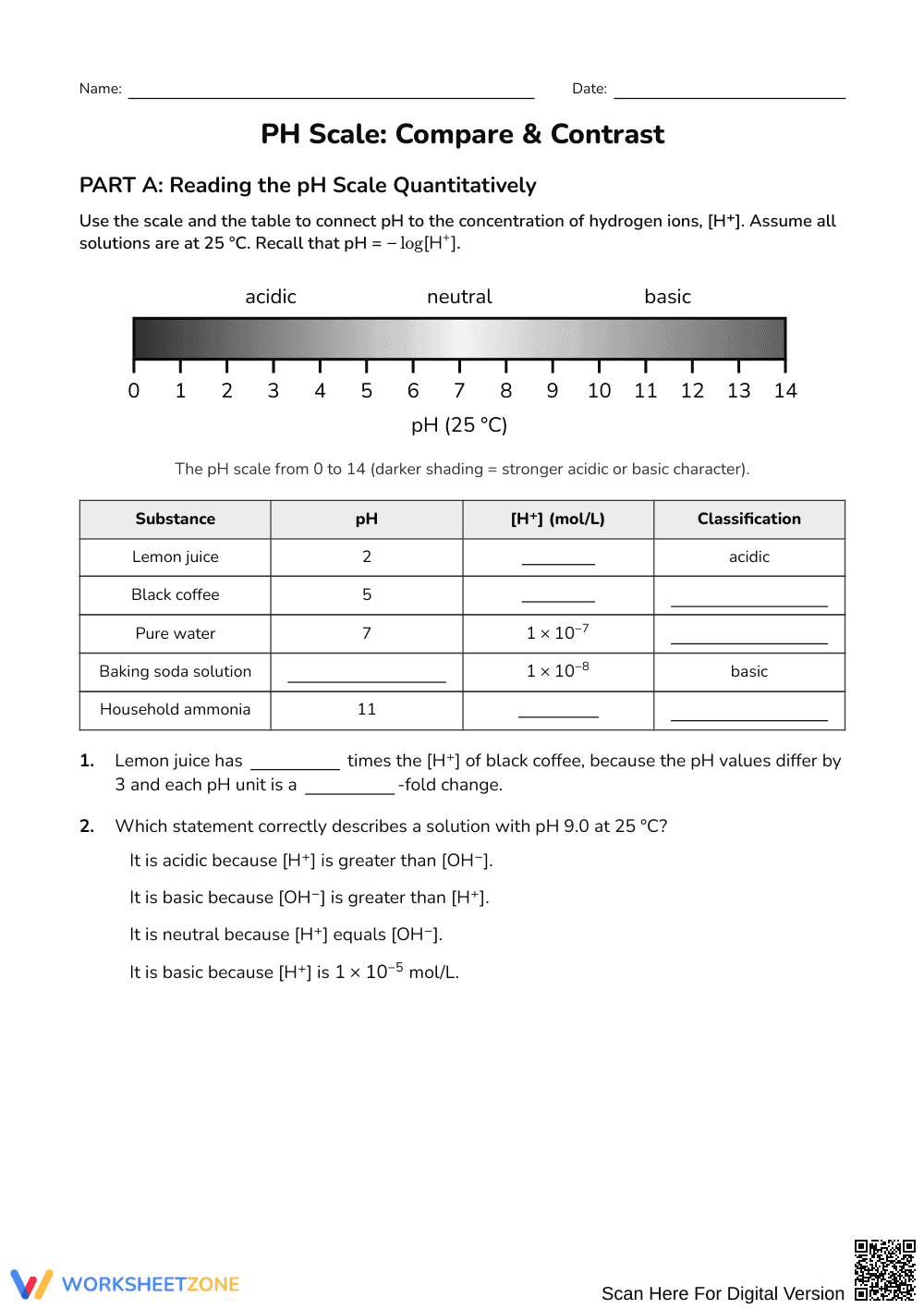
This comprehensive chemistry worksheet guides high school students through quantitative pH calculations, particulate representations of acid strength, and thermochemical neutralization evidence. Learners contrast logarithmic hydronium concentrations, evaluate weak versus strong acid dissociation at the particle level, and calculate calorimetric enthalpy changes across 33 rigorous, scaffolded problems.
At a Glance
- Grade: Grades 9–12 · Subject: High School Science
- Standard: High School Physical Science — Model particle interactions and calculate quantitative solution changes
- Skill Focus: pH scale calculations, particulate acid models, and neutralization calorimetry
- Format: 4 pages · 33 problems · Answer key included · PDF
- Best For: Honors chemistry unit assessment review
- Time: 45–60 minutes
What's Inside
Across 4 focused pages, students analyze real-world acidic and basic solutions using logarithmic tables, comparative organizers, and reaction calorimetry data. The activity features structured data tables contrasting 0.10 M hydrochloric acid and 0.10 M acetic acid, multiple-choice conceptual checks, quantitative ionization formulas, and a full 4-page answer key detailing mathematical steps, ionic equations, and claim-evidence-reasoning explanations.
Skill Progression
- Guided Practice (Part A, 11 tasks): Students compute logarithmic hydrogen ion differences using provided reference values and evaluate peer misconceptions regarding tenfold scale changes.
- Supported Practice (Part B, 12 tasks): Learners complete a structured comparison matrix contrasting strong versus weak acids, calculating percent ionization and explaining particle dissociation.
- Independent Practice (Part C, 10 tasks): Students solve calorimetry word problems, deduce net ionic equations, calculate molar neutralization energy, and craft an evidence-based argument.
This sequential design reflects the gradual-release model, transitioning students smoothly from scaffolded arithmetic to independent macroscopic and submicroscopic analysis.
Standards Alignment
This resource aligns with high school physical science standards requiring learners to formulate explanations of chemical reactions, use models to simulate atomic-level changes, and apply mathematical representations to describe solution equilibrium. Both conceptual particle tracking and energy calculations can be copied directly into lesson plans, IEP goals, or district curriculum mapping tools.
How to Use It
Deploy this resource during the mid-point or summary phase of an acid-base equilibrium unit. In an active instructional sequence, assign Parts A and B as collaborative partner work directly following an acid dissociation lecture, reserving Part C as an independent formative check. During class, monitor whether students confuse acid concentration with acid strength when evaluating identical molarities of strong and weak acids. Expect completion within 45 to 60 minutes.
Who It's For
Designed for high school chemistry, honors science, and introductory advanced placement cohorts. Integrated scaffold tables support developing learners, while multi-step enthalpy calculations challenge advanced students. Pair this activity directly with a wet-lab titration or coffee-cup calorimeter investigation.
Structured practice that integrates particulate representations with quantitative problem solving produces measurable gains in chemical literacy. According to research documented in Fisher & Frey (2014), systematic cognitive scaffolding that combines explicit modeling with guided peer collaboration allows learners to effectively bridge abstract thermodynamic models and observable laboratory data. By engaging with 33 targeted problems addressing logarithmic ion concentration, percent dissociation, and enthalpy changes, students build robust conceptual frameworks that connect macroscopic pH indicators directly to microscopic molecular behavior. This multi-representation framework ensures students develop lasting mastery across core high school chemistry concepts, enabling them to evaluate experimental evidence, construct rigorous scientific claims, and master complex analytical chemistry tasks across diverse assessment contexts.


