
































Complete pH Scale Model Worksheet | Grades 9-12 Science

Paste this activity's link or code into your existing LMS (Google Classroom, Canvas, Teams, Schoology, Moodle, etc.).
Students can open and work on the activity right away, with no student login required.
You'll still be able to track student progress and results from your teacher account.
This comprehensive chemistry worksheet guides high school students to construct, analyze, and refine conceptual and quantitative models of the pH scale. Learners investigate hydronium and hydroxide ion concentrations, evaluate student draft models to identify misconceptions, examine logarithmic dilution trends, and apply thermochemical neutralization data to explain pH shifts at the particle level.
At a Glance
- Grade: Grades 9–12 · Subject: Science
- Standard: High School Physical Science — Develop and use models to illustrate chemical properties
- Skill Focus: Construct, complete, and revise models of the pH scale
- Format: 4 pages · 32 problems · Answer key included · PDF
- Best For: Chemistry modeling practice and unit reinforcement
- Time: 45–60 minutes
What's Inside: Across 4 structured pages, this resource features 32 analytical items organized into distinct investigation phases. Students work with comparative pH scale bars, common household solution tables, particle transfer equations, student draft critique prompts, ion concentration matrices, dilution series tables, and a thermochemical cup calorimetry scenario. A thorough 4-page answer key provides worked-out mathematical steps, ionic equations, and sample model explanations.
Skill Progression
- Guided Practice (Part A, 10 tasks): Students classify household solutions across the 0–14 scale bar, examine relative ion concentrations across neutral thresholds, and determine fold changes in hydronium concentration with direct reference anchors.
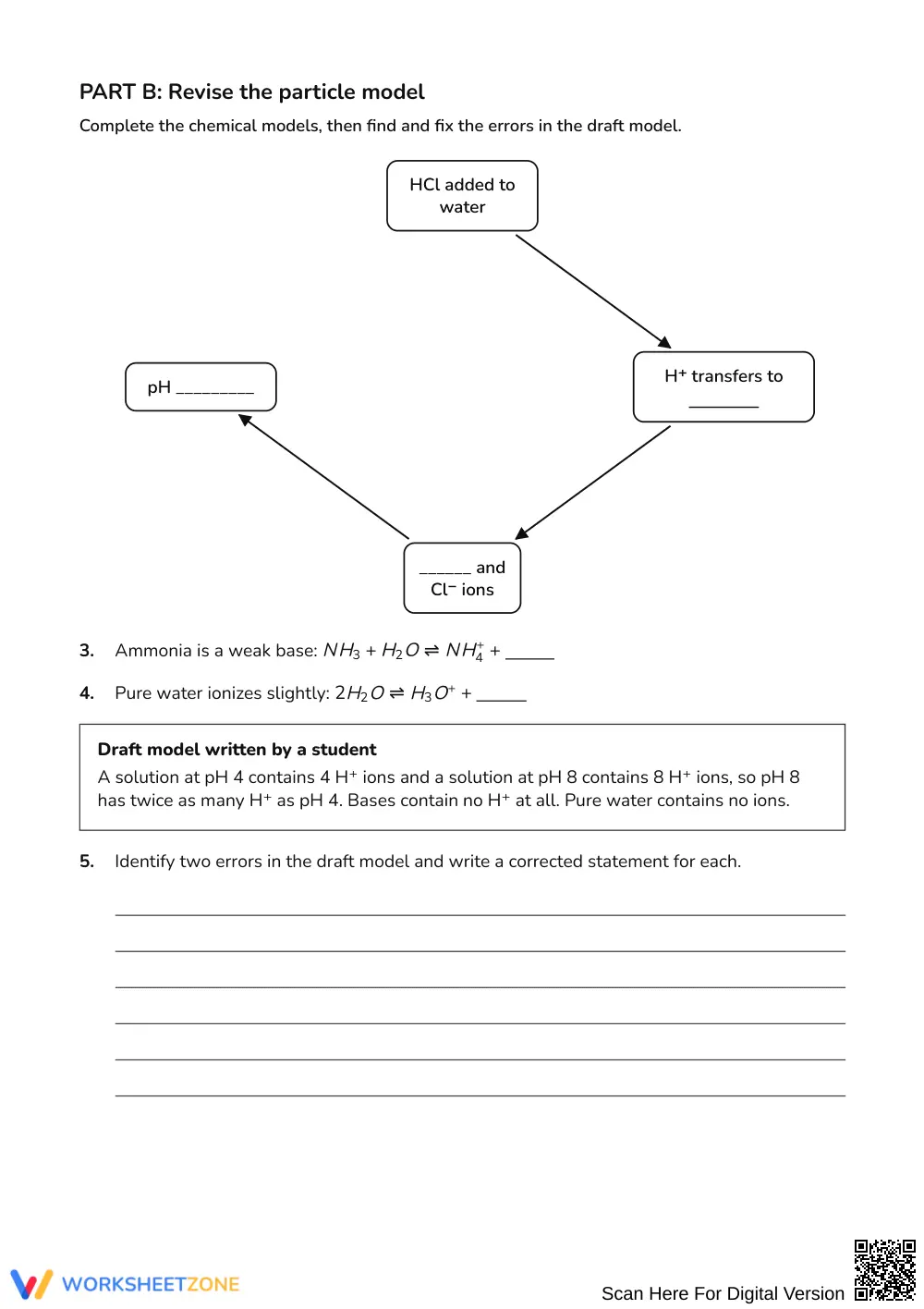
- Supported Practice (Part B, 11 tasks): Learners critique flawed particle models, correct peer misconceptions regarding autoionization, and apply the ion product of water to calculate hydronium and hydroxide values.
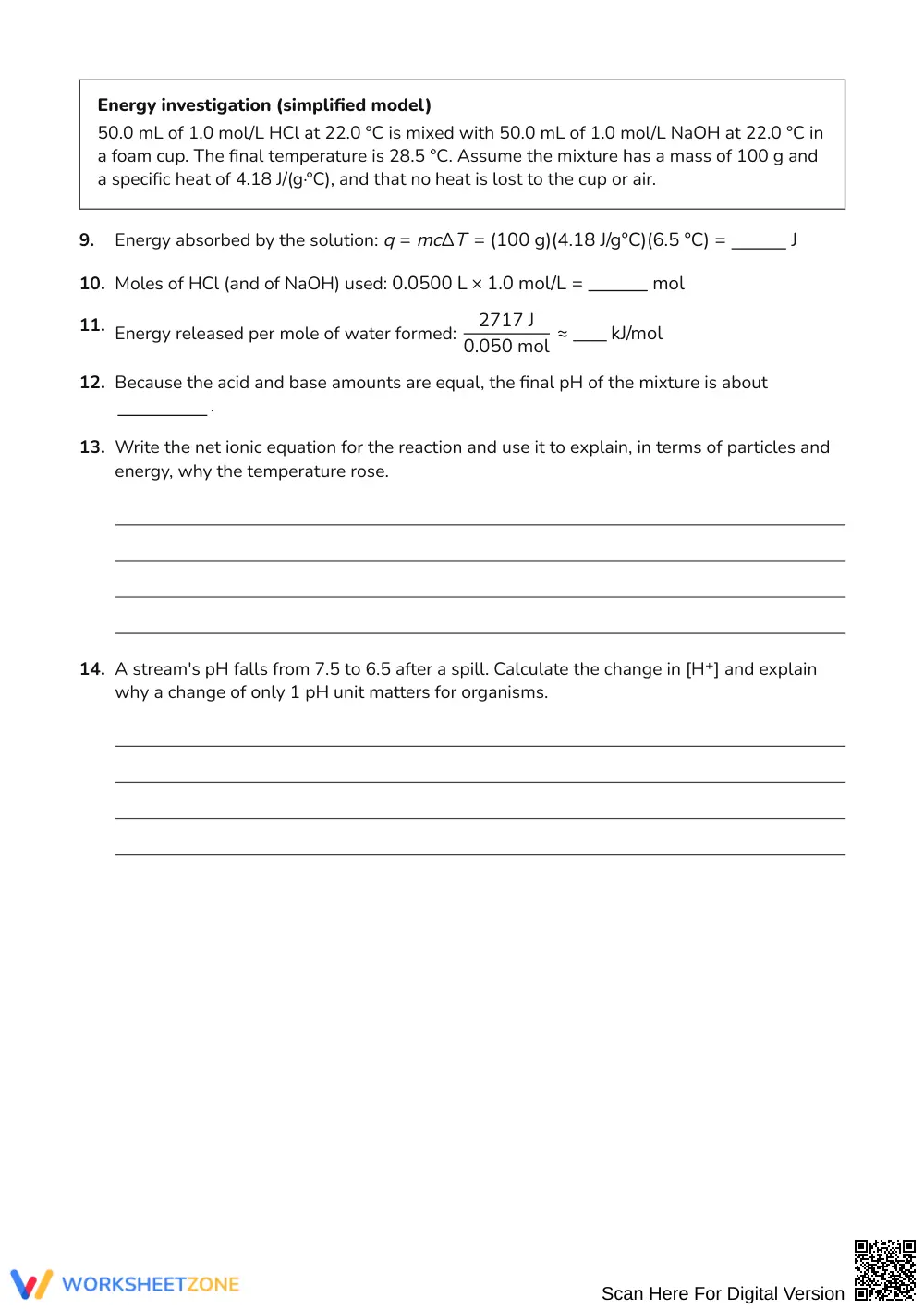
- Independent Practice (Part C, 11 tasks): High schoolers independently analyze serial dilution data, compute orders-of-magnitude differences using logarithmic relationships, calculate neutralization enthalpies, and evaluate environmental pH shifts in biological systems.
This structured sequence follows an intentional gradual-release framework, moving learners from visual scale interpretation to independent particle modeling and multi-step quantitative reasoning.
Standards Alignment
This resource aligns with high school physical science core ideas governing chemical reactions, solution chemistry, and scientific modeling. Students construct and revise models to explain particle interactions, predict reaction shifts, and illustrate the quantitative relationships underlying acid-base chemistry. Teachers can copy these instructional objectives directly into lesson plans, IEP goals, or district curriculum mapping tools.
How to Use It
Implement this 4-page worksheet during or immediately after direct instruction on acid-base equilibria and logarithmic scales. It functions effectively as a mid-unit modeling workshop where pairs critique Part B draft models before tackling independent calculations in Part C. During work time, circulate to verify whether students recognize that pH is a logarithmic index rather than an absolute ion count. Most students finish within 45 to 60 minutes.
Who It's For
This activity is designed for high school chemistry, physical science, and environmental science students developing scientific modeling competencies. Embedded data tables and step-by-step prompts scaffold struggling learners, while calorimetry and environmental application problems extend advanced thinkers. Pair this printable with a laboratory titration or an acid-base indicator demonstration to reinforce observable phenomena alongside particle models.
According to Fisher & Frey (2014), modeling instruction produces the largest learning gains when students actively critique flawed conceptual drafts rather than merely filling in completed diagrams. This Grades 9–12 science resource operationalizes that research through 32 scaffolded tasks, requiring students to identify why naive particle interpretations fail when describing acid-base neutrality. By coordinating macroscopic pH values, particulate hydronium transfers, and logarithmic calculations across 4 detailed pages, the worksheet builds robust scientific literacy. The included 4-page answer key supports rapid formative feedback and student self-assessment, ensuring learners successfully bridge the gap between empirical observations and particulate explanations.


