































Essential pH Scale Basics Worksheet | Grades 9–12 Science

Paste this activity's link or code into your existing LMS (Google Classroom, Canvas, Teams, Schoology, Moodle, etc.).
Students can open and work on the activity right away, with no student login required.
You'll still be able to track student progress and results from your teacher account.
This comprehensive high school chemistry worksheet equips students to master foundational acid-base vocabulary, logarithmic pH calculations, and common chemical misconceptions. Learners analyze hydrogen ion concentration, classify real-world solutions, and compute decade changes across 30 scaffolded tasks to build rigorous scientific literacy.
At a Glance
- Grade: Grades 9–12 · Subject: Science
- Standard: High School Chemistry — Calculate pH and evaluate hydrogen ion concentration relationships in aqueous solutions
- Skill Focus: pH Scale: Foundations & Vocabulary
- Format: 4 pages · 30 problems · Answer key included · PDF
- Best For: First-time chemistry instruction and review
- Time: 45–60 minutes
What's Inside
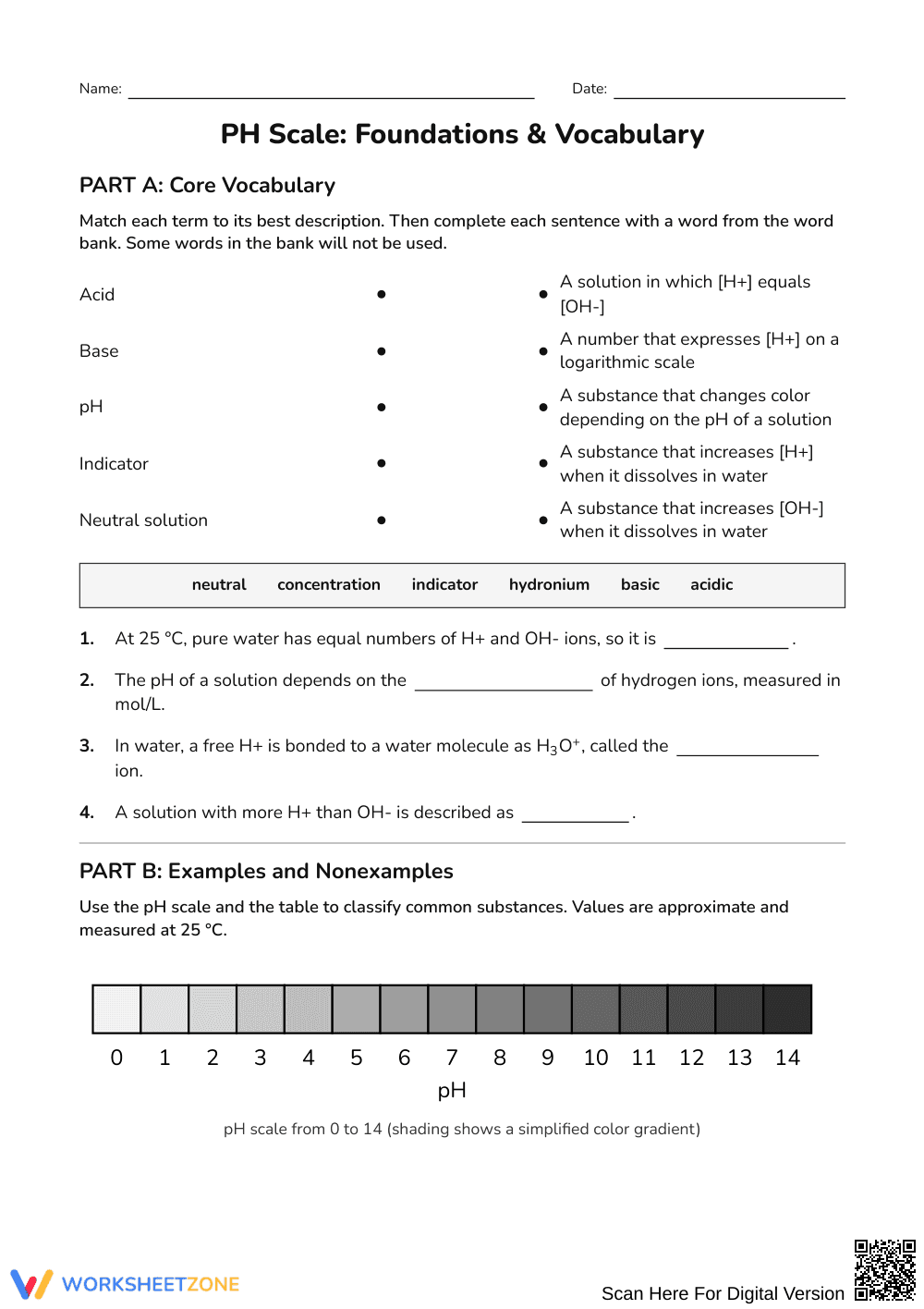
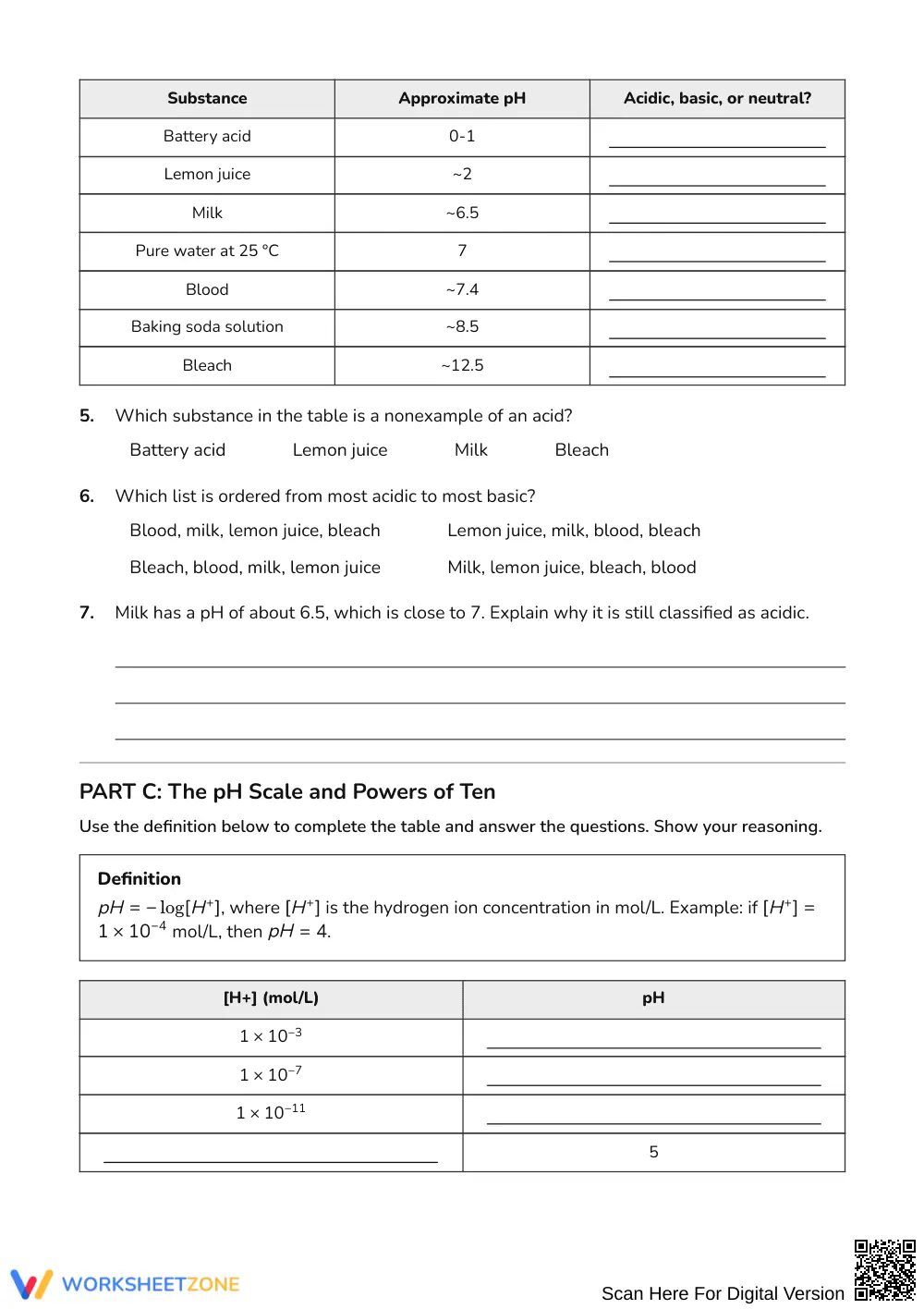
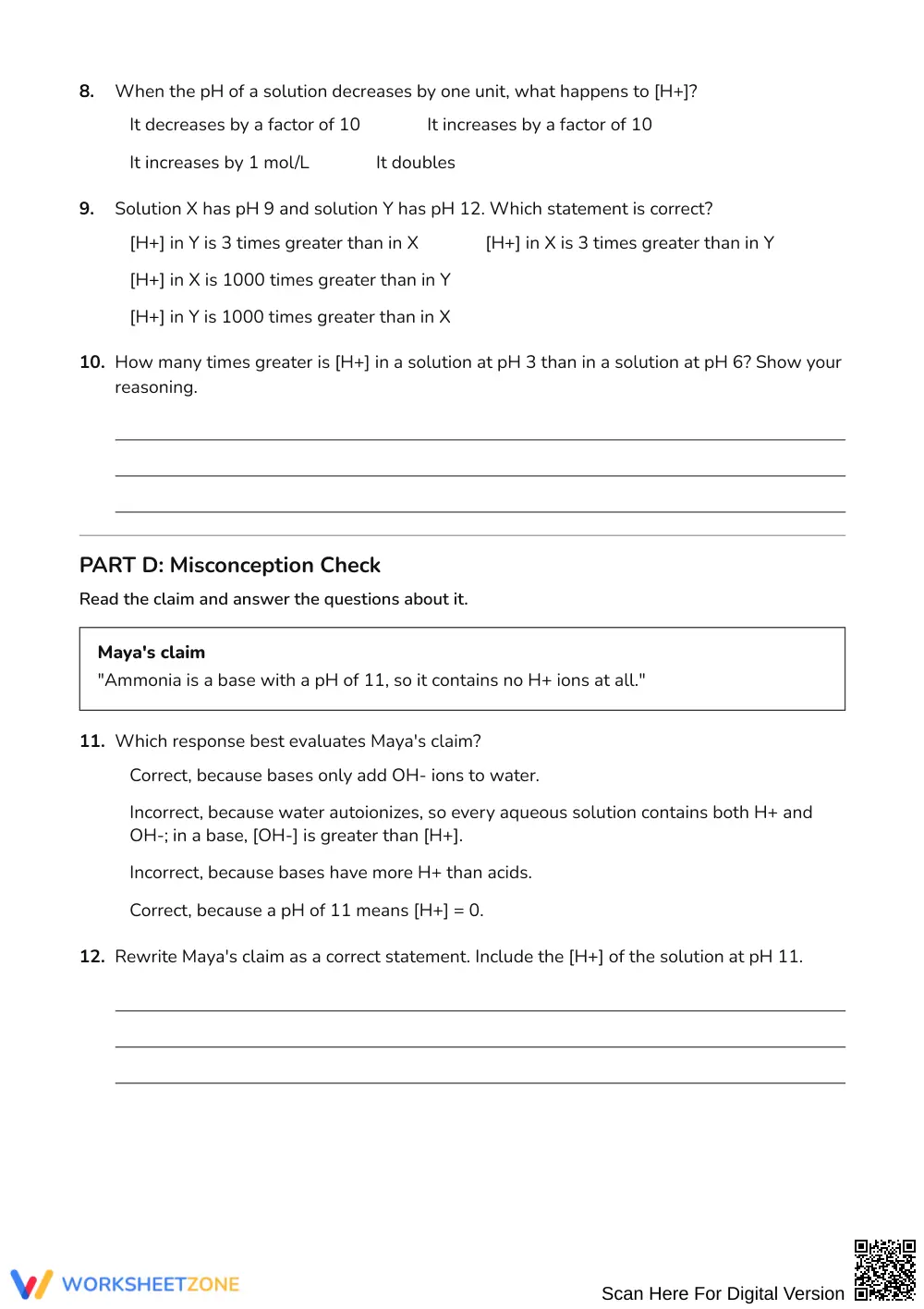
This 4-page printable resource includes term-matching activities, fill-in-the-blank vocabulary prompts using an authentic word bank, substance classification tables, power-of-ten mathematical models, and misconception-correction prompts. A complete 4-page answer key provides step-by-step ratio calculations, hydronium ion explanations, and sample student explanations for immediate grading.
Skill Progression
- Guided Practice (Part A): Students define core terms like hydronium, indicator, and neutral solution through structured matching and guided cloze sentences supported by a targeted word bank (9 tasks).
- Supported Practice (Parts B & C): Learners examine a color-coded pH spectrum, order everyday substances from acidic to basic, and compute order-of-magnitude changes in hydrogen ion molarity using explicit mathematical models (14 tasks).
- Independent Practice (Part D): Students independently evaluate flawed chemical arguments about autoionization, correct non-linear acidity claims, and identify valid aqueous statements without scaffolding (7 tasks).
This sequence follows a gradual-release model, moving high school learners from foundational terminology into independent quantitative reasoning.
Standards Alignment
This resource aligns with high school physical science standards addressing chemical reactions, solution chemistry, and acid-base equilibrium. Students calculate ion concentrations using negative logarithms, model the chemical properties of hydronium and hydroxide ions, and explain water self-ionization. Standard alignment details can be copied directly into lesson plans, IEP goals, or district curriculum mapping tools.
How to Use It
Deploy this worksheet directly after direct instruction introducing the Arrhenius definition of acids and bases. As students solve the power-of-ten ratio problems in Part C, circulate to check whether learners recognize that each unit drop on the scale multiplies hydrogen ion concentration by ten rather than adding a fixed amount. Allocate 45 to 60 minutes for individual completion or collaborative paired practice.
Who It's For
This resource serves high school chemistry and physical science students seeking clear conceptual grounding before advanced titrations. Provide struggling math learners with a scientific notation reference strip, while pairing advanced students with an inquiry lab on household liquid indicators.
According to Fisher & Frey (2014), structured practice that pairs explicit vocabulary acquisition with corrective reasoning strengthens conceptual retention in secondary science. This 4-page, 30-task worksheet supports high school students as they transition from basic operational definitions of acids and bases to quantitative logarithmic thinking. Students systematically address widespread chemical misunderstandings regarding neutral points and autoionization while calculating decade changes in hydronium concentration. The rigorous structure ensures students develop both qualitative reasoning and mathematical precision across 45 to 60 minutes of focused chemistry engagement.


