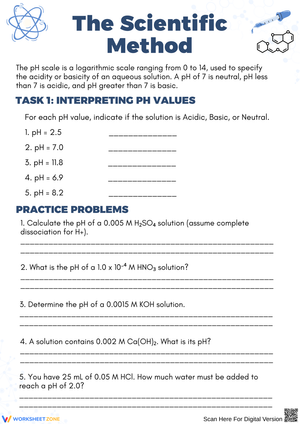
10th Grade pH Scale printable worksheets
These 10th grade ph scale printable worksheets give chemistry teachers a concrete, paper-based way to check whether students can actually use the 0-to-14 scale — not just recite which end is acidic. Each worksheet moves students through labeling, classification, and short reasoning tasks, producing formative data teachers can act on before the unit reaches lab work with indicators or buffers.
What Each Worksheet Asks Students to Do
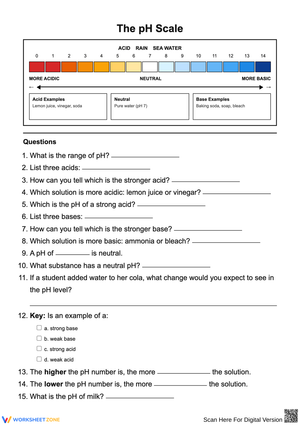
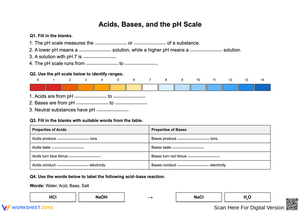
The 10th grade ph scale printable worksheets in this set ask students to do several distinct kinds of work rather than cycling through the same task format repeatedly. Students mark acidic, neutral, and basic regions on a pH number line, then place familiar substances — lemon juice, pure water, baking soda solution, stomach acid — at approximate positions along it. Comparison items require students to identify which of two solutions is more acidic or more basic, and short-response prompts ask them to connect a number value to chemistry vocabulary: acid, base, neutral, strong, weak.
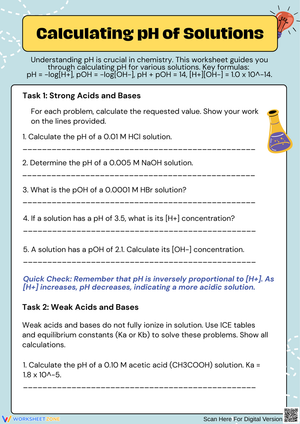
At least one worksheet addresses the logarithmic character of pH directly. Students explain why a change from pH 6 to pH 5 represents a tenfold increase in hydrogen ion concentration — not a one-unit arithmetic step. That distinction separates students who have a working understanding of the scale from those who memorized the endpoints without grasping the structure between them.
The substance-sorting items deserve particular attention from teachers. Students often answer labeling questions correctly but stumble when the same knowledge appears as an ordering task. A student who can write "coffee is acidic" but cannot correctly rank coffee (pH approximately 5), lemon juice (pH approximately 2), and tomato juice (pH approximately 4) from most to least acidic is signaling exactly where instruction needs to go next.
Student Errors Worth Catching Early in the Unit
The most persistent error in 10th grade pH work is treating the scale as linear. A student who describes pH 3 as "twice as acidic" as pH 6 — rather than a thousandfold difference in hydrogen ion concentration — has not internalized the logarithmic structure. This shows up clearly in short-response items when students write explanations like "pH 3 is a little more acidic than pH 4," a phrasing that sounds reasonable but misrepresents the actual magnitude of difference between those two values.
A second pattern involves directionality. Some students reverse the scale under timed or test conditions, placing stronger acids toward the high end. This tends to happen when students have previously encountered textbook layouts with pH 14 on the left. Worksheets that position 0 on the left and ask students to confirm their classification in writing surface this confusion before it costs them on a unit exam.
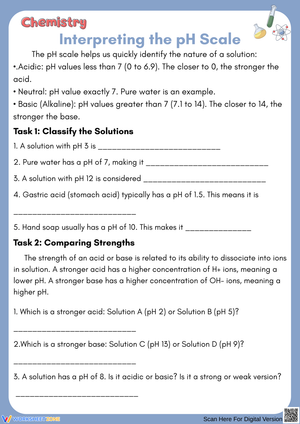
Third: students routinely treat pH 6.5 as neutral, rounding generously toward 7. The comparison items on these worksheets expose that gap directly — students have to commit to a classification and justify it in a sentence, which makes the vague rounding strategy visible to teachers during a quick review of written work.
Fitting These Worksheets Into the Instructional Sequence
The most effective placement for the labeling and classification worksheets is immediately after the first direct-instruction pass on pH — not before it, and not delayed until test review. Students need to process the 0-to-14 range while the explanation is still fresh. Assigning a labeling worksheet in the final ten minutes of the introductory lesson gives teachers immediate feedback on whether students transferred what they just heard, which shapes how the next class period needs to open.
For the comparison and logarithmic-reasoning worksheets, waiting one or two class periods works better. Once students have seen a concrete demonstration — pH paper, a color-change indicator, or a teacher-led walkthrough of the scale with substance examples — the written reasoning tasks land with more traction. Introducing the harder prompts before students have any perceptual anchor for what scale values represent tends to produce pattern-matching rather than genuine thinking.
The set also fits well as a Monday warm-up during an acids-and-bases unit. Five minutes on a classification or comparison worksheet before new content begins keeps earlier pH vocabulary active through spaced retrieval without displacing the main lesson. Teachers who run lab days midweek often use a Friday worksheet as a low-stakes check to confirm that students connected their lab results back to the numeric scale — rather than treating the two activities as unrelated.
Standard Alignment
These worksheets fall within NGSS disciplinary core idea PS1.B (Chemical Reactions) and the crosscutting concept of Scale, Proportion, and Quantity. Understanding that the pH scale is logarithmic rather than arithmetic is a direct application of that crosscutting concept: quantitative relationships reveal patterns that simple counting cannot show. The science-practice dimension that applies most cleanly is Science Practice 5 (Using Mathematics and Computational Thinking), specifically when students explain why a one-unit change in pH reflects a tenfold change in hydrogen ion concentration rather than a simple additive shift.
Most state chemistry frameworks for 10th grade explicitly name acid-base chemistry as a required unit, with pH classification listed as a skill students must demonstrate. Teachers working under Texas TEKS Chemistry (§112.35), California's NGSS-aligned standards, or New York Regents Chemistry curricula can map the classification and comparison tasks directly to those frameworks without additional adjustment. The short constructed-response items also address the science-practice expectation of constructing explanations from evidence, which appears across most state standards documents regardless of how closely they follow the NGSS structure.
Tiering the Practice for Different Levels of Readiness
For students who are still building comfort with the 0-to-14 range, print each worksheet with the full pH scale at the top as a reference. This gives them a visual anchor without removing the cognitive demand of the task — they still classify, compare, and explain; they just are not working from memory on the scale's structure at the same time. Including a consistent reference across the group also means every student is reasoning from the same starting point, rather than from individual notes that may contain errors.
The logarithmic reasoning items are where the real challenge lives for students who move quickly through classification work. Push them past the worksheet prompt: after writing an explanation for a one-unit pH change, ask them to derive a rule covering a two-unit or three-unit change, applied to a pH value not listed on the worksheet. That extension requires no additional prep and produces richer evidence of understanding than another round of labeling.
Students who freeze on written explanation items often do better with a sentence frame written on the board: "The solution at pH ___ has a higher/lower concentration of hydrogen ions than the solution at pH ___ because..." That kind of structured prompt lowers the barrier to entry on the written portion without simplifying the chemistry. For teachers working with mixed-ability classes, 10th grade ph scale printable worksheets adapt cleanly without requiring entirely separate materials for each tier.
Frequently Asked Questions
Do these worksheets require lab materials or any setup?
No. Each worksheet works entirely on paper. Students classify, compare, and reason using the pH scale and their chemistry knowledge. No pH paper, indicators, or solutions are needed — which makes the resources practical for homework, substitute teacher days, and unit review sessions without any lab setup.
When in a pH unit should teachers introduce these?
The labeling and classification worksheets belong in the first one or two class periods, right after initial instruction on the scale. The comparison and logarithmic reasoning worksheets work better once students have a concrete reference point — typically a day or two into the unit. Introducing the harder reasoning tasks too early, before students have any experiential grounding in what the values represent, tends to produce guessing rather than reasoning.
Can these be used as quizzes rather than practice?
Yes. Because 10th grade ph scale printable worksheets follow the same question formats found on most chemistry assessments — classification, comparison, and short constructed response — they translate directly into quiz format with minimal adjustment. Remove the reference scale from the top of the worksheet if one is included, and the resource functions as a clean assessment. Leave it in, and it remains a practice tool. The support structure changes; the underlying chemistry content does not.
How should teachers handle the logarithm component if students haven't yet studied logarithms in math class?
Treat the logarithmic character of pH as a vocabulary-level fact rather than a mathematical derivation. Students do not need to calculate log values or work with exponential notation at the level a math course requires. They need to know that each 1-unit change in pH represents a tenfold change in hydrogen ion concentration, and they need enough practice applying that fact to short comparison prompts. These worksheets stay at that level throughout — no formal logarithm notation, no derivations required.
Clear All