































Complete pH Scale Review Worksheet | Grades 9-12 Science

Paste this activity's link or code into your existing LMS (Google Classroom, Canvas, Teams, Schoology, Moodle, etc.).
Students can open and work on the activity right away, with no student login required.
You'll still be able to track student progress and results from your teacher account.
This comprehensive chemistry assessment equips high school students to master the pH scale through quantitative analysis, particle diagrams, and thermochemical calculations. Across three structured parts, learners demonstrate how hydronium ion concentration determines solution acidity, evaluate logarithmic shifts, and explain energy transfers during acid-base neutralization reactions.
At a Glance
- Grade: Grades 9–12 · Subject: Science
- Standard: High School Physical Science — Analyze pH values, logarithmic hydronium concentrations, acid ionization, and neutralization thermochemistry
- Skill Focus: Cumulative Assessment of the pH Scale
- Format: 4 pages · 27 problems · Answer key included · PDF
- Best For: End-of-unit assessment or comprehensive exam review
- Time: 45–60 minutes
What's Inside
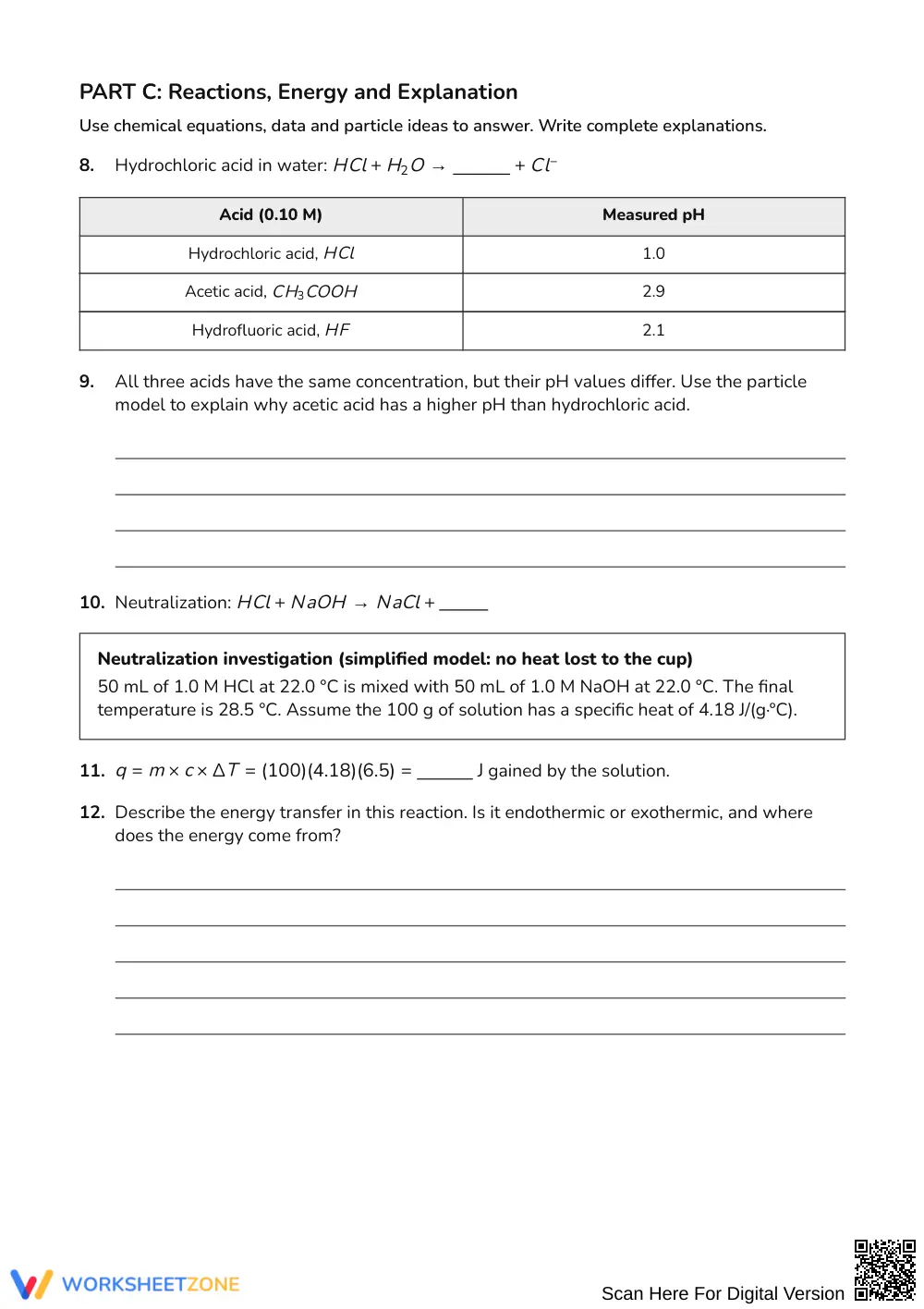
This 4-page assessment delivers 27 rigorous tasks organized into three distinct operational sections. Students interact with visual particle-model tables, evaluate real-world logarithmic substance data, solve thermochemical calorimetry problems using specific heat formulas, and interpret hydrochloric acid titration curves. A complete 4-page answer key provides step-by-step mathematical solutions and model scientific explanations for immediate scoring.
Skill Progression
- Guided practice (Part A — 8 tasks): Visual scaffolds guide students as they compare ion counts in particulate models, connect hydronium and hydroxide ratios, and read foundational pH scale benchmarks.
- Supported practice (Part B — 9 tasks): Semi-structured tables prompt students to calculate tenfold changes across substance pH values, evaluate biological blood pH claims, and verify multi-select solution properties.
- Independent practice (Part C — 10 tasks): Students operate without scaffolds to explain differential acid ionization, compute neutralization enthalpy using calorimetry equations, and justify sharp titration curve inflection points.
This deliberate sequence reflects the gradual release of responsibility model, guiding students from conceptual particle identification to rigorous, unassisted quantitative analysis.
Standards Alignment
This assessment directly aligns with high school physical science standards for chemical reactions, solution equilibrium, and thermochemistry. Students demonstrate mastery by modeling particle interactions, calculating logarithmic hydronium shifts, and analyzing heat flow in neutralization. This standard alignment can be copied directly into lesson plans, IEP goals, or district curriculum mapping tools.
How to Use It
Deploy this assessment immediately after completing direct instruction on acid-base chemistry and titration curves, allocating 45 to 60 minutes for completion. Alternatively, assign individual sections as targeted station reviews prior to a district benchmark exam. During administration, conduct a formative observation check on Part B: note whether students mistakenly treat pH differences linearly rather than applying base-10 logarithmic powers.
Who It's For
This resource is designed for on-level and advanced Grades 9–12 chemistry students synthesizing solution concepts. For emerging bilingual learners or students needing additional support, pair this assessment with a visual pH scale anchor chart illustrating particle ratios before administering the independent titration free-response items.
High school physical science standards mandate that students construct models and use mathematical representations to explain chemical reaction equilibrium, solution acidity, and energy conservation. This 4-page cumulative assessment benchmarks student competence in calculating logarithmic hydrogen ion concentration shifts, identifying relative acid strengths from ionization data, and interpreting titration curves alongside thermochemical calorimetry. Grounded in the instructional framework articulated by Fisher & Frey (2014), the resource structures 27 rigorous tasks across a gradual-release trajectory from visual particle representations to unassisted quantitative justifications. By requiring learners to evaluate empirical evidence from substance comparisons and connect macroscopic pH readings to submicroscopic particulate behaviors, the assessment yields actionable diagnostic data on student conceptual readiness. Secondary science educators can rely on this comprehensive instrument to verify standards mastery, identify persistent mathematical misconceptions surrounding base-10 scales, and inform targeted intervention in high school chemistry classrooms.


