
































Complete Real-World pH Worksheet | Grades 9–12 Science

Paste this activity's link or code into your existing LMS (Google Classroom, Canvas, Teams, Schoology, Moodle, etc.).
Students can open and work on the activity right away, with no student login required.
You'll still be able to track student progress and results from your teacher account.
This comprehensive high school science worksheet engages students in applying logarithmic pH concepts directly to authentic environmental and physiological systems. Learners examine hydrogen ion concentrations, evaluate real data on ocean acidification, and analyze neutralization reactions in human digestive technology through 23 carefully sequenced analytical tasks.
At a Glance
- Grade: Grades 9–12 · Subject: Science
- Standard: High School Physical Science — Apply chemical principles and the logarithmic pH scale to environmental and technological systems
- Skill Focus: Real-World Application
- Format: 4 pages · 23 problems · Answer key included · PDF
- Best For: Post-lecture application, chemistry unit review, or sub plans
- Time: 45–55 minutes
What's Inside
The 4-page worksheet includes data tables, chemical reaction equations, multi-step calculation prompts, and conceptual free-response questions across three real-world contexts. A complete 4-page answer key provides step-by-step mathematical reasoning, ion concentration derivations, and sample student explanations for immediate evaluation.
Skill Progression
- Guided Practice (Part A, Tasks 1–7): Students interpret common household solutions on the pH scale, calculate hydrogen ion concentration changes using [H⁺] = 10⁻ᵖᴴ, and relate logarithmic shifts to factor-of-ten multipliers with structural references.
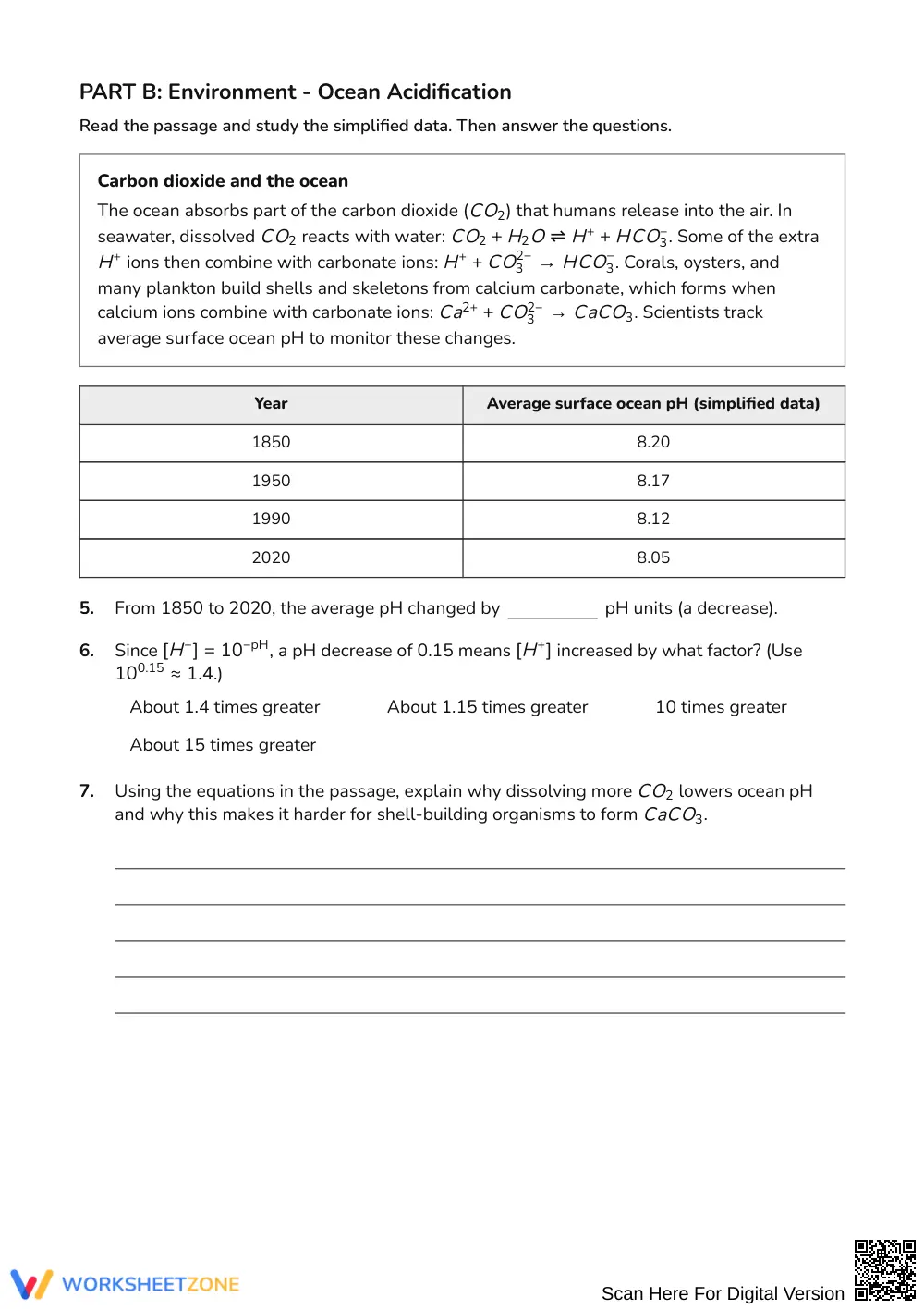
- Supported Practice (Part B, Tasks 8–15): Learners analyze authentic historical data tracking ocean acidification from 1850 to 2020, evaluating equilibrium shifts, carbonate availability, and common misconceptions surrounding basic versus acidic thresholds.
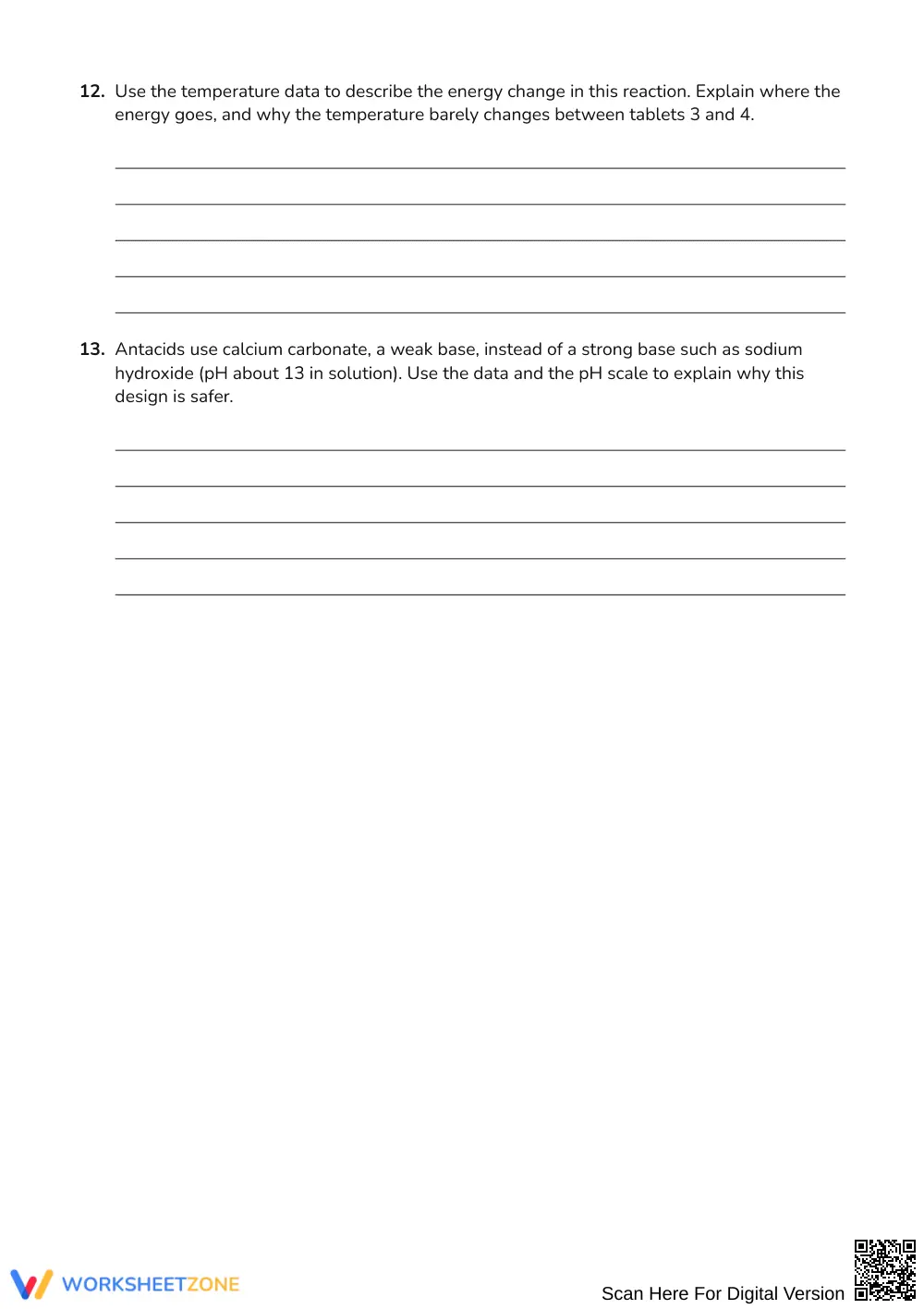
- Independent Practice (Part C, Tasks 16–23): Working independently, students model stomach acid neutralization using antacid lab data, balance chemical equations, evaluate exothermic thermal trends, and justify chemical design choices.
This scaffolded progression adheres to the gradual release of responsibility model, guiding students smoothly from foundational scale reading to independent system-level scientific argumentation.
Standards Alignment
This resource aligns with high school chemistry and physical science performance expectations focusing on chemical reactions, reaction rates, chemical equilibrium, and the mathematical properties of the logarithmic pH scale. The curriculum emphasizes evaluating evidence and communicating scientific explanations regarding human impacts on oceanic chemistry. These learning objectives can be copied directly into lesson plans, IEP goals, or district curriculum mapping tools.
How to Use It
Administer this worksheet during guided classwork immediately following direct instruction on logarithms and acid-base definitions, or assign it as an independent review module before summative assessments. During classwork, observe how students handle the claim in Part B that the ocean has become acidic; students who grasp the logarithmic scale will recognize that dropping to pH 8.05 increases [H⁺] while remaining chemically basic. Expected completion time ranges from 45 to 55 minutes.
Who It's For
This learning resource serves general chemistry, physical science, and environmental science students in grades 9 through 12. Differentiate instruction by pairing struggling learners with a logarithmic reference card or an anchor chart displaying conjugate acid-base pairs before independent analysis.
According to Fisher & Frey (2014), structuring academic tasks around clear evidentiary passages and data sets supports secondary learners in developing durable content mastery. This 4-page, 23-task science worksheet addresses high school chemical equilibrium and pH concepts through authentic environmental and medical scenarios, including ocean acidification trends and stomach antacid neutralization. By prompting students to evaluate quantitative hydrogen ion concentrations alongside qualitative chemical equations, the activity reinforces scientific literacy and mathematical reasoning. Students confront persistent misconceptions regarding the logarithmic scale, demonstrating that minor numerical decreases represent substantial increases in hydronium concentration. Complete with verified answer keys, this resource offers educators reliable assessment data to verify analytical reasoning and chemical comprehension across general and advanced secondary science classrooms.


