


























1 / 2
0
Views
0
Downloads


0.0
0
Save
0 Likes
Share
The Molecular Messengers: Exploring RNA Worksheet
0 Views
0 Downloads
Paste this activity's link or code into your existing LMS (Google Classroom, Canvas, Teams, Schoology, Moodle, etc.).
Students can open and work on the activity right away, with no student login required.
You'll still be able to track student progress and results from your teacher account.
Information
Description
What It Is:
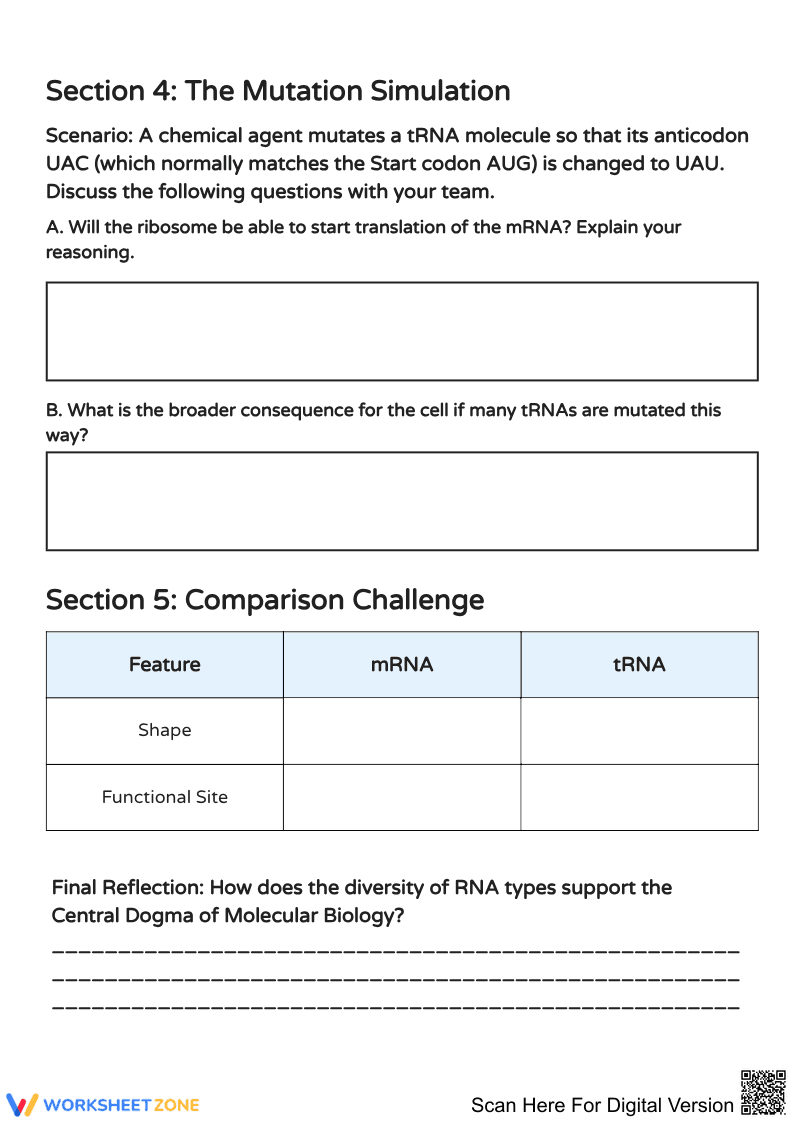
This worksheet guides students through the logic, structure, and specialized roles of RNA. It includes discussion prompts, identification of RNA types (mRNA, tRNA, rRNA), and structural fill-in-the-blank questions comparing RNA to DNA.
Why Use It:
It deepens understanding of why RNA acts as an intermediary in protein synthesis and clarifies the collaborative roles of different RNA molecules. The combination of reasoning and recall questions strengthens both conceptual and structural knowledge.
How to Use It:
• Discuss why cells use RNA instead of building proteins directly from DNA.
• Identify mRNA, tRNA, and rRNA based on their specific functions.
• Complete structural fill-ins comparing RNA and DNA features.
• Review responses to reinforce transcription and translation concepts.
Grade Suitability:
Best suited for Grades 8–11.
• Middle school advanced life science units on genetics.
• High school biology lessons on molecular biology and protein synthesis.
Target Users:
Science teachers, homeschool educators, tutors, and students studying genetics and molecular biology fundamentals.
This worksheet guides students through the logic, structure, and specialized roles of RNA. It includes discussion prompts, identification of RNA types (mRNA, tRNA, rRNA), and structural fill-in-the-blank questions comparing RNA to DNA.
Why Use It:
It deepens understanding of why RNA acts as an intermediary in protein synthesis and clarifies the collaborative roles of different RNA molecules. The combination of reasoning and recall questions strengthens both conceptual and structural knowledge.
How to Use It:
• Discuss why cells use RNA instead of building proteins directly from DNA.
• Identify mRNA, tRNA, and rRNA based on their specific functions.
• Complete structural fill-ins comparing RNA and DNA features.
• Review responses to reinforce transcription and translation concepts.
Grade Suitability:
Best suited for Grades 8–11.
• Middle school advanced life science units on genetics.
• High school biology lessons on molecular biology and protein synthesis.
Target Users:
Science teachers, homeschool educators, tutors, and students studying genetics and molecular biology fundamentals.


