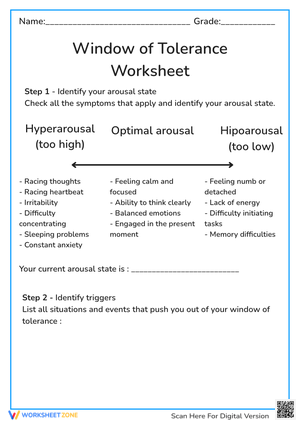
These 10th grade window of tolerance worksheets pdf resources give teachers and counselors a concrete way to bring self-regulation language into the classroom without turning a lesson into a clinical session. Each worksheet translates a foundational trauma-informed concept — the zone of optimal readiness for learning — into focused reflection tasks students complete in advisory, health class, or a counseling group. The set stays squarely on recognition and strategy: students learn to notice where they are, name the signals in their body, and identify a practical move that helps them return to a learning-ready state.
What Each Worksheet Targets
The worksheets build three interconnected skills: identifying internal states, connecting those states to the window of tolerance model, and selecting regulation strategies suited to each zone. Students are not simply reading a definition — they are mapping their own patterns onto a shared framework.
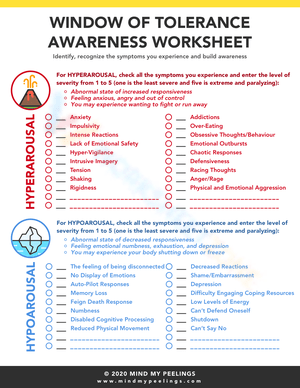
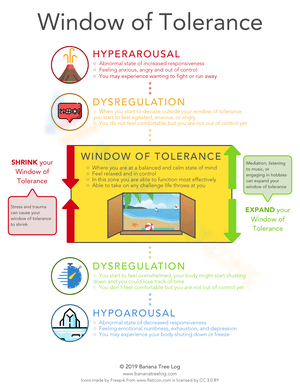
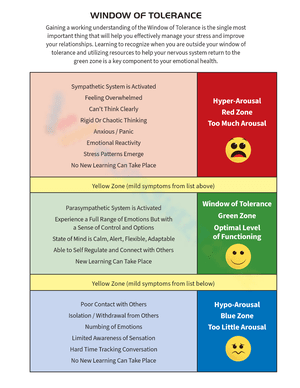
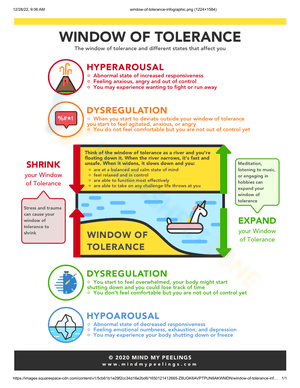
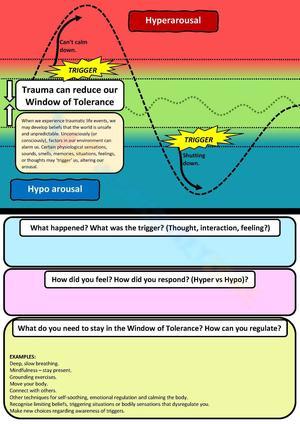
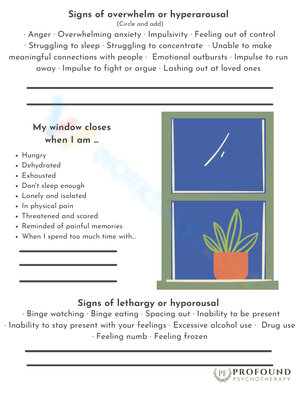
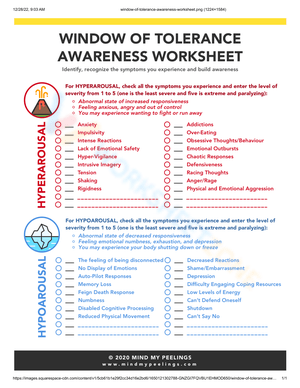
- Zone identification: Students distinguish between hyperarousal (racing heart, tight chest, intrusive thoughts, agitation) and hypoarousal (heaviness, mental fog, emotional numbness, withdrawal) and learn to describe each zone in their own words.
- Body signal recognition: Prompts ask for physical cues — the kind that surface during a difficult test, a peer conflict in the hallway, or the anticipation before a presentation.
- Trigger mapping: Students reflect on specific school situations that move them outside their window, including sleep deprivation, grade pressure, social exclusion, and sudden schedule changes.
- Strategy selection: Each worksheet includes space for students to build a personalized list of regulation moves they can realistically use during the school day — slow breathing, a brief walk, grounding through sensory details, or a short written reset.
- Return recognition: Students describe what "back inside the window" feels like — in their body, their thinking, and their readiness to engage — so the destination becomes as concrete as the problem.
Why This Concept Lands Differently at Grade 10
The window of tolerance is worth introducing at every grade, but 10th grade is where it becomes genuinely functional rather than abstract. Students at this level are managing simultaneous academic pressure from multiple demanding courses, navigating social hierarchies that have grown substantially more complex since middle school, and starting to make decisions with real consequences — around relationships, extracurricular commitments, and future plans. Their nervous systems often run at high cost without any framework to explain what is happening inside them.
The biggest instructional payoff at this grade is the reframe: behavior stops looking like attitude and starts looking like regulation state. A student who shuts down mid-lesson may not be unmotivated — they may be so far below their window that engagement is neurologically unavailable. When students understand that, the self-shame tends to drop and curiosity about patterns tends to replace it. That shift alone is worth 15 minutes of instruction.
There is also a performance angle that resonates specifically with this age group. Students at this stage respond to evidence that regulating their nervous system improves how they actually perform — clearer thinking on a timed essay, faster recovery after a conflict with a peer, better sustained focus heading into a high-stakes seminar. Framing the worksheet as a performance tool rather than a wellness activity changes how seriously students take the work.
Misconceptions Students Bring That These Worksheets Help You Catch
The pattern we see most often is confusing hypoarousal with calm. Students who are shut down — flat affect, minimal responsiveness, fixed gaze at the desk — frequently describe themselves as "fine" or "just tired." They are not inside their window; they are below it. When a student says "I don't feel anything, so I must be okay," that is exactly the moment to draw the diagram and point below the floor. Worksheet prompts that ask students to describe physical cues during quiet withdrawal — rather than simply labeling an emotion — are the most effective at surfacing this confusion, because numbness shows up in the body even when it is invisible to observers.
A second misconception is that the window is a fixed personal trait. Students who have experienced chronic stress or anxiety often conclude they simply have a narrow window because of who they are, permanently. Worksheets that ask students to compare their internal state across different settings — a low-stakes afternoon vs. a test morning, or a class they feel comfortable in vs. one where they feel evaluated constantly — introduce useful doubt about that belief. Seeing variation in their own responses is more convincing than being told that windows can expand over time.
A third pattern worth anticipating: students expect regulation strategies to produce instant, complete relief. When three slow breaths do not immediately resolve a spiral, many students conclude that breathing "doesn't work for me." Prompts that ask students to rate their activation level before and after a brief grounding exercise — even when the shift is only from a 7 to a 5 — help students recognize incremental change as meaningful rather than holding out for instant reset.
Building These Worksheets Into Your Instructional Week
The most effective use of these worksheets is not a single lesson — it is a repeating structure. When students encounter the same framework multiple times across different contexts, the language moves from assigned vocabulary to an actual thinking tool. These 10th grade window of tolerance worksheets pdf resources work best in short, recurring routines rather than one-off introductions.
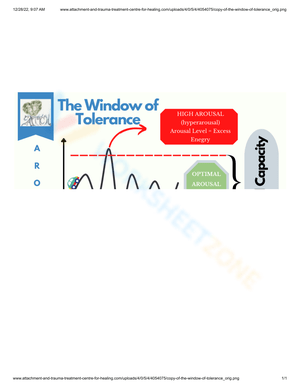
- Advisory opener: A 5-minute check-in where students mark their current zone on the visual diagram and identify one physical cue they notice — fast enough to complete before the transition to first period.
- Pre-test reset: Distribute the strategy bank worksheet the morning of an exam and give students 3 minutes to choose one grounding move and note when they plan to use it if their focus starts to slip.
- Re-entry after dysregulation: Keep a shortened version — just the zone diagram and two reflection questions — in a folder for students returning from a regulated cool-down space. The task is naming what happened and choosing one next step, not processing the event in full.
- Counseling group anchor: School counselors use a full worksheet as a low-pressure conversation starter, giving students something to write on privately before any group discussion opens up.
One detail that makes a real difference in classroom uptake: teachers who model the language themselves get faster student buy-in. Saying "I notice my own system feels a bit above my window right now — I'm going to take one breath before we start" normalizes the concept and removes the stigma of being the only person in the room who experiences dysregulation.
Adapting the Set for a Range of Learners
For students with IEPs or 504 plans that address emotional regulation, the window framework aligns cleanly with existing behavior support documents. A student whose plan already identifies triggers and coping strategies gains a shared visual language they can use with any teacher, not only their case manager. The worksheet becomes a bridge between support-team language and everyday classroom practice — which tends to improve generalization in ways that isolated pull-out instruction does not.
Students who freeze at open-ended prompts — a predictable response when the topic feels personal — do better with sentence-starter formats: "When I am above my window, my body usually... / When I drop below it, I often notice..." These structured prompts reduce the blank-page barrier without lowering the conceptual demand. By contrast, students ready for deeper analysis can extend the work by examining why their window shifts across settings — why they feel more regulated in one classroom than another, or how sleep quality affects their capacity the following morning.
For students with trauma histories, the most important adaptation is removing any expectation of disclosure. These 10th grade window of tolerance worksheets pdf resources should be completed as private reflection by default, with sharing entirely student-initiated. Building a consistent opt-out into the routine — where students turn in only what they choose — maintains the psychological safety that makes honest self-reflection possible in the first place.
Standard Alignment
These worksheets address two core competency areas in the CASEL framework. Self-Awareness at the high school level includes recognizing how emotions influence thinking and behavior — exactly what the zone-identification and body-signal work targets. Self-Management includes regulating emotions, thoughts, and behaviors across different situations, which maps directly to the strategy-selection and return-recognition components of each worksheet.
For states with explicit K-12 SEL standards, this content typically falls under the emotional regulation strand for grades 9-12. Illinois SEL Standard 1A benchmarks "Analyze the interaction of thoughts, feelings, and actions" at the high school level — the metacognitive layer these worksheets build through structured, repeated reflection. Teachers in other states can map the same content to local SEL or health education standards using the CASEL competency crosswalk tools available through their state education agency.
Frequently Asked Questions
How is the window of tolerance different from general coping skills instruction?
Coping skills instruction gives students a menu of strategies. The window of tolerance adds a diagnostic layer beneath that — a way to notice when a strategy is needed and which direction a student is dysregulated. A student above their window (activated, agitated, hypervigilant) needs different support than one who is below it (shut down, numb, withdrawn). Without that distinction, students often apply the wrong strategy and conclude that coping tools do not work for them — when the real problem was a mismatch between the strategy and the zone.
What if a student's responses indicate significant ongoing distress?
These worksheets are psychoeducation and reflection tools, not screening instruments. If a student's written responses suggest chronic dysregulation or describe experiences that go well beyond situational school stress, that information should move through your school's standard counseling referral process — not be addressed by the classroom teacher alone. The private-response default built into the routine means teachers naturally see responses without creating a public disclosure moment for the student.
Can these worksheets work in a regular academic class, not just advisory or counseling?
Consistently applied across advisory, health, and academic settings, these 10th grade window of tolerance worksheets pdf resources build the shared language that makes regulation conversations possible anywhere in the building. A history teacher who references "above your window" before a Socratic seminar is reinforcing the same framework students first encountered in advisory. That kind of cross-context repetition is what turns a concept from a lesson into a habit of mind — and it requires nothing more than a teacher who uses the language they have already heard students use.
How often should the framework be revisited across the school year?
Short, frequent check-ins outperform occasional deep dives. Once students have completed a full introduction worksheet, a half-sheet check-in — two questions, three minutes — is enough to sustain the habit weekly. This is spaced retrieval working as intended: the same framework reactivated in brief intervals produces stronger internalization than a single polished lesson. Students who use the same four or five questions across an entire semester often reach the point where they run through the check-in mentally without the paper — which is the actual goal.












 Interactive Worksheet Maker
 Quiz Maker
 Word Search Maker
 Crossword Puzzle Maker
 Word Scramble Generator
 Sentence Scramble Generator
 Handwriting Worksheet Generator
 Name Tracing Generator
 Fill In The Blank Generator