Trauma Timeline Worksheets Printable for 10th Grade
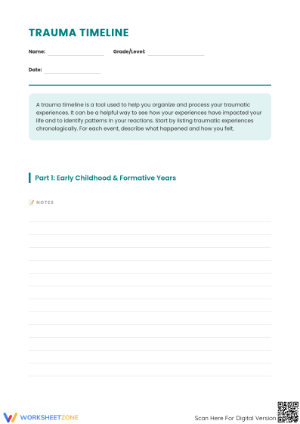
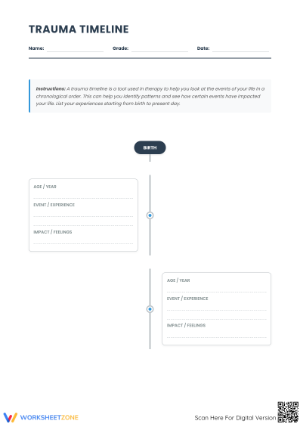
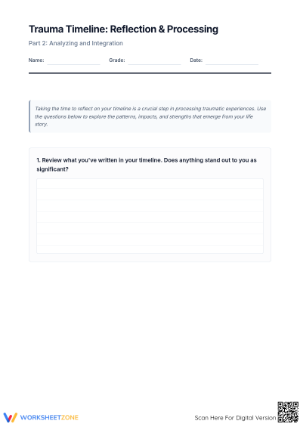
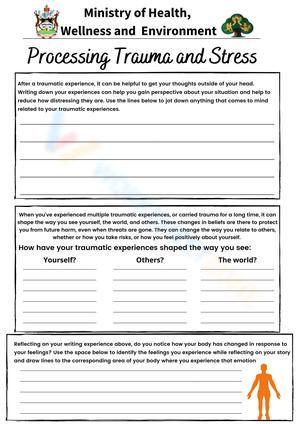
These trauma timeline worksheets printable for 10th grade come in three distinct visual formats — a river-of-life layout, a peaks-and-valleys chart, and a structured linear timeline — with each format pairing chronological event mapping to explicit prompts for identifying coping strategies, support figures, and personal strengths. The set belongs in SEL classes, advisory periods, and school counseling sessions, though English teachers running memoir or personal narrative units reach for them regularly too. Each worksheet also includes a "future markers" section that asks students to place goals and aspirations on the timeline beyond the present day, turning the activity from retrospective only into genuinely forward-looking work.
What Each Worksheet Contains
The full set of trauma timeline worksheets printable for 10th grade covers several distinct reflective skills within each format. Students sequence significant life events chronologically, then annotate each event using structured prompts: What did you feel? Who showed up for you? What did you do to keep going? That third prompt is the one teachers skip past at their own cost — it surfaces coping strategies students have already used but rarely named, and naming them is where the strength-identification work actually happens. The future-markers section asks students to place two or three projected goals or hoped-for relationships on the timeline beyond the current date, giving abstract goal-setting a spatial location on the page.
The three formats are not interchangeable. The river layout tends to feel less clinical and works more readily with students who resist anything that resembles a structured academic assignment. The peaks-and-valleys chart maps events on a rise-and-fall graph and appeals to students who think visually about contrast and pattern. The linear timeline uses a horizontal format with defined annotation fields, and it works best for students who need clear containment and visible structure before they will engage with emotionally demanding content.
Why the Timeline Format Works at This Grade Level
Tenth grade sits at a productive intersection for this kind of work. Students have accumulated enough lived experience — five to six years of clear autobiographical memory, often including transitions, losses, and significant relationships — to trace genuine patterns across time. Their metacognitive capacity has also developed to the point where retrospective analysis is not just possible but actively interesting to them. The identity questions that dominate this developmental period, particularly around who they are becoming and what past experiences have shaped them, map directly onto what a timeline asks students to do. The visual structure externalizes internal experience, which reduces the cognitive demand of holding years of emotional history in working memory while simultaneously reflecting on it.
For students who struggle with verbal or written expression, the spatial task of placing events along a river or marking peaks on a graph is accessible in a way that an open-ended prompt rarely is. The placement comes first; the writing comes second. That ordering opens the activity for students who would otherwise produce a blank page.
How to Build These Worksheets Into Your Lesson Plans
The most effective classroom sequence uses two days rather than one. Day one opens with a whole-class discussion about how past experiences shape identity, followed by a modeled walkthrough using a fictional character the class already knows — a novel protagonist, a historical figure, not a personal teacher disclosure. Students who encounter the timeline cold, without any prior discussion of what belongs on it or how specific to get, tend to produce flat event lists without emotional annotation. The model gives them a concrete reference point for the level of reflection the prompts require.
Day two is the worksheet session. Before distributing, teach one grounding technique — the 5-4-3-2-1 sensory method works well and takes under three minutes — so students have a self-regulation tool available if a memory surfaces that catches them off guard. Build in a cool-down period after completion: five to eight minutes of quiet journaling or a low-demand creative task. Moving directly from this kind of reflection into a high-stakes academic task undercuts the processing time students need. Post the school counselor's name and room number visibly before the session starts; this signals available support without requiring an announcement that draws attention to the topic mid-activity.
Student Response Patterns Worth Anticipating
The most consistent pattern in classrooms: students treat the worksheet as a biographical exercise rather than a reflective one. They write what happened without annotating how they felt, who helped, or what internal resources they drew on. The annotation prompts address this directly, but students whose academic identities are built around factual precision — those who are strong in history or science, in particular — resist open-ended emotional prompts and default to event summaries. A brief explicit statement before distributing helps: "Some of you will write only what happened. The prompts are asking for something different — what you felt and who showed up for you matters as much as the event itself." Most students receive that framing and use the prompts as intended.
The future-markers section produces its own diagnostic information. Students who leave it entirely blank are not always being avoidant — some genuinely struggle with the concept of personal agency over their own future, which is itself worth noting. Students who complete it exclusively with external benchmarks ("graduate high school," "get a job") without any relational or internal markers are worth a quiet follow-up conversation. Neither response is a failure to complete the worksheet correctly; both are things the worksheet surfaces that a standard writing prompt would not.
Standard Alignment
These worksheets address two CASEL core competencies in tandem. Under self-awareness, the timeline structure develops students' ability to identify their emotions accurately, recognize how their experiences connect to their current values and behavior, and articulate personal strengths — all named elements of CASEL's self-awareness domain at the high school level. Under self-management, the coping-strategy annotation and the future-markers extension address goal-setting, the use of planning strategies, and students' recognition of stress-management approaches they have already used successfully. These connections are built into the prompt structure, not added on after the fact.
States with adopted SEL standards typically map those standards to CASEL competencies, so teachers in those states can identify applicable state-level codes. The trauma timeline worksheets printable for 10th grade fit this grade level specifically because CASEL's developmental framework identifies high school as the stage for deepening self-knowledge and constructing a coherent personal narrative — precisely the work these worksheets structure through visual mapping, strength identification, and forward projection.
Adjusting the Worksheets for Students at Different Points of Readiness
The trauma timeline worksheets printable for 10th grade adapt across a wider readiness range than the three formats might initially suggest. Students with significant trauma histories sometimes find the river-of-life and peaks-and-valleys layouts visually overwhelming when the timeline spans their full life — seeing the arc of a difficult history laid out spatially can amplify distress rather than reduce it. For those students, narrowing the scope to the last two or three years brings the same reflective structure with a smaller emotional footprint. The linear format with defined event fields also works better for students who need containment; the spatial openness of the river layout can feel unmanageable when the history being mapped is genuinely heavy.
Students who are emotionally ready for more depth benefit from two extension options: using a second color to mark how their understanding of a past event has shifted over time, or writing a short letter to their past self at one marked point. For students who resist writing entirely, the river-of-life format accepts drawings and symbols in place of written annotations — the spatial act of placing events along the path still activates the reflective process even without prose. Teachers working with English language learners often pair each worksheet with a translated list of strength and emotion words so that annotation prompts don't stall on vocabulary access.
Frequently Asked Questions
Are students expected to share their completed timelines with the class?
No. The reflective value of this activity lies in the individual process of construction, not in disclosure. If a student wants to share a strength or insight they discovered, that is worth welcoming, but requiring any display of the timeline itself runs counter to the trauma-informed principles the activity is built on. Students should know before they begin that what they put on the page is private.
What should a teacher do if a student discloses serious trauma during the worksheet activity?
Follow the school's standard safeguarding protocol — the same one that governs any disclosure, whether it surfaces through a worksheet, a journal entry, or a conversation. These worksheets create conditions where a student may feel safe enough to surface something they have been carrying; they do not create a different category of disclosure. Teachers who use this set regularly brief the school counselor before the lesson so a referral pathway is already warm rather than being arranged in the moment.
How does the activity work for students who say nothing significant has ever happened to them?
This comes up in most classrooms and usually reflects one of three things: the student is accurately reporting a stable history, the student is protecting themselves from the activity's emotional demands, or the student has normalized experiences they haven't yet recognized as meaningful. The strength-identification prompts have traction regardless of event weight. A student who writes that nothing difficult has happened can still name a moment they felt genuinely capable, someone who consistently showed up for them, or a skill they built over time. The worksheet works without trauma content.
Clear All