These dear man worksheets printable for 10th grade give teachers a concrete framework for teaching interpersonal effectiveness — a skill that rarely receives explicit classroom instruction even in schools with active SEL programs. Built on the DBT acronym Describe, Express, Assert, Reinforce, Mindful, Appear confident, Negotiate, each worksheet translates a therapy-informed communication sequence into situations a 15-year-old actually encounters: unequal group project work, a rumor spreading through a friend group, or a conversation with a teacher about missed instruction.
What Each Worksheet Asks Students to Do
The set targets a specific slice of communication: making a request, holding a limit, or addressing conflict while keeping both the relationship and self-respect intact. Students draft actual language for a real situation — not a hypothetical lifted from a textbook. Each worksheet includes the following components:
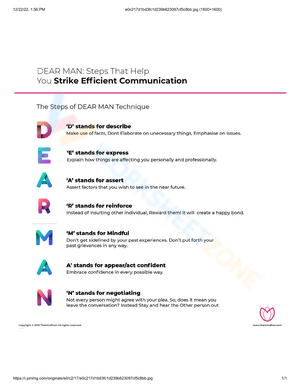
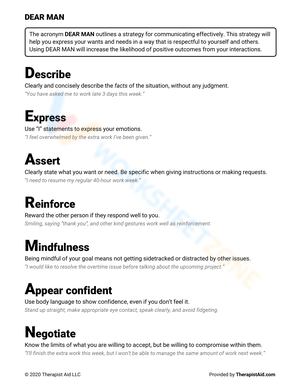
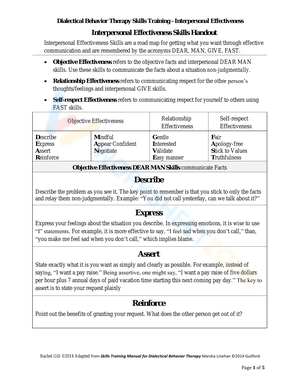
- A quick-reference guide defining each step of the acronym
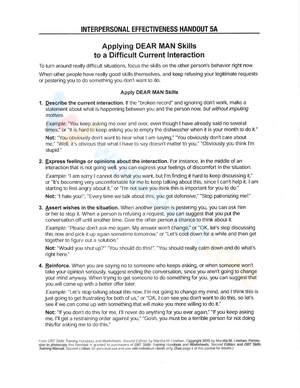
- A model script showing how the seven parts connect in natural student language
- A realistic scenario drawn from Grade 10 contexts — group project tension, a peer conflict, a teacher communication about missed credit
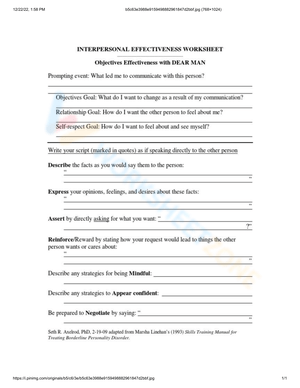
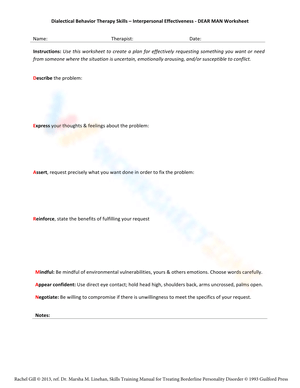
- A drafting space where students write each step before assembling the full script
- Reflection questions focused on tone, word choice, and how to handle anticipated pushback
The reflection section is where learning tends to consolidate. Students who draft confidently in the writing phase often discover, during reflection, that their Assert line is too vague — "I want things to improve" rather than "I'm asking you to complete the opening section of the group report by Thursday so we can combine drafts before the presentation."
Why 10th Grade Is the Right Moment for This Skill
By sophomore year, students carry stronger opinions, more complex peer dynamics, and higher emotional stakes in social situations — but many still lack the vocabulary to turn a feeling into a clear, specific request without escalating. DEAR MAN addresses that gap directly. The step-by-step format functions as a working memory support: instead of holding the entire conversation in their heads while managing anxiety, students can work through one move at a time.
The distinction between Describe and Express is the most developmentally useful lesson in the set. Tenth graders routinely collapse fact and feeling — "she's been ignoring me" (a judgment) instead of "she hasn't responded to any of my messages this week" (an observable event). That separation between what happened and how it felt is genuinely difficult at this age, and the worksheet structure makes the distinction visible in a way that a general class discussion about communication rarely achieves.
Fitting These Worksheets Into Your Week
These worksheets work in advisory, health, and SEL blocks, and they fit comfortably in any 35–45 minute period when paired with a brief teacher model. The most efficient structure: introduce the acronym with one projected example in the first five minutes, hand out the worksheet for independent drafting (10–12 minutes), run a partner read-aloud or short role-play (8–10 minutes), and close with the reflection questions. The full cycle fits within a single period.
The partner read-aloud step is worth protecting. When students hear their own Assert line spoken aloud, they catch problems their eyes missed on paper — a tone that reads angrier than intended, or a Reinforce step framed as a threat ("if you don't change this, I'll tell the teacher") rather than a genuine mutual benefit. That moment of hearing the words tends to produce more useful revision than written feedback alone.
Teachers using dear man worksheets printable for 10th grade in advisory blocks often run the initial draft one day and the revision and reflection the following session, giving students enough distance to return to their script with a clearer eye. After role-play, narrow the revision task to one line rather than the entire draft: ask students to tighten either the Describe or Assert step. That constraint demonstrates that small, precise changes in wording are what actually shift the tone of a conversation.
Student Error Patterns Worth Knowing Before You Hand These Out
The most consistent problem isn't incomplete drafts — it's the Assert line landing as a complaint rather than a request. Students write "you never contribute to the project" (an accusation) when the step calls for something like "I'm asking you to finish the data section by Wednesday so we can combine our work before the deadline." The distinction between expressing frustration and naming a specific, actionable ask is one most students need to hear modeled two or three times before it becomes instinctive.
A second recurring pattern: students write the Reinforce step as a consequence — "or else I'll have to tell the teacher" — rather than framing it as a mutual benefit: "that way we both go into the presentation feeling prepared." This signals that they've grasped the structure at a surface level but haven't yet understood that Reinforce is about shared gain, not an implied punishment. Showing a contrast example before students draft reduces this error reliably.
The Mindful step generates consistent confusion. Students read "stay focused" and treat it as an attitude — staying calm — so they sometimes skip it entirely. Clarifying that Mindful means actively redirecting the conversation back to the original request when the other person deflects, changes the subject, or escalates — and modeling a two-line redirect in front of the class — helps students recognize this as a concrete conversational move, not a passive state of mind.
Differentiating These Worksheets Across Student Readiness Levels
Students who freeze at a blank page benefit from sentence starters attached to each letter: "When [specific event] happened..." for Describe, "I felt..." for Express, "I'm asking you to..." for Assert. Those language frames cut down on avoidance without removing the cognitive work of forming the student's own ideas.
Students who complete the basic draft quickly can take on a comparison task: write both a reactive response — the first thing that comes to mind — and a DEAR MAN response, then analyze which outcome each is more likely to produce. This extension builds the metacognitive layer: understanding not just how to apply the structure but why it tends to produce better outcomes than the reactive alternative. For small-group counseling settings, the same worksheets support repeated practice across multiple sessions, with body language and vocal tone introduced once the verbal script feels stable. Keeping language and delivery as separate variables prevents students from feeling overwhelmed at the outset.
Standard Alignment
These worksheets align with CASEL's Relationship Skills competency, specifically the expectation that students communicate clearly, listen actively, and resolve conflict constructively. At the 10th-grade level, most state SEL frameworks expect students to demonstrate assertive communication across social, academic, and family contexts — precisely the range these scenario prompts address. Schools implementing PBIS-aligned behavior systems can position the worksheets as explicit instruction in prosocial communication, reinforcing the behavioral expectations already present in the classroom environment.
Frequently Asked Questions
Is DEAR MAN appropriate for a general classroom, or does it belong in counseling?
It fits comfortably in classroom SEL, health, or advisory settings. The framing matters: present each worksheet as a communication planning tool for everyday school situations, not as therapeutic intervention. When scenarios are academic and social — unequal group project work, a conversation with a teacher about a missed assignment, a peer conflict over information shared without permission — the lesson reads as communication skills instruction, which is exactly what it is. If a student uses the worksheet to surface a more serious personal concern, follow your school's standard support procedures.
How does DEAR MAN differ from a standard assertive communication activity?
Most assertive communication pages ask students to use "I" statements or practice calm disagreement and stop there. DEAR MAN gives students a seven-step repeatable sequence for making a request, setting a limit, or managing pushback. That sequence is what makes the structure transferable: a student who internalizes it can apply the same mental checklist to a group project conflict, a conversation with a caregiver, and a social media boundary. The dear man worksheets printable for 10th grade in this set build toward that transferability — every scenario asks students to identify specifically where in the sequence their communication tends to break down.
What if a student refuses to engage with the assigned scenario?
That resistance usually signals the scenario doesn't feel real enough. Let the student substitute a situation they are actually navigating — something recent or ongoing — and apply the structure to that instead. Students who rewrite the prompt almost always produce stronger, more specific Assert lines than they would have with a teacher-assigned situation. If the substituted scenario is too personal for group sharing, the student keeps that draft private and writes a second, more neutral version for the class debrief.
Can these worksheets serve as a formative assessment?
The completed script and reflection questions together make a workable formative check on communication skills. Look at whether the Describe line is factual rather than evaluative, whether the Assert line names a specific and actionable request, and whether the Reinforce step frames a mutual benefit rather than an implied consequence. Those three elements provide a clear, observable standard to assess against. Dear man worksheets printable for 10th grade are less suited to summative assessment — the skill is better evaluated through observed role-play or a brief teacher-student conference than through a written document alone.












 Interactive Worksheet Maker
 Quiz Maker
 Word Search Maker
 Crossword Puzzle Maker
 Word Scramble Generator
 Sentence Scramble Generator
 Handwriting Worksheet Generator
 Name Tracing Generator
 Fill In The Blank Generator