DBT Chain Analysis Worksheets Printable for 10th Grade
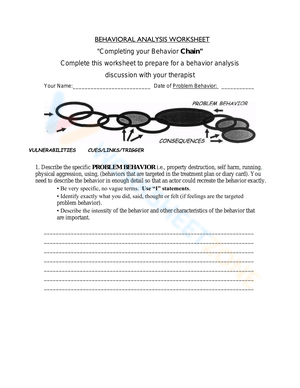
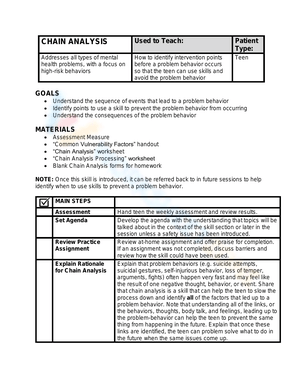
These dbt chain analysis worksheets printable for 10th grade give school counselors and SEL teachers a structured format for breaking one behavioral event into its component links — from pre-existing vulnerability conditions through the triggering moment, internal reactions, the behavior itself, and both immediate and delayed consequences. Each worksheet focuses on a single event, which keeps students from the scattered, generalized self-criticism that makes behavioral reflection feel like punishment rather than skill practice.
What Each Worksheet Targets
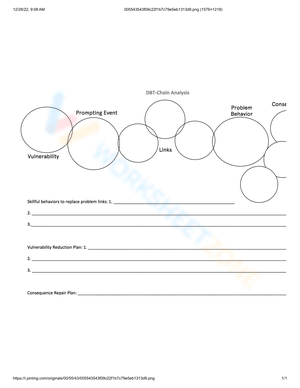
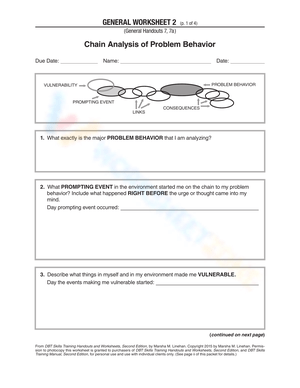
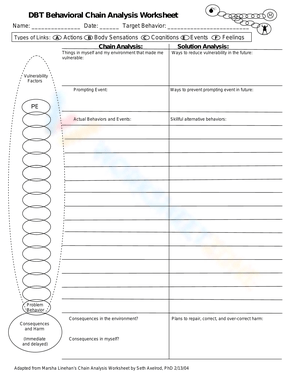
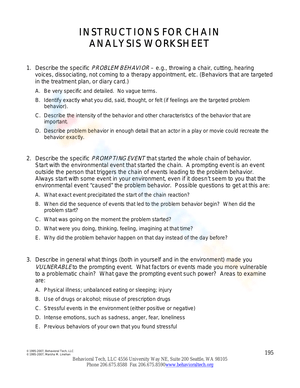
The set works through the full behavior chain in distinct, labeled sections. Students begin by identifying vulnerability factors — the conditions present before anything went wrong: sleep deficit, hunger, unresolved conflict from earlier in the day, or the cumulative weight of a heavy exam week. For 10th graders, these pre-conditions matter enormously because fifteen- and sixteen-year-olds are often convinced their reactions are spontaneous rather than the product of a depleted emotional baseline. Naming those conditions explicitly reframes self-regulation as something they can influence before a trigger even appears.
From there, students name the prompting event with precision. One of the most useful exercises in the set asks students to write the prompting event in one sentence, then check whether they've described an external event — something that actually happened — or slipped into an interpretation. That distinction between "she didn't reply to my text for two hours" and "she was ignoring me on purpose" is often the first time students see their own inference-making at work.
Internal links — the thoughts, emotions, and physical sensations that fall between the trigger and the behavior — get their own section with chronological ordering. Students mark each item as a thought, a feeling, or a physical sensation, because conflating these three produces fuzzy chains that don't support concrete skill practice. The behavior section asks for a precise, judgment-free description of the action, and the consequences section separates what happened in the next ten minutes from what happened over the following days, surfacing the short-term relief / long-term cost pattern that drives most of the behaviors students actually want to change.
Mistakes Students Make That These Worksheets Help You Catch
The most consistent error at this grade level is writing the prompting event too broadly. A student who had a conflict with a friend will write "bad day at school" as the trigger — which is an outcome summary, not an event. Pressing them to identify the specific moment ("she said I was being dramatic in front of the whole lunch table at 12:15") creates a workable chain. Without that specificity, the worksheet stays vague and the repair points students identify later are equally vague: "be calmer" instead of "walk away before I respond."
A second consistent problem is collapsing internal links. Students jump from "I was triggered" directly to "I yelled," with nothing in between. The structured columns push them to slow that sequence down, but many students initially fill those columns backward — they remember the emotion that peaked right before the behavior and miss the three or four internal steps that preceded it. Asking students to write the behavior first, then work backwards link by link, often surfaces thoughts they didn't realize they'd had.
Some students also list consequences that are really vulnerability factors for the next event. "I felt guilty afterward" belongs in consequences; "now I was in a bad mood the next morning" is the start of a new chain. Making that distinction explicit early saves real confusion when students begin using the worksheet to plan behavioral changes.
Building These Worksheets Into Your Counseling and Classroom Routine
The most effective entry point is not a student's hardest behavioral event — it's a low-stakes scenario the whole class or small group can map together. A teacher modeling a chain analysis on a non-threatening event (forgetting gym clothes, arriving late because of a locker jam) demonstrates the process without exposing anyone's real vulnerabilities. After one full shared model, students are ready to attempt their own with considerably less resistance.
Using dbt chain analysis worksheets printable for 10th grade for positive behavior analysis early in the unit builds student trust in the format. Walking through a time they handled something well — stayed composed during an unfair grade dispute, talked a peer down from an escalating argument — lets students see that the chain works in both directions and that they already carry productive links in their behavioral repertoire. A student who only ever uses the worksheet after an incident associates it with failure; a student who has also used it to study a success associates it with self-knowledge.
In counseling sessions, one worksheet per session is enough for most students early in the process. The cognitive work of reconstructing an event in sequence — without defending, minimizing, or spinning — is genuinely demanding. In classroom SEL blocks, weekly practice with neutral or positive examples builds proficiency so that when students eventually bring a real crisis to the format, the mechanics are already automatic.
Standard Alignment
These worksheets connect directly to the CASEL framework's self-awareness and self-management competencies. Within self-awareness, accurately labeling emotions and recognizing how one's own thoughts influence subsequent feelings and behavior is practiced explicitly in the internal links section. Within self-management, identifying impulse control opportunities — the repair points embedded in the chain — aligns with CASEL's language around demonstrating personal agency and using planning and organizational skills. Districts using CASEL as their documented SEL standards framework will find these worksheets a natural fit for 9th–10th grade SEL instruction. The worksheets also support the broader CASEL goal of responsible decision-making by training students to examine the actual mechanics of their choices rather than simply labeling behavior as good or bad after the fact.
Differentiating These Worksheets Across Student Readiness Levels
For students new to behavioral self-reflection, the most practical adjustment is reducing the number of internal links they're expected to identify in their first few attempts. Asking a student to find one thought, one emotion, and one physical sensation — rather than filling every row of the internal links column — keeps the cognitive load manageable without changing the structure of the chain. Students who complete the full chain consistently can be pushed toward a more refined task: identifying the earliest repair point in the sequence, which requires a more precise understanding of causality than simply listing links in order.
Students further along in DBT skill practice benefit from a second worksheet that examines the same event from the perspective of another person involved — tracing how the behavior affected that person's subsequent chain. This extension requires perspective-taking that most 10th graders find genuinely difficult and produces the most substantive discussions about interpersonal impact.
For students who struggle with written expression, allowing them to use abbreviated notes, symbols, or a spoken draft before transcribing key terms into the columns respects processing differences without changing what the skill demands. The goal is the behavioral mapping, not the handwriting.
Frequently Asked Questions
How do you introduce chain analysis without making students feel they're being analyzed for misbehavior?
Framing matters more than the worksheet itself. Presenting chain analysis as "how your brain actually processes events" — rather than "why you got in trouble" — changes the room. Leading with a positive behavior example before anyone uses the worksheet on a difficult event lets students experience the format as a tool for self-understanding rather than a disciplinary record.
What do you do when a student's chain analysis surfaces a serious mental health concern?
Any worksheet that surfaces content related to self-harm, abuse, or crisis — whether in the vulnerability factors, the internal links, or the consequences — follows your school's standard reporting and intervention protocols. These materials are SEL instructional resources, not clinical instruments, and they work best within a structure where a trained counselor reviews student responses in individual or small-group contexts.
Can these worksheets be used in a general education classroom, or are they only appropriate for counseling settings?
The dbt chain analysis worksheets printable for 10th grade work in both settings, though the facilitation approach differs. In a counseling context, the focus is on the individual student's actual event. In a general education SEL class, using fictional or shared scenarios keeps the work instructional and removes the pressure of personal disclosure. Both uses build the same underlying skill — the classroom version simply operates at lower emotional intensity.
How do you handle students who say they can't remember the sequence well enough to complete the worksheet?
Memory reconstruction is a real obstacle. Two adjustments help: completing the worksheet close in time to the event — within a few hours rather than a day later — and prompting with specific sensory anchors ("where were you standing, what could you hear, what were you thinking right before?"). Those prompts typically draw out more detail than asking students to narrate abstractly. For recurring behaviors, a composite chain built from several similar events often produces more accurate internal links than any single memory would.
Where do these worksheets fit within a broader SEL curriculum sequence?
The dbt chain analysis worksheets printable for 10th grade belong after students have developed basic emotional vocabulary and can distinguish thoughts from feelings — skills typically addressed in earlier grades or in foundational SEL units. Introducing chain analysis before students can accurately label their internal states produces chains with "I felt bad" in every link, which doesn't give them enough specificity to identify repair points. Once emotion identification is solid, chain analysis becomes the natural next layer of self-awareness work.
Clear All