10th Grade Boundaries Worksheets for Healthy Relationships
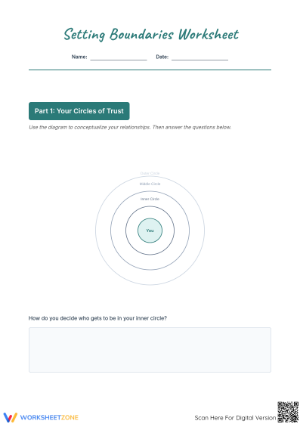
These 10th grade boundaries worksheets give health educators and school counselors structured, scenario-driven tools for one of the most underserved conversations in secondary SEL: the gap between recognizing that a limit has been crossed and actually saying something about it. The set covers personal, emotional, and digital limits across relationship contexts genuinely relevant to 15- and 16-year-olds — peer friendships, romantic relationships, and family dynamics — using formats that require students to write, analyze, and respond rather than simply read and check boxes.
What Students Practice
Each worksheet targets a distinct skill within the broader arc of what educators sometimes call boundary literacy. Taken together, the set builds from awareness to analysis to active communication:
- Categorizing limit types — Students sort scenario examples into physical, emotional, intellectual, material, and digital categories before identifying limits of their own. The sorting step forces precision; students who believe they understand the categories frequently discover they have been conflating emotional and intellectual limits.
- Constructing "I statements" — A fill-in template moves students through three required components: the feeling, the specific behavior triggering it, and the change being requested. The structure is intentionally rigid at the practice stage.
- Analyzing peer and romantic scenarios — Students read a brief scenario, identify the violation type, and write an assertive response. The scenarios progress in complexity, starting with lower-stakes peer situations and moving toward romantic dynamics where students are more likely to rationalize or go silent.
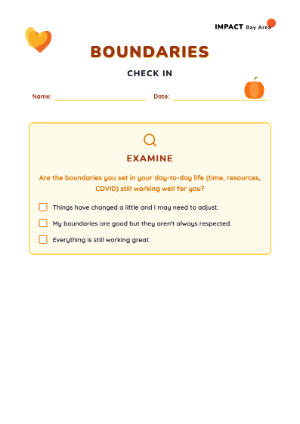
- Evaluating relationship health — A checklist-based worksheet asks students to assess a relationship across multiple dimensions rather than a single incident, which discourages the common move of dismissing a pattern because no individual moment felt severe enough to name.
- Drafting personal digital rules — Students produce a short written document covering response-time expectations, photo-sharing consent, and password privacy — something they can keep and return to when the social pressure feels real.
Why This Format Works for Tenth Graders Specifically
Students at this age have enough abstract reasoning capacity to evaluate hypothetical situations thoughtfully, but in-the-moment emotional activation still overrides that reasoning when they are actually inside a conflict. Scenario analysis works precisely because it separates the cognitive task from the emotional charge. When a student reads about a fictional peer whose partner demands access to their phone, they analyze the situation and write a response without any social stakes attached. That written response becomes a reference point for the real conversation later — not a guarantee, but a rehearsed position to draw on.
The "I statement" template format addresses a related developmental pattern. Adolescent communication defaults toward either passivity ("it's fine, whatever") or blame ("you always do this"). The three-part structure — feeling, behavior, request — interrupts both defaults by requiring a specific construction. Students who do this kind of structured writing practice before any discussion produce noticeably more regulated responses during partner role-play than students who receive only verbal instruction on the same content. The writing does cognitive work that talk alone does not replicate.
Where Students Go Wrong — and Why the Distinction Matters
The most persistent error in this work is students equating assertiveness with aggression. When asked to write what they would say to a friend who keeps borrowing money without paying it back, a typical first draft reads: "Stop asking me for money or I'm done with you." That is an ultimatum, not a limit. The structural distinction is this: a limit describes what the speaker will do, while an ultimatum dictates what the other person must do. "I'm not able to lend money right now" is different in kind from "you need to stop asking." Students do not arrive at that difference independently — it needs to be named explicitly and practiced through revision cycles, which is why the "I statement" worksheets include both a first-draft field and a revision step rather than a single response field.
A second consistent pattern involves digital limits. Students readily accept that sharing a phone passcode is optional among friends, but shift position when the same scenario involves a romantic partner. At this age, the cultural script closely associates intimacy with total transparency, so a student who understands digital privacy in the abstract will still write — when the scenario involves a boyfriend or girlfriend — that refusing to share a password "sends the wrong message." That response is not ignorance; it is a genuine values conflict. The worksheets address it directly by separating the concept of trust from the concept of access, a distinction that takes more than one conversation to stick.
Where These Worksheets Fit in a Health or Advisory Block
The scenario analysis and relationship evaluation worksheets work well as standalone activities during advisory periods — they run in about 20 minutes without requiring prior instruction, which makes them practical for counselors dropping into homeroom blocks. The "I statement" worksheet runs better across two sessions: day one for drafting, day two for partner read-aloud practice. That read-aloud step is worth protecting in your lesson plan. Students who only write their statements rarely transfer the language to live situations; saying a limit out loud, even in a low-stakes classroom pairing, is a different cognitive and physical task than writing it, and the transition between the two is where most students stall.
These 10th grade boundaries worksheets also function as private reflection tools in counseling contexts. Not every student is positioned to share in a group discussion, and the content here is personal enough that forcing whole-class disclosure can backfire. Building in an option to complete a worksheet independently and submit it for private written feedback keeps every student in the work without requiring them to go public with experiences they may not be ready to name.
Standard Alignment
These 10th grade boundaries worksheets align with two National Health Education Standards. NHES Standard 4 (grades 9–12) addresses interpersonal communication skills for health enhancement; the assertive communication and "I statement" worksheets meet this standard directly by requiring students to construct and practice specific language for navigating health-related interpersonal situations. NHES Standard 7 (grades 9–12) covers health-enhancing behaviors and self-management, which encompasses the personal digital rules worksheet and the relationship evaluation checklist.
Within the CASEL framework, the set targets Relationship Skills (communicating clearly, setting limits, negotiating conflict) and Self-Awareness (identifying personal values, recognizing how feelings influence behavior). CASEL positions these competencies as foundational at the secondary level because high schoolers are actively constructing the relational patterns they will carry into adulthood. Tenth grade sits at a particularly meaningful instructional point: students are old enough to engage the concepts with real nuance, and the habits are still forming.
Supporting Different Readiness Levels With This Set
Students who process abstract social concepts more slowly often benefit from having the scenario worksheets read aloud in pairs before writing independently. The scenario text is not linguistically demanding, but students who struggle with reading fluency spend working memory on decoding rather than analysis, which produces thin responses. Reading aloud first frees attention for the actual thinking task.
Students who are ready for more demanding work find the relationship evaluation checklist more challenging when they generate their own assessment criteria from scratch rather than rating the provided items. Producing the criteria for a healthy relationship — rather than applying someone else's — requires them to articulate and defend a position, which is a higher-order application of the same concept. A further extension: assign a small group to draft a "peer guide to digital limits" addressed to incoming 9th graders. That reframing forces them to explain their reasoning in a way the standard worksheet format does not demand.
Frequently Asked Questions
Can these worksheets be used in a small-group counseling setting rather than a full class?
Yes, and small groups are often the stronger context for this content. Groups of four to six students allow for more candid conversation around the scenarios than a 30-person health class typically permits. The scenario analysis and relationship evaluation worksheets need no adaptation for small groups. The "I statement" worksheet benefits from the partner read-aloud step, which a small group makes easy to facilitate within the time available.
What do I do if a student discloses something serious while completing one of these worksheets?
This content — relationship patterns, digital pressure, personal limits — surfaces real disclosures. Build a private submission option into any worksheet where students are reflecting on their own relationships. A brief note at the bottom of each worksheet indicating that students may speak with you privately provides a low-barrier path forward without requiring public disclosure. Follow your school's mandatory reporting protocols if a disclosure indicates harm or abuse; the worksheet is not a substitute for a referral conversation.
Are these worksheets appropriate for a health class where students have had no prior SEL instruction?
The set does not assume prior SEL vocabulary, but it does assume students can name basic emotions and have some familiarity with the word "boundaries" in a general sense — a bar most 10th graders easily clear. For classes where the concept is entirely new, ten minutes of whole-class discussion before distributing the categorization worksheet gives students enough grounding to work independently. These 10th grade boundaries worksheets treat boundary-setting as the lesson's central focus; they work best in that role rather than as a brief detour inside a larger unit on something else.
Clear All