Boundaries circle pdf worksheets for 10th grade give teachers a structured way to move the relationship-boundaries conversation past vague vocabulary and into decisions students actually face — who gets access to personal news, who can text after midnight, what kinds of touch are welcome in a given context. Each worksheet presents that sorting work visually and ties it to realistic teen scenarios. The result is a lesson that feels relevant rather than prescribed.
What the Worksheets Ask Students to Do
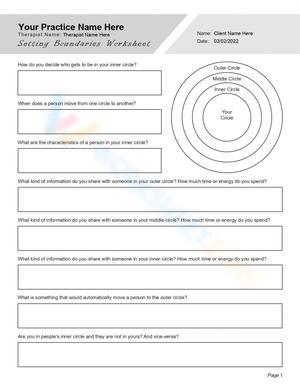
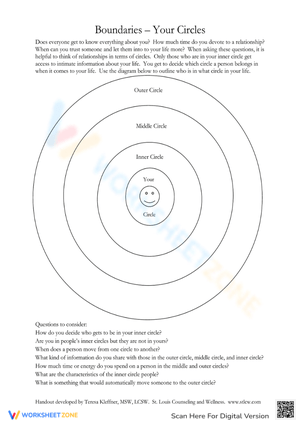
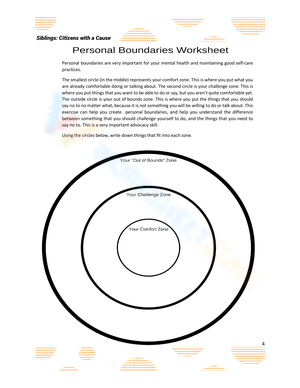
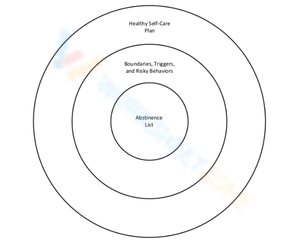
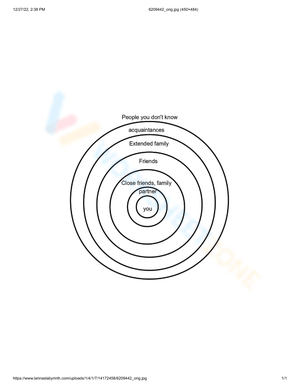
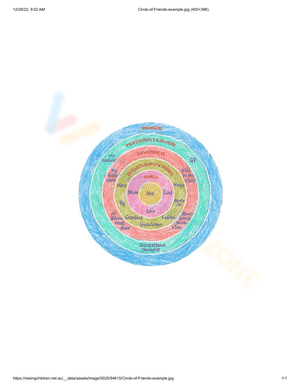
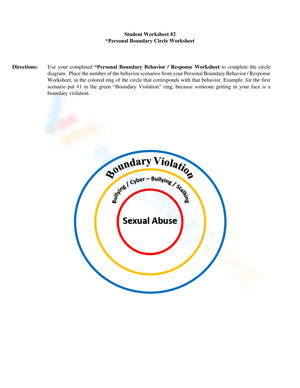
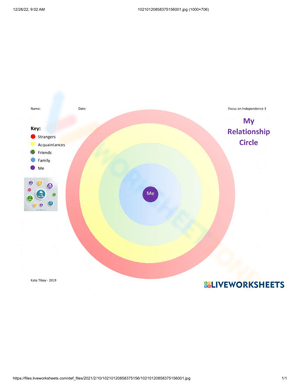
The core task across each worksheet is a relationship-circle sort. Students place people — close friend, sibling, dating partner, classmate, coach, manager, online contact — into concentric rings based on closeness and trust, then answer behavior-specific questions for each ring. Once students map out who belongs where, the real work begins: deciding what kinds of access each person should have. The worksheet raises questions such as:
- Who can know private feelings or recent personal news
- Who can contact you at any hour without it feeling intrusive
- What kinds of touch feel welcome, unwanted, or situational depending on setting
- What conversations belong in person versus in a group chat or a post
Beyond the sorting task, each worksheet asks students to analyze short scenarios. A partner demanding a phone password, a classmate posting someone else's photo without asking, a coworker pressing for personal information — students mark whether each situation respects a boundary, crosses one, or needs a direct conversation to clarify. The shift from labeling to reasoning is where the real learning happens.
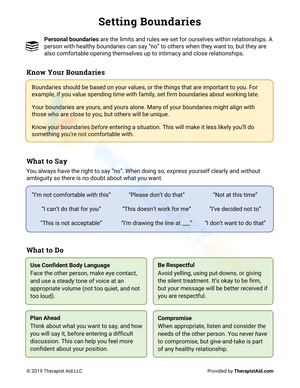
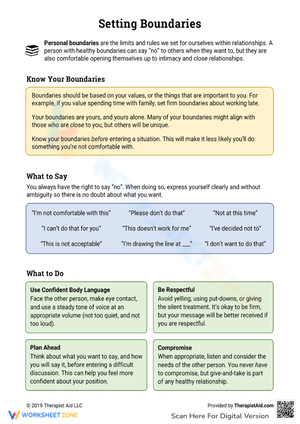
A third format in the set uses sentence-completion prompts: I feel respected when..., A sign that I need a boundary is..., One way to say no clearly is.... These short responses turn abstract concepts into working language students can take into real conversations, not just fill in during a lesson.
Why This Topic Belongs in Tenth Grade, Not Earlier
Younger students benefit from personal-space lessons and simple rules. Tenth graders are managing something harder: situations where the right answer isn't obvious, where someone they genuinely like is still crossing a line, where social media creates gray zones that require judgment rather than rule-following. They are also old enough to reflect on their own behavior as potential boundary-crossers, not only as people protecting themselves from others.
That developmental shift makes this the right moment for the circles model. It gives students a repeatable framework for thinking through mixed situations — not a rule to memorize, but a lens to apply. The visual format reduces cognitive load on a topic that is already emotionally charged; students can sort a scenario into the model before they have to articulate why it feels wrong. Boundaries circle pdf worksheets for 10th grade also connect directly to the SEL competencies students at this grade are expected to demonstrate: recognizing their own emotional responses in social situations, managing those reactions, and making responsible choices in relationship contexts.
Mistakes Students Make That These Worksheets Help Surface
The most consistent error isn't placing the wrong person in the wrong ring — it's collapsing the distinction between caring about someone and giving them unlimited access. A student will place a dating partner in the inner circle across every category — private information, late-night texting, unsupervised location sharing, physical contact — as though emotional closeness eliminates the need for any limit. That belief is worth addressing directly, because it maps onto real dynamics that lead to confusion or coercion.
A related pattern: students treat boundaries as rejections. When a scenario asks whether a friend texting at midnight is appropriate, some students write "it depends — I don't want to hurt their feelings." They understand the concept intellectually but won't apply it because they've absorbed the idea that saying no damages a relationship. Naming that confusion explicitly during discussion usually unlocks more honest written responses.
Online scenarios produce a specific blind spot. Students who handle physical and emotional boundary concepts clearly will still mark "fine" next to scenarios involving tagging someone without permission, screenshotting a private message, or posting another person's location. The digital space feels separate from relationship rules to many tenth graders, so those scenarios need the most discussion time of any format in the set.
Building These Worksheets Into a Lesson That Actually Moves
Start not with the worksheet but with two minutes of neutral framing: boundaries exist in every relationship — between teachers and students, between teammates, between classmates and close friends. That framing takes the personal heat off before anyone picks up a pencil. Tenth graders are more likely to engage seriously when the topic isn't introduced as something only certain students need to hear.
An 8-minute mini-lesson on the circle model gives students enough language to work independently. Cover inner, middle, and outer rings with examples that are clearly about teens but clearly not about any individual in the room. Then release students to the sorting or scenario worksheet while circulating to listen. The exit task — one boundary statement written in their own words — functions as a quick formative check on whether the concept moved from abstract to usable.
Boundaries circle pdf worksheets for 10th grade fit this sequence naturally because the format already builds in stages: visual organizer first, scenario analysis second, reflection prompt third. In advisory or counseling settings, spreading the sequence across two sessions works better — first session for the sorting task, second session for scenario discussion. That pacing gives students time to sit with the model before they're asked to evaluate ambiguous situations.
Standard Alignment
These worksheets align with three of the eight National Health Education Standards (NHES). NHES Standard 2 — analyzing how peers, family, culture, and media influence health behavior — applies when students examine social pressure in the scenario analysis. NHES Standard 4 — using interpersonal communication skills to enhance health and reduce risk — is addressed directly by the boundary-statement reflection prompts. NHES Standard 5 — applying decision-making skills to health choices — runs through every activity in the set. At the high school level, NHES performance indicators expect students to evaluate how relationships affect health decisions, which is precisely what the circle model asks students to do in a structured, repeatable format.
Adjusting the Worksheets Across Different Comfort Levels and Support Needs
For students who freeze at open-ended prompts, a word bank of relationship categories and boundary-related vocabulary — trust, access, privacy, pressure, limits — combined with sentence frames like "In this situation, I would..." gives enough structure to start writing without removing the thinking. The goal is to reduce the language barrier, not to simplify the conceptual task.
For students ready to go further, the strongest extension is a question the basic format doesn't raise: how does a boundary shift over time in a relationship? A new friendship and a three-year friendship may look identical on a circle diagram, but trust changes — and sometimes breaks and rebuilds. Asking students to trace that movement in writing produces more sophisticated responses and connects to dynamics they're already navigating outside the classroom.
One honest limitation worth naming: students who have experienced boundary violations in family, peer, or dating contexts sometimes shut down when scenarios hit close. Having a general-example option available — "use a made-up person, or a character from a show or book" — preserves participation without forcing disclosure. Boundaries circle pdf worksheets for 10th grade work across a range of settings precisely because the format is flexible enough for the student who needs tight structure and the student who is ready to push past the model's edges.
Frequently Asked Questions
Can these worksheets be used in both health class and advisory without the lesson feeling repetitive?
Yes — and the two settings serve different purposes. Health class is the right place to introduce the concept: what boundaries are, why they matter, how consent fits in. Advisory works better for application — take a scenario from the worksheet and run it as a small-group discussion. Students who built the concept in health class arrive in advisory ready to reason through specific situations, and the shared worksheet ties both lessons together without duplicating the same instruction.
What should I do if a student's response suggests a safety concern?
Treat the written responses the way you would any informal writing — read them, and follow your school's mandated-reporter protocol if something flags a concern. One practical move: write a brief note on the worksheet directing the student to speak with the school counselor, rather than addressing it in front of the class. The worksheet is not a disclosure instrument, but teachers should scan completed responses with that lens active.
How do I handle students who become visibly uncomfortable during the lesson?
Keep examples general and repeat that framing throughout — students are analyzing categories and patterns, not sharing personal stories. The general-example option gives students a way to stay engaged without disclosing anything real. If a student remains distressed, a quiet conversation after class is more effective than a public check-in, which can increase rather than reduce discomfort.
Is this appropriate for a class where some students have trauma histories?
The circle model appears in a number of trauma-informed SEL curricula, but implementation matters more than the tool itself. Avoid requiring personal examples, avoid cold-calling during emotional discussion, and make written reflection the primary channel rather than oral sharing. Ten minutes with your school counselor before teaching this lesson — in a class where you know trauma histories are present — is time well spent. They may offer specific language adjustments or volunteer to co-facilitate.












 Interactive Worksheet Maker
 Quiz Maker
 Word Search Maker
 Crossword Puzzle Maker
 Word Scramble Generator
 Sentence Scramble Generator
 Handwriting Worksheet Generator
 Name Tracing Generator
 Fill In The Blank Generator