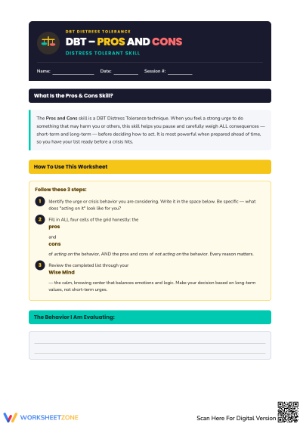
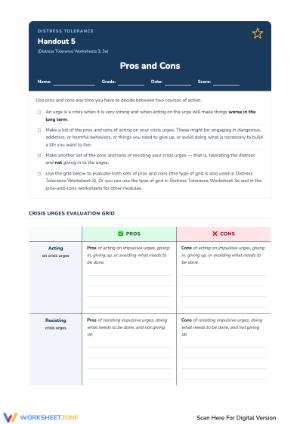
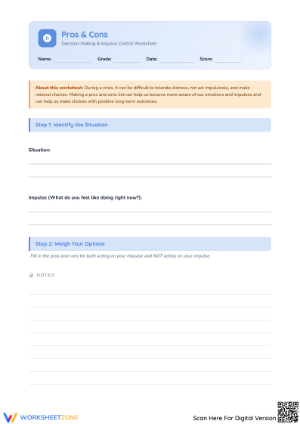
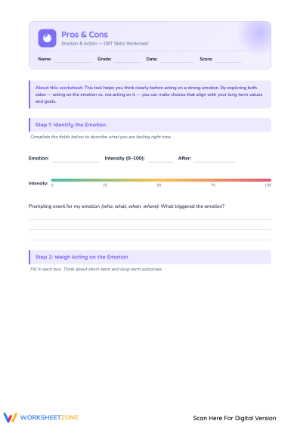
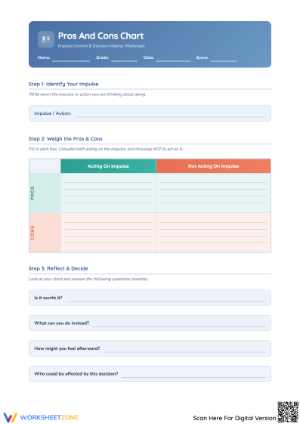
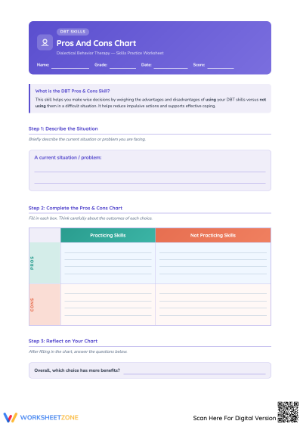
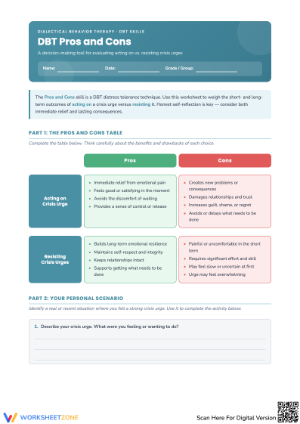
These dbt pros and cons worksheets pdf for 10th grade give teachers a ready-to-use tool for the DBT Distress Tolerance skill that matters most at the sophomore level — the four-quadrant Pros and Cons framework — written at a reading level that works in a general health or advisory setting without requiring clinical training to facilitate. Each worksheet targets a single urge or decision point and asks students to map all four angles of that moment before they act.
What's Inside the Set
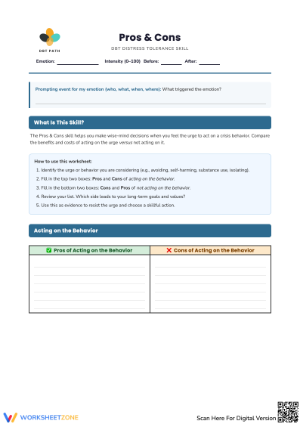
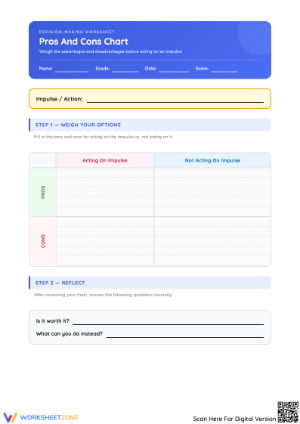
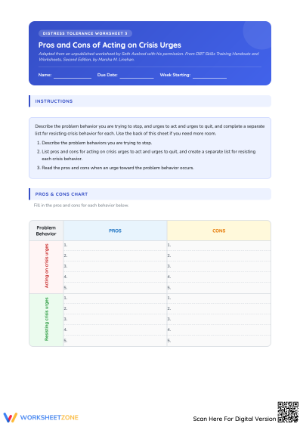
The four-quadrant structure is the core innovation here. A standard pro/con list asks students to weigh one path. The DBT version asks them to run two paths simultaneously — acting on the urge and resisting it — and then name the costs and benefits of each. The scenarios on these worksheets are drawn from the actual pressure points of sophomore year: the urge to send a hostile message during a conflict, to skip a presentation when anxiety spikes, to stay up until 2 a.m. the night before a major test.
- Pros of Acting on the Urge: Students identify the immediate function the behavior serves — usually fast emotional relief, social belonging, or avoidance of discomfort. This quadrant demands honesty, not performance.
- Cons of Acting on the Urge: Students map the downstream costs — the grade drop, the damaged relationship, the increased stress they were originally trying to escape.
- Pros of Resisting the Urge: Students articulate what holding the line actually gains them — a maintained GPA, a repaired relationship, a concrete moment of self-trust they can point to later.
- Cons of Resisting the Urge: The quadrant most students initially leave blank. It asks them to name what resisting genuinely costs — boredom, the sting of exclusion, the physical discomfort of sitting with anxiety — which validates the difficulty of the choice without excusing the behavior.
In practice, the bottom-right quadrant is the one that generates the most honest writing. A student who puts "I'll have to feel really anxious for the whole hour and not do anything about it" is naming something real — and that named reality is the starting point for any genuine shift in behavior.
Why the Fourth Quadrant Changes the Conversation
Tenth graders sit at a specific developmental intersection: the prefrontal cortex is still building out its impulse-regulation circuitry while social consequences feel more immediate and more catastrophic than at almost any other point in adolescence. Most SEL frameworks respond to this by presenting the correct choice — resist the urge, make the healthy decision — which students immediately recognize as the adult agenda. The four-quadrant model bypasses that dynamic because it never specifies a correct answer. It requires students to generate four categories of honest consequence and arrive at their own analysis. The "Cons of Resisting" quadrant does the dialectical work: it signals that the worksheet trusts the difficulty of the student's position, which is the foundational stance of DBT. When students feel understood rather than corrected, they engage with the analysis instead of performing it.
Patterns in Student Work Worth Addressing Before You Move Forward
The most consistent error is students treating the "Pros of Acting on the Urge" quadrant as a trap. They leave it blank or write "none, there are no real pros" because they assume the exercise exists to prove the urge was wrong. That assumption collapses the whole tool. The urge exists because it serves a function — usually fast relief from something genuinely painful — and naming that function is the honest starting point. When a student writes "nothing, the urge is just bad," they are showing you performed compliance, not actual thinking. Modeling the exercise yourself with a low-stakes real example shifts that dynamic fast: "I had the urge to cancel a staff meeting last March, and the honest pro was that I was stretched thin and genuinely needed the time back" tends to give students permission to be truthful about their own quadrant.
A second pattern worth catching early: students conflate the "Pros of Acting" quadrant with the "Cons of Resisting" quadrant and write identical entries in both. These are related but distinct. If the urge is to leave a party early, the pro of acting is immediate relief from social anxiety — something gained. The con of resisting is having to tolerate an hour of that same anxiety — something endured. The first is about acquisition; the second is about cost. Most tenth graders need that distinction named explicitly before they can hold it on their own.
Building These Worksheets Into Your Lesson Plans
The most reliable entry point is a scenario with genuine emotional pull but no personal risk — something everyone in the room has felt without being exposed by it. "The urge to check your phone during the first ten minutes of studying" works consistently well. Run that one as a whole-class think-aloud, filling all four quadrants on the board together, before asking students to apply the dbt pros and cons worksheets pdf for 10th grade to scenarios that are more personal. Moving from a shared public scenario to a private individual one is the instructional bridge that makes the skill transferable.
Advisory period fits the pacing of these worksheets well. The 15–20 minute block is enough time to introduce a scenario, complete the four quadrants, and briefly surface two or three observations without rushing the debrief. A reliable weekly rhythm: introduce a new scenario on Monday as a warm-up, revisit it in a short discussion on Wednesday, and close Friday by asking students — not to share what they wrote, just a show of hands — whether they noticed the mental process starting automatically at some point during the week. That spaced repetition across three low-stakes touchpoints builds retention more reliably than a single 50-minute lesson on the topic.
One logistical note worth passing along: students who keep a blank copy in their binder or digital folder are more likely to reach for the tool during a real situation. Practicing the format when calm — during a normal class period with a fictional scenario — creates enough familiarity that the structure is accessible when emotions are high and working memory is under pressure.
Adjusting the Worksheets for Different Student Readiness Levels
Students who find extended written expression effortful can use the quadrants as structured note space rather than formal writing — short phrases, fragments, even quick visual shorthand. The cognitive work lives in the categorization, not the prose. For students with strong self-awareness who move through the basic grid quickly, add a ranking step: number the items in each quadrant by emotional weight, then write one sentence explaining which single entry actually drives their conclusion. That forced ranking requires a more precise self-reading than a flat list does.
In an advanced health or psychology elective, the dbt pros and cons worksheets pdf for 10th grade serves as a strong entry point into a broader DBT skills unit — TIPP, ACCEPTS, radical acceptance — with the Pros and Cons grid as the anchor skill students return to across modules. These students can also author their own scenarios from real peer conflicts or academic pressure situations rather than working from teacher-supplied prompts. Moving from using the worksheet to designing the scenario for someone else deepens the analysis and surfaces assumptions students didn't know they were making.
Standard Alignment
These worksheets align with the CASEL Self-Management competency, specifically the strand targeting impulse control and goal-directed behavior — the expectation that students demonstrate the capacity to delay gratification and manage behavioral urges in service of longer-term goals. At Grade 10, this competency is paired instructionally with self-awareness work, because students cannot regulate what they have not yet identified. The four-quadrant structure operationalizes both skills at once: the "Pros of Acting" quadrant builds self-awareness by requiring students to name the function of the urge, and the full grid builds self-management by running that named urge through structured consequence analysis.
For districts using the National Health Education Standards (NHES), this activity maps directly to Standard 5: students will demonstrate the ability to use decision-making skills to enhance health. The DBT framework adds structural rigor to that standard by requiring consequence analysis across two competing behavioral paths rather than a single option evaluation.
Frequently Asked Questions
How is this different from a regular pro/con list or T-chart?
A T-chart or standard decision list examines one path: what happens if I take this action. The DBT Pros and Cons grid runs two paths simultaneously — acting on the urge and not acting — and maps the costs and benefits of both. The structural difference is the bottom-right quadrant: the cons of resisting. No standard decision-making tool asks students to name what self-control actually costs them. That honesty is what makes the exercise feel credible to tenth graders rather than preachy.
Do these worksheets require a counselor or therapist to facilitate?
No. The skill itself — structured reflection before a behavioral response — has no clinical prerequisite. Teachers in advisory, health, and social studies classrooms use this format effectively as part of decision-making or stress management units. These worksheets are not a substitute for counseling, but the reflective structure is appropriate for general classroom use. If a student's responses raise a concern, the standard school protocol applies — same as any written classroom work.
What do I do when a student writes something genuinely raw in the "Pros of Acting" quadrant?
The most common situation is not a safety disclosure but an honest observation: "the pro is I wouldn't have to feel invisible for the rest of the day." That kind of answer is an opening for a quiet individual check-in, not a clinical flag. Read the room before introducing the more personal scenarios — starting with lower-stakes shared examples gives you a baseline for what a student's written voice looks like when they are genuinely reflecting versus when something needs follow-up.
What if a student refuses to engage and calls the worksheet irrelevant or pointless?
That response usually means one of two things: the scenario hit too close, or the student has been through enough feelings-worksheet rituals that led nowhere to be skeptical of this one too. The most effective counter is to use the dbt pros and cons worksheets pdf for 10th grade with a scenario that carries some humor and zero personal exposure first — the urge to rage-quit a video game mid-match, or the urge to immediately text back during a conflict — before asking students to apply the tool to heavier material. Once the grid works on something familiar and low-stakes, resistance tends to drop on its own.












 Interactive Worksheet Maker
 Quiz Maker
 Word Search Maker
 Crossword Puzzle Maker
 Word Scramble Generator
 Sentence Scramble Generator
 Handwriting Worksheet Generator
 Name Tracing Generator
 Fill In The Blank Generator