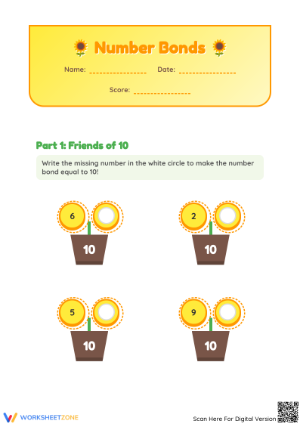
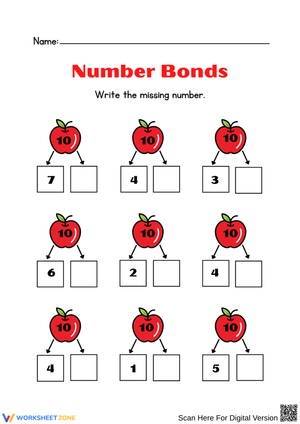
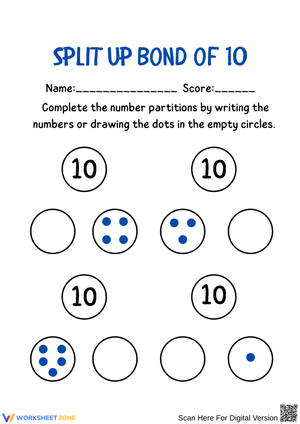
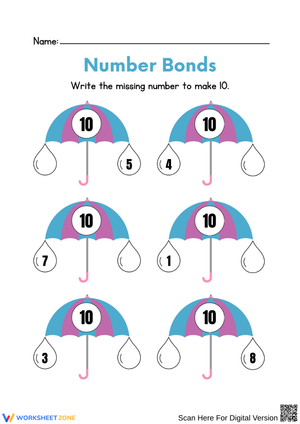
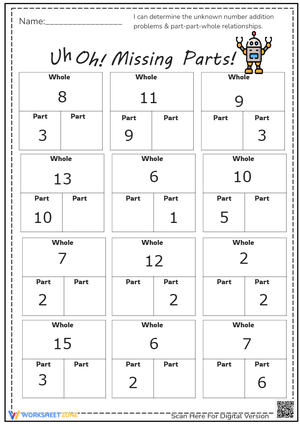
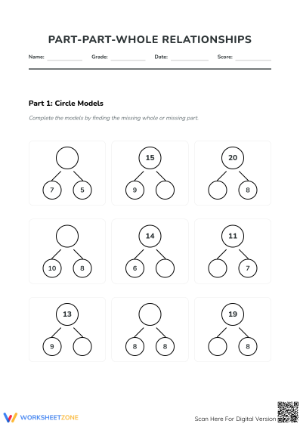
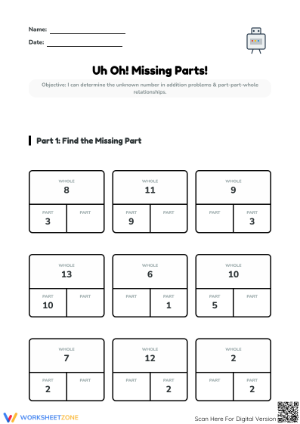
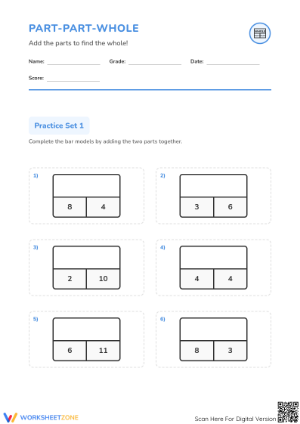
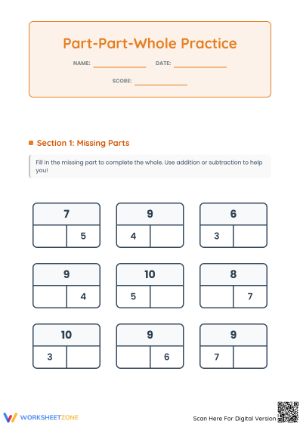
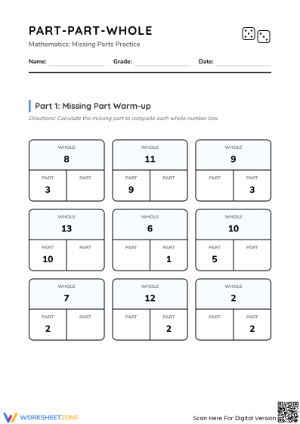
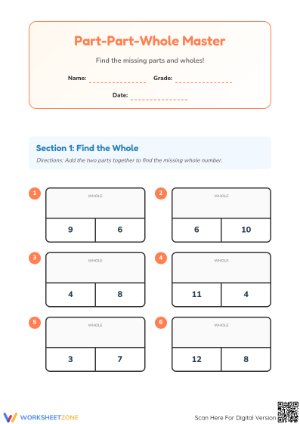
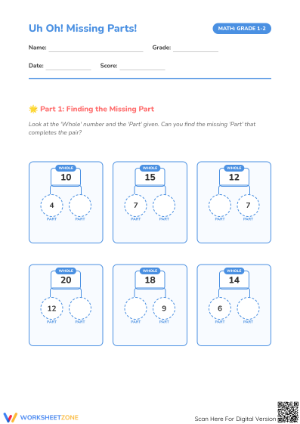
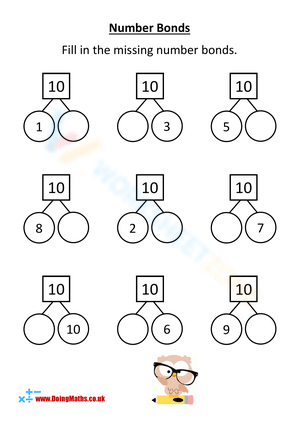
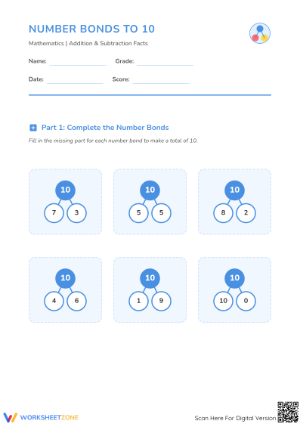
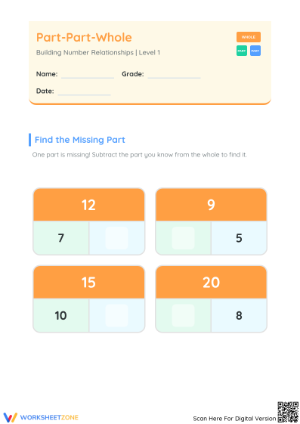
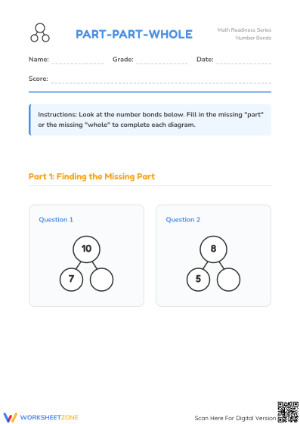
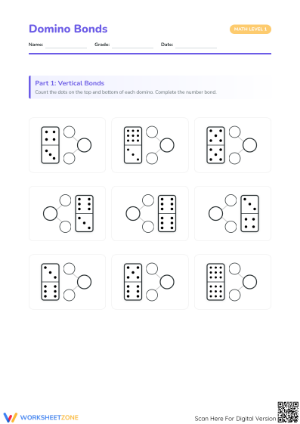
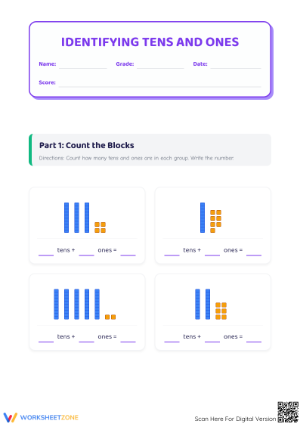
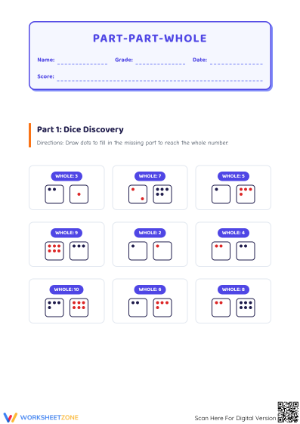
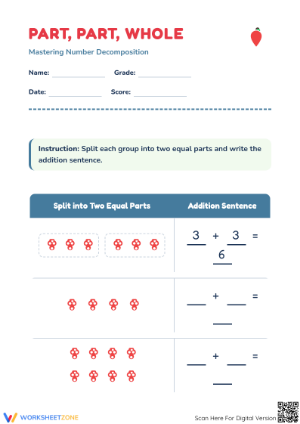
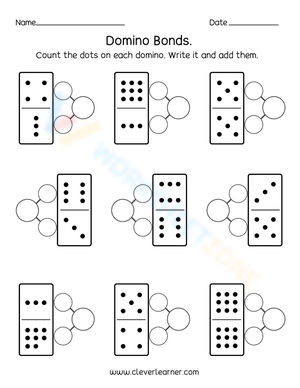
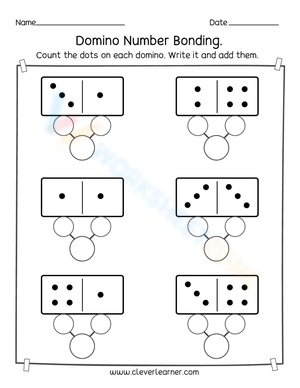
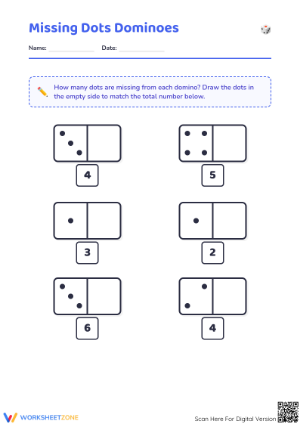
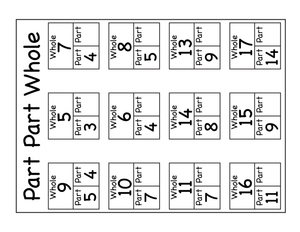
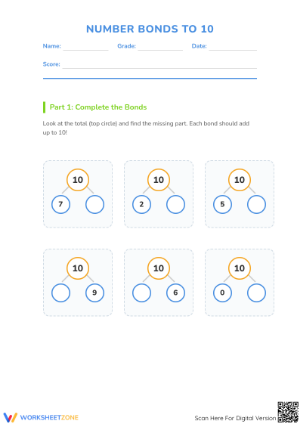
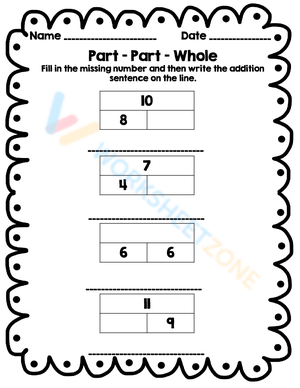
Part part whole pdf worksheets for 1st grade give teachers a direct, printable tool for the stage of number sense instruction when students begin treating a number not as a fixed count but as a flexible relationship between smaller quantities. Each worksheet presents the part-part-whole model through number bonds, ten-frame images, missing-number prompts, and picture-supported problems — the formats students encounter in whole-group lessons and need to practice with growing independence.
Skills Targeted Across the Set
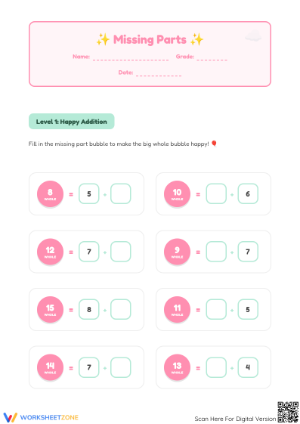
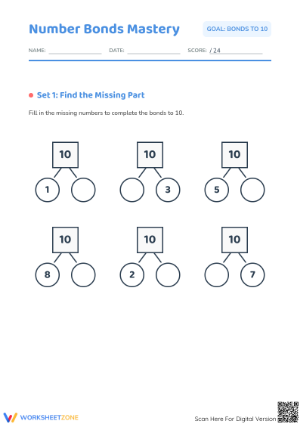
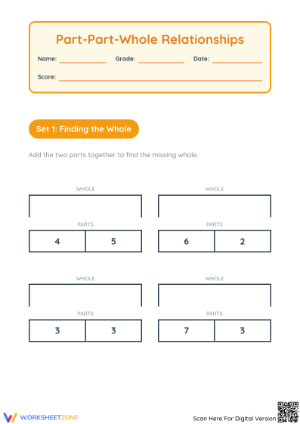
The worksheets move through several related competencies that build on each other within a Grade 1 scope and sequence. Students begin by identifying the whole when two parts are shown visually, then practice writing both parts when the whole and only one part are given. Missing-part tasks — where the whole and one part are filled in and the second part is blank — push students past counting-all strategies and toward reasoning about number relationships. Each worksheet also connects the visual model to a written equation, so students practice translating a number bond into the symbolic form they will encounter on assessments and in later units.
- Composing and decomposing numbers within 10 — the foundational skill for Grade 1 number sense
- Extending the same model to within 20 — once students are confident with smaller numbers
- Identifying missing parts — the precursor skill for subtraction reasoning
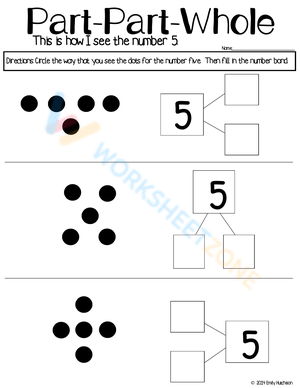
- Matching pictures, number bonds, and equations — representing the same relationship three ways on one worksheet
- Writing related addition facts from one model — recognizing that 3 + 5 = 8 and 5 + 3 = 8 come from the same bond
Why This Model Belongs in First Grade Instruction
Grade 1 is the year students are expected to move away from counting-all strategies and toward recognizing stable number combinations. A child who has to count every dot to add 4 and 3 is not yet seeing the whole as composed of those parts — the procedure is running without the relationship underneath it. The part-part-whole model makes that relationship visible. When students see 7 at the top of a number bond with 4 in one branch and a blank in the other, they are forced to reason rather than count. That reasoning, practiced repeatedly across these worksheets, is what cognitive research on early arithmetic describes as developing number sense — and students who build it in first grade handle two-digit addition and regrouping with noticeably less difficulty the following year.
The worksheet format also supports gradual release well. Teachers model with physical counters, draw the model on the board, and students then move to paper practice. The printed number bond mirrors the exact structure from whole-group instruction, so the transition from manipulatives to the worksheet feels continuous rather than abrupt.
Mistakes Students Make That These Worksheets Help You Catch
The most consistent error in student work is placing the whole in a part box. Show a student a number bond for 8 with 5 already written in one part circle, and they write 8 in the other part circle instead of 3. If you trace the logic, the student identified the number most recently discussed and placed it where their eyes landed — not where it belongs structurally. Teaching students to locate and label the whole circle first, before writing anything else, reduces this particular error significantly. Some teachers mark the whole circle with a small star at the start of lessons until students internalize which position it occupies.
A second pattern is what might be called recount-instead-of-reason. When a worksheet shows the whole as 9 and one part as 6, some students will count out 9 counters, count 6 of them, and then start from 1 again on the remaining group rather than think about what 9 and 6 already tell them. This is a signal that the student hasn't internalized the relationship model. Covering the known part and asking "what do I need to add to 6 to make 9?" is more productive than allowing a full recount, and it points students directly toward the subtraction reasoning embedded in every missing-part task.
A third, less obvious error: students who handle number bonds within 10 correctly will sometimes fall apart on picture pages where objects are arranged randomly rather than in two distinct groups. They stop seeing the part-part-whole structure and revert to counting everything from scratch. Including picture pages with varied arrangements in the set surfaces that weakness during independent practice, which is exactly when teachers can intervene before it becomes habitual.
Fitting These Worksheets Into Your Instructional Week
Morning math warm-ups are the single best slot for this material. A short number bond row during the 5–7 minutes before instruction begins takes almost no setup and activates the exact prior knowledge needed for an addition or subtraction lesson. Students get repetition at a low-stakes time, and teachers get an immediate informal read on who is still uncertain before the lesson starts.
For small-group reteach, one worksheet with missing-part problems is enough for a focused 10-minute session. More than that and the group becomes a completion task rather than a conversation. The goal during intervention is to get students talking through their reasoning — "the whole is 7, one part is 4, so the other part must be..." — not finishing a stack of pages. Use the worksheet as a prompt for that oral reasoning, not as the destination.
Exit tickets work well with the missing-part format. Hand out one worksheet per student in the last five minutes of math, ask them to complete the first three number bonds, and collect. That data tells you by tomorrow morning which students still need the concept and which are ready for the within-20 extension. The part part whole pdf worksheets for 1st grade in this set are formatted with clean, uncluttered number bonds that students can start immediately — no new layout to explain before the timer runs out.
Standard Alignment
These worksheets align directly to CCSS 1.OA.B.3 (apply properties of operations as strategies to add and subtract) and CCSS 1.OA.C.6 (add and subtract within 20, demonstrating fluency for addition and subtraction within 10). The part-part-whole structure is also the conceptual foundation for CCSS 1.OA.B.4, which defines subtraction as an unknown-addend problem — precisely the reasoning that missing-part tasks develop before students ever see a minus sign in isolation.
In terms of classroom placement, these worksheets are appropriate from the beginning of the number operations unit through the end of the year. Use within-10 versions early in the fall for composition and decomposition work. After winter break, the within-20 versions extend the same model into the range required by end-of-year fluency benchmarks.
Adjusting These Worksheets for a Range of Learners
For students who need more support, the most effective adjustment is not simplifying the worksheet — it is adding a physical layer before the paper task. Have students build each number bond with two-color counters, placing red counters for one part and yellow for the other, then count both colors and write the whole. That two-color step makes the separation of parts visually unambiguous in a way that a printed number bond alone cannot replicate. Students who complete the worksheet after this step place the numbers correctly far more consistently than students who go straight to the page.
For students working ahead of grade level, within-10 tasks are often finished too quickly to build much. Use the within-20 worksheets and add a verbal or written prompt: "Show two other ways to make the same whole." A student who finds multiple combinations for 14 is building flexible thinking that matters in second-grade place value work. The most advanced students benefit from moving past number bonds entirely and writing the full family of four equations — both addition forms and both subtraction forms — from a single model, which the equation-writing sections of these worksheets support.
When working with part part whole pdf worksheets for 1st grade across a mixed-readiness classroom, distributing different worksheets to different table groups tends to work better than trying to differentiate within one worksheet. First graders notice when their page looks different from a neighbor's, but separate worksheets distributed quietly by table eliminate that self-consciousness while keeping the logistics of whole-class review manageable.
Frequently Asked Questions
When in the school year should Grade 1 teachers introduce these worksheets?
Most teachers introduce the part-part-whole model during the first number sense unit, typically in September or October, alongside or just after work with linking cubes and counters. Students don't need to be fluent with addition facts before using these worksheets — the worksheets are how that fluency gets built. Waiting for fluency first inverts the sequence.
How do these worksheets connect to subtraction instruction?
Every missing-part task is subtraction thinking expressed in addition language. When a student knows the whole is 8 and one part is 5, finding the other part is the same operation as 8 − 5. Making this connection explicit during lessons — "we are using our number bond to do subtraction thinking" — helps students see subtraction as a related operation rather than a separate, harder topic introduced later. The visual model makes that relationship concrete before the minus sign enters the picture.
Are these worksheets appropriate for homework?
Sending home part part whole pdf worksheets for 1st grade after the model has already been introduced and practiced in class is reasonable. When the format is familiar from school, students and caregivers can read the page without needing an explanation first. If the worksheet format is new to the student, the homework becomes harder for families to support and less useful as practice. Introduce the format in class first, then send it home.
What should a teacher do when a student finishes every worksheet quickly and accurately?
Move that student toward two things: larger number ranges and multiple-decomposition tasks. A student who finishes a within-10 worksheet in two minutes with everything correct should receive within-20 practice next, then prompts asking for more than one way to decompose the same whole. Beyond that, ask the student to generate their own number bonds and write all four related equations from each one. Creating rather than completing marks the upper boundary of what these worksheets offer and signals a student ready for more complex operations work.













 Interactive Worksheet Maker
 Quiz Maker
 Word Search Maker
 Crossword Puzzle Maker
 Word Scramble Generator
 Sentence Scramble Generator
 Handwriting Worksheet Generator
 Name Tracing Generator
 Fill In The Blank Generator