




























Views
Downloads


Part-Part-Whole Addition Worksheet | Essential Grade 1

Paste this activity's link or code into your existing LMS (Google Classroom, Canvas, Teams, Schoology, Moodle, etc.).
Students can open and work on the activity right away, with no student login required.
You'll still be able to track student progress and results from your teacher account.
This worksheet helps Grade 1 students master number decomposition through the part-part-whole model. By splitting groups into equal parts, learners visualize the relationship between numbers and their components, ultimately strengthening mental addition and doubles recognition. The structured layout ensures that students can bridge the gap between concrete counting and abstract equations.
At a Glance
- Grade: 1 · Subject: Math
- Standard:
CCSS.MATH.CONTENT.1.OA.C.6— Add and subtract within 20, demonstrating fluency for addition within 10- Skill Focus: Part-part-whole decomposition into equal parts
- Format: 2 pages · 6 problems · Answer key included · PDF
- Best For: Early addition and doubles fact practice
- Time: 10–15 minutes
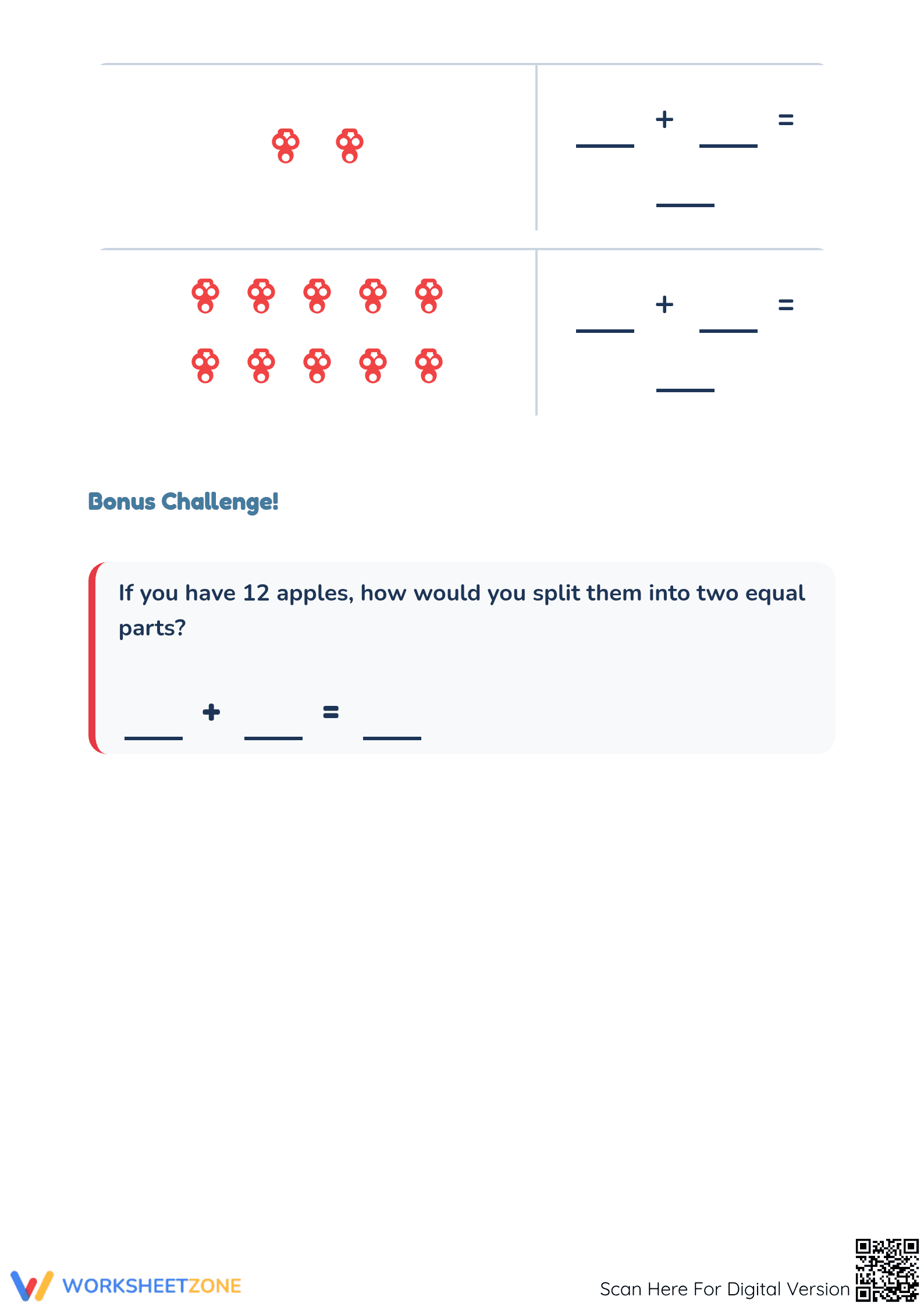
This 2-page PDF features 6 tasks, including a "Bonus Challenge" designed to stretch student thinking beyond visual aids. The worksheet provides clear representations of cherries that students must divide into two equal groups. It includes dedicated spaces for writing addition sentences and sums, supported by a full answer key to facilitate immediate feedback and self-correction.
Skill Progression
- Guided practice: The first problem provides a worked example with dotted outlines, showing students exactly how to separate the total into two distinct parts of 3.
- Supported practice: Subsequent visual problems remove the outlines but retain the group structure, requiring students to count and divide independently into equal addends.
- Independent practice: The final "Bonus Challenge" shifts to a word problem format, asking students to decompose the number 12 without a direct image.
The layout follows a gradual-release model, moving from visual scaffolds to abstract number manipulation.
Standards Alignment
The primary focus is CCSS.MATH.CONTENT.1.OA.C.6, which requires students to add and subtract within 20, demonstrating fluency for addition and subtraction within 10. Use of strategies such as doubles is a key component of this standard. This worksheet specifically targets the understanding of equal addends and their whole. Both standard codes can be copied directly into lesson plans, IEP goals, or district curriculum mapping tools.
How to Use It
Use this resource during the independent practice phase of a lesson on doubles or the part-part-whole model. It works effectively as a quick formative assessment to check if students can accurately divide a whole into two equal parts. Monitor students to ensure they count the total group before attempting the split, providing a tip to circle the two groups they create. Expected completion time is 10–15 minutes.
Who It's For
Designed for first-grade students but highly effective for kindergarteners ready for decomposition or second graders needing intervention on doubles facts. It pairs naturally with physical manipulatives like counters or a part-part-whole mat during direct instruction to reinforce the concept of numeric balance.
According to the RAND AIRS 2024 report on elementary mathematics, the use of visual models like the part-part-whole diagram is critical for developing early number sense and algebraic thinking. This worksheet aligns with research-based practices by requiring students to perform number decomposition (specifically CCSS.MATH.CONTENT.1.OA.C.6), a skill that NAEP data consistently identifies as a predictor of later success in more complex operations. By splitting a set into two equal parts, students build a foundation for understanding the concept of doubles and the relationship between addition and subtraction. Fisher & Frey (2014) emphasize that such visual scaffolds facilitate the gradual release of responsibility, moving learners from concrete counting to abstract symbolic representation. This resource provides the necessary repetition for students to internalize these numeric relationships, ensuring they reach the required fluency levels for Grade 1.


