


























Views
Downloads



Essential Part-Part-Whole Worksheet | Grade 1 Math
Paste this activity's link or code into your existing LMS (Google Classroom, Canvas, Teams, Schoology, Moodle, etc.).
Students can open and work on the activity right away, with no student login required.
You'll still be able to track student progress and results from your teacher account.
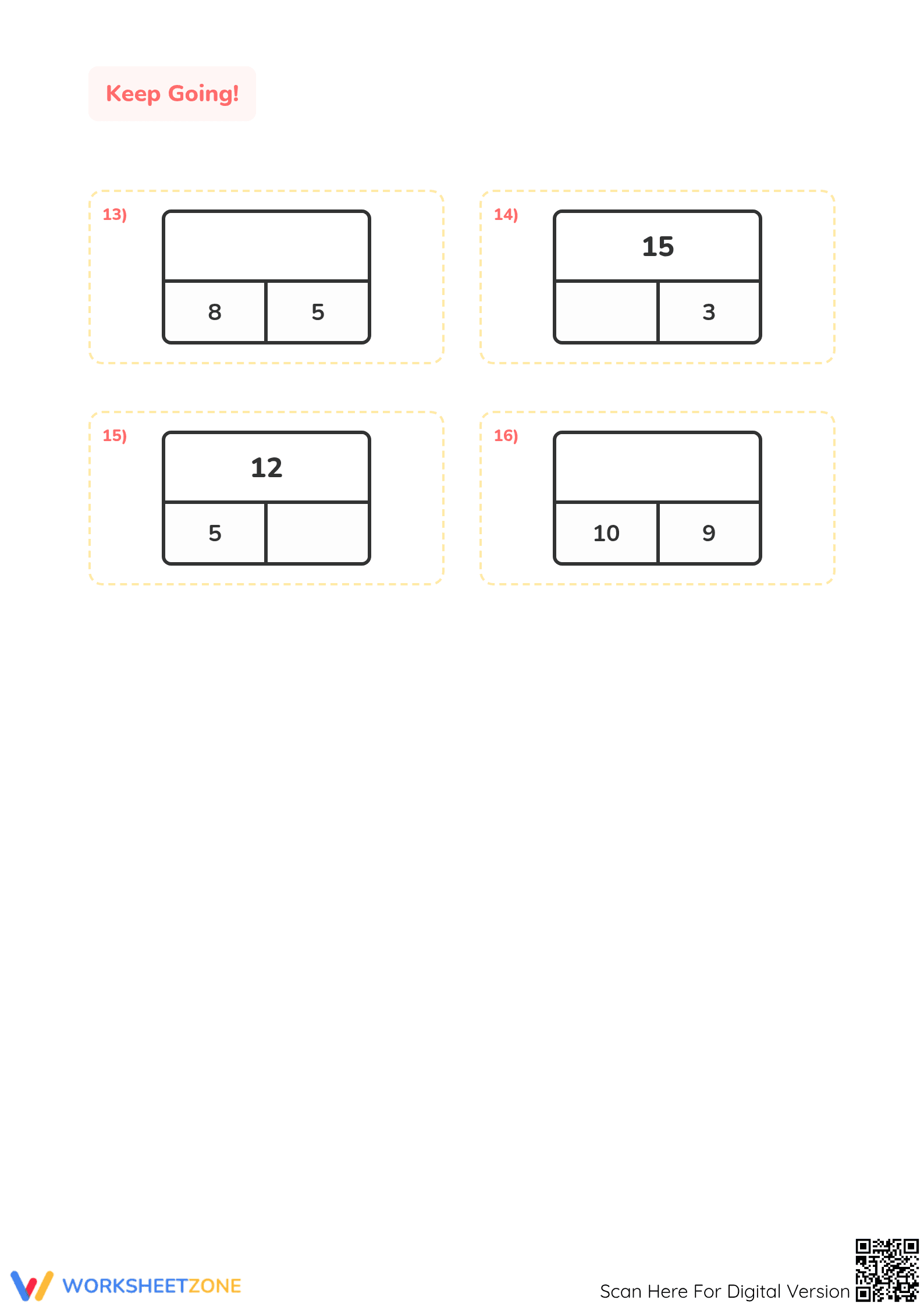
This Grade 1 math worksheet helps students master the relationship between addition and subtraction through 16 structured part-part-whole problems. By calculating missing numbers in visual models, learners build the conceptual foundation necessary for algebraic thinking and arithmetic fluency. Students will identify whether they need to find a part or the whole to complete each set.
At a Glance
- Grade: 1 · Subject: Math
- Standard:
CCSS.MATH.CONTENT.1.OA.D.8— Determine the unknown whole number in addition or subtraction equations- Skill Focus: Part-part-whole number bonds
- Format: 3 pages · 16 problems · Answer key included · PDF
- Best For: Independent practice or math center rotations
- Time: 15–20 minutes
Inside this 3-page PDF, you will find 16 individual part-part-whole diagrams. The first page features six problems labeled as mixed practice, while the subsequent pages offer ten more opportunities to solidify the skill. Every problem utilizes a clear rectangular graphic organizer that clearly distinguishes between the two parts and the single whole. A comprehensive answer key is included for quick grading.
The zero-prep workflow for this resource is designed for maximum efficiency in busy classrooms. Teachers can simply print the three-page set in less than 30 seconds. Distribution to a standard class takes approximately one minute, and students can begin working immediately thanks to the intuitive visual models. Reviewing the completed work with the provided answer key requires under two minutes of teacher time.
This worksheet is strictly aligned to CCSS.MATH.CONTENT.1.OA.D.8, which requires students to determine the unknown whole number in an addition or subtraction equation relating three whole numbers. By mastering these number bonds, students also meet the requirements for CCSS.MATH.CONTENT.1.OA.B.4, understanding subtraction as an unknown-addend problem. Both standard codes can be copied directly into lesson plans, IEP goals, or district curriculum mapping tools.
Use this worksheet during the independent practice portion of a lesson on number relationships. It serves as an excellent formative assessment to check if students understand when to add or subtract to find a missing value. Observe whether students use "counting on" or "counting back" strategies during the first five minutes. The expected completion time for all 16 problems is roughly 20 minutes.
This resource is ideal for first-grade students and can be used for second-grade review or kindergarten enrichment. It pairs naturally with an anchor chart showing the "part + part = whole" and "whole - part = part" formulas. This tool is especially helpful for students who benefit from visual representations of abstract numerical concepts.
According to the Fisher & Frey (2014) framework for gradual release of responsibility, the transition from guided to independent practice is essential for mathematical fluency. This worksheet aligns with CCSS.MATH.CONTENT.1.OA.D.8 by requiring students to determine the unknown whole number in an addition or subtraction equation relating three whole numbers. Research suggests that visualizing number relationships through part-part-whole models helps students move beyond rote memorization toward a conceptual understanding of operations. By providing 16 varied problems that alternate between missing parts and missing wholes, this resource ensures that students can flexible apply their knowledge of number bonds. This structured approach mirrors effective instructional strategies identified in the RAND AIRS 2024 report on elementary mathematics, which emphasizes the importance of frequent, low-stakes practice in building arithmetic confidence. Educators can utilize these findings to support evidence-based intervention or enrichment activities within diverse classroom settings.


