


























Views
Downloads
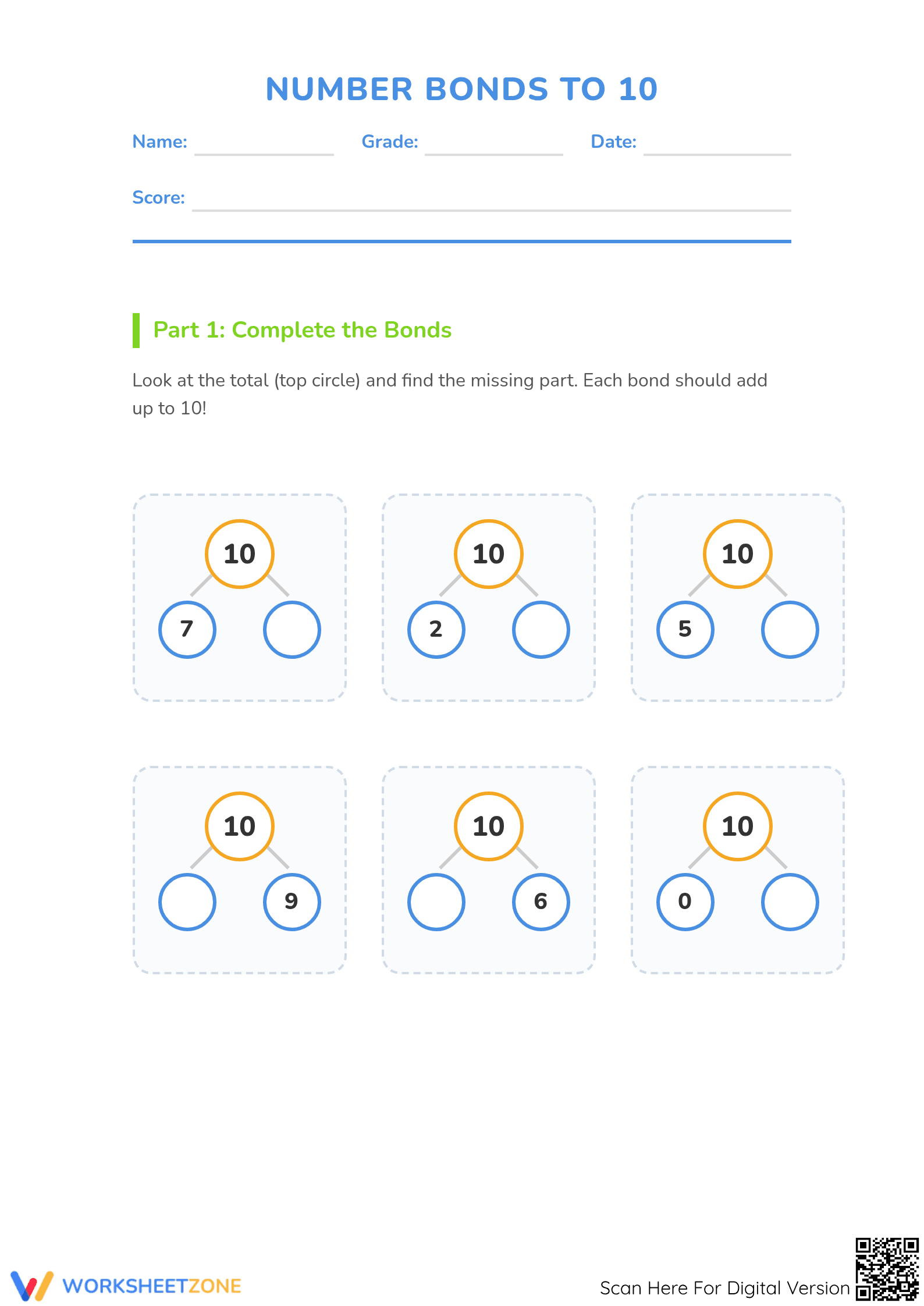

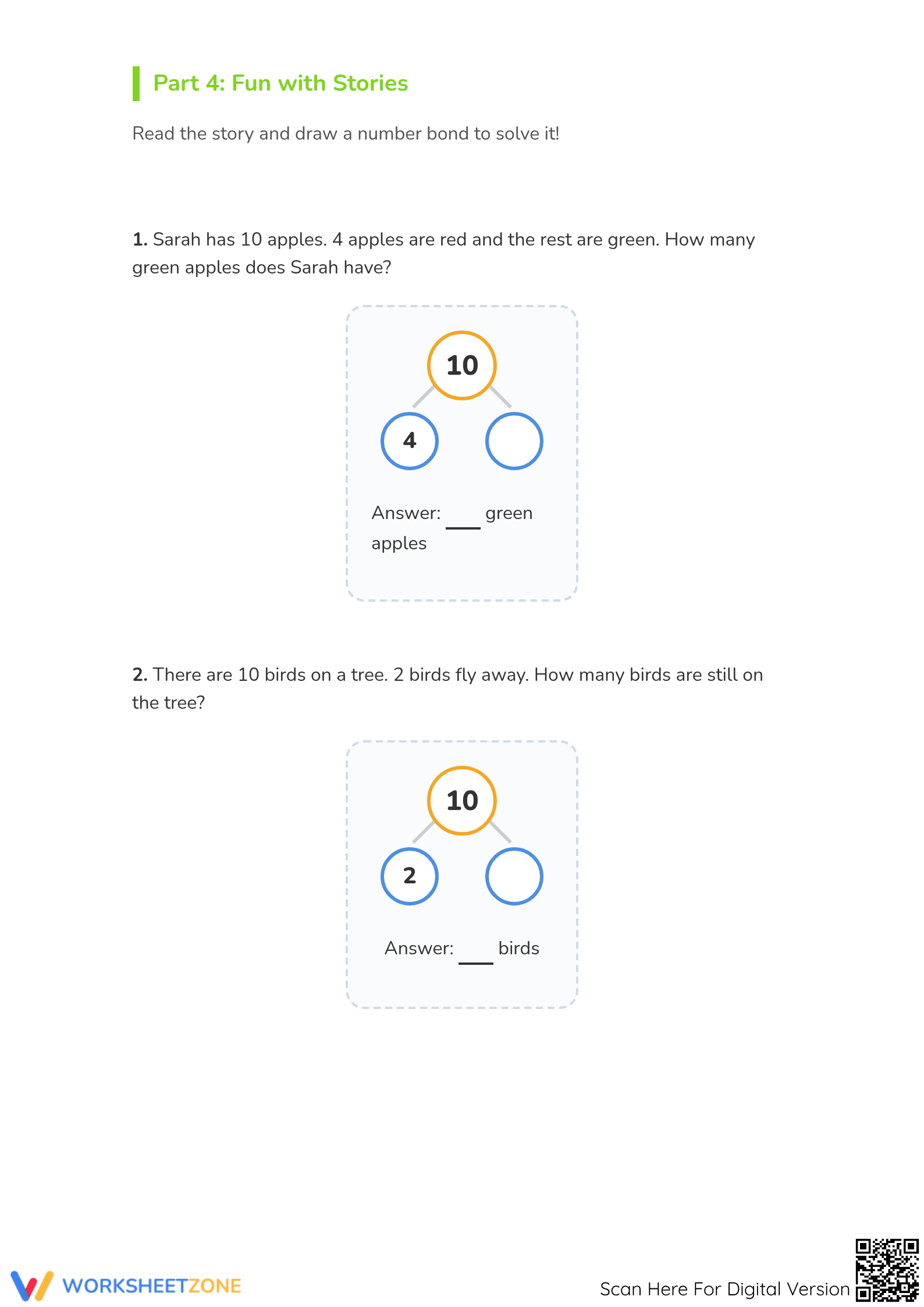

Grade 1 Number Bonds to 10 — Printable No-Prep Worksheet
Paste this activity's link or code into your existing LMS (Google Classroom, Canvas, Teams, Schoology, Moodle, etc.).
Students can open and work on the activity right away, with no student login required.
You'll still be able to track student progress and results from your teacher account.
Mastering number bonds to 10 is a foundational milestone for first-grade mathematicians. This comprehensive worksheet provides structured practice to help students visualize part-part-whole relationships and translate them into formal addition equations. By connecting visual models to abstract math, learners develop the mental flexibility required for future mental math strategies.
At a Glance
- Grade: 1 · Subject: Math
- Standard:
CCSS.MATH.CONTENT.1.OA.C.6— Add and subtract within 10 demonstrating fluency for part-whole relationships- Skill Focus: Number Bonds to 10
- Format: 3 pages · 17 problems · Answer key included · PDF
- Best For: Small group math centers or independent practice
- Time: 15–20 minutes
Inside this three-page packet, you will find 17 tasks designed to build numeracy. The first sections utilize visual part-whole circles to anchor composition understanding. Part three transitions to horizontal addition sentences with missing addends, while the final section introduces application-based word problems. A full answer key and coloring opportunities are included to support teacher grading and student engagement.
This resource is designed for a zero-prep workflow. First, print the three-page PDF in under 30 seconds. Next, distribute the sheets with a brief two-minute modeling session. Finally, review the completed work using the provided answer key for instant formative feedback. Total teacher preparation time is less than two minutes, making it an ideal choice for emergency sub plans or busy mornings.
This worksheet is rigorously aligned to CCSS.MATH.CONTENT.1.OA.C.6. The standard requires students to add and subtract within 20, demonstrating fluency within 10. By focusing specifically on pairs that sum to 10, this tool supports the "Making Ten" strategy in the Common Core framework. Both standard codes can be copied directly into lesson plans, IEP goals, or district curriculum mapping tools.
Use this worksheet during the independent practice phase. After demonstrating part-whole relationships with manipulatives, assign the first two pages. Observe students as they complete the addition sentences in part three to identify misconceptions regarding the equals sign. The word problems on page three serve as an excellent exit ticket to assess application of higher-order thinking skills.
This material is tailored for first-grade students but serves as a vital remediation tool for second graders lacking fluency. For differentiation, provide ten-frames to students who struggle with the abstract equations. It pairs naturally with a number line or a "Making Ten" anchor chart to support diverse learners in general or special education settings.
The development of part-whole fluency is a critical predictor of long-term mathematical success. According to the NAEP 2024 analysis, students who master number bonds within 10 demonstrate significantly higher proficiency in multi-digit addition and subtraction in later elementary grades. This worksheet directly addresses CCSS.MATH.CONTENT.1.OA.C.6 by providing 17 repetitions across four distinct task types: completion, calculation, equation writing, and story problem solving. Research by Fisher & Frey (2014) emphasizes that "guided to independent" sequences, like the one used here, reduce cognitive load and improve retention of basic math facts. By integrating visual scaffolds with symbolic notation, this resource ensures that Grade 1 learners move beyond simple counting and toward relational thinking. Educators can confidently utilize this printable as a research-aligned tool for building the mental models necessary for algebraic reasoning and computational fluency.


