




























Views
Downloads
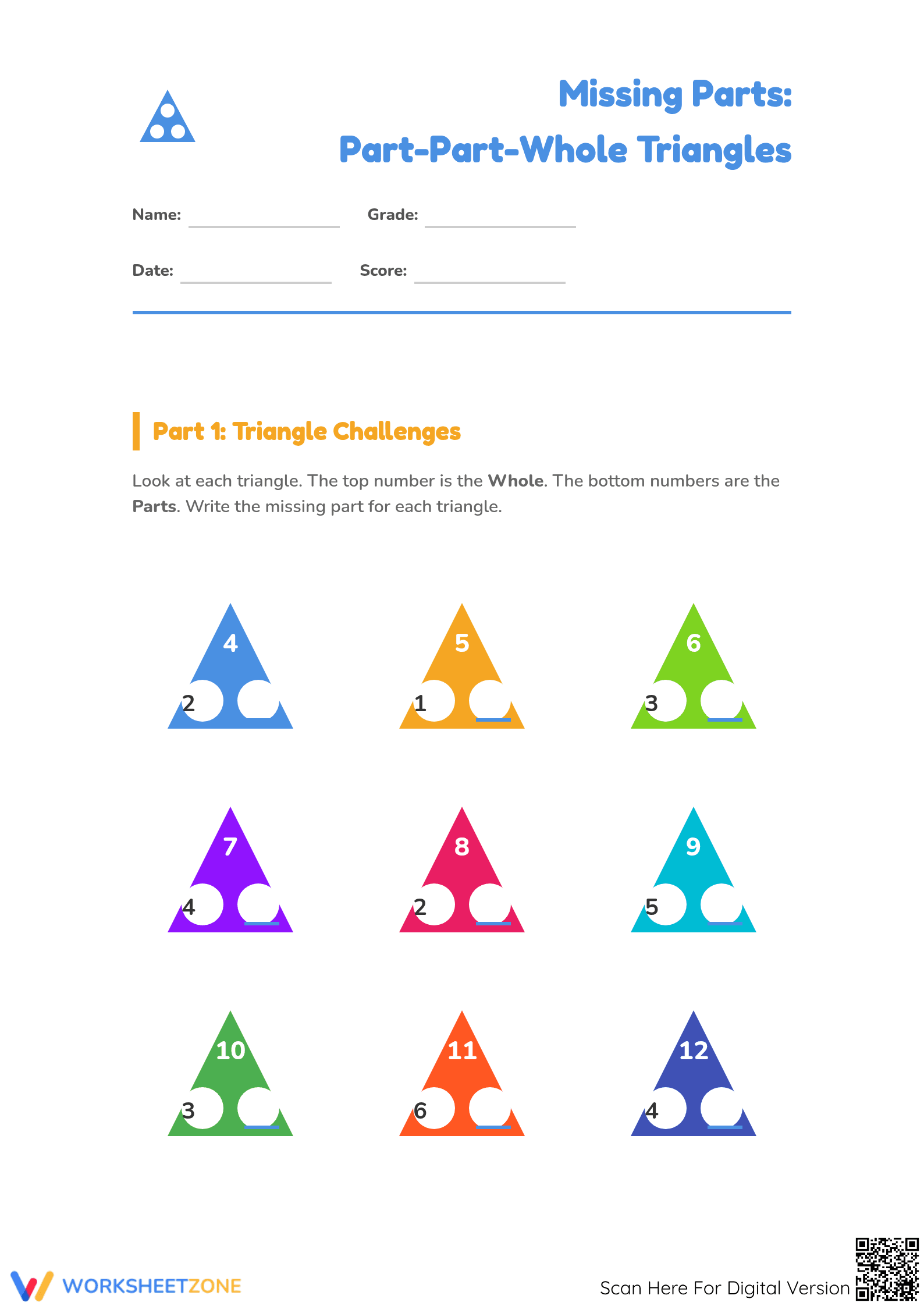


Printable Part-Part-Whole Math Worksheet | Grade 1-2

Paste this activity's link or code into your existing LMS (Google Classroom, Canvas, Teams, Schoology, Moodle, etc.).
Students can open and work on the activity right away, with no student login required.
You'll still be able to track student progress and results from your teacher account.
Develop a rock-solid foundation in number relationships with this comprehensive part-part-whole worksheet. Designed for Grade 1 and Grade 2 students, this resource moves beyond simple calculation to help learners visualize how numbers interact. By completing these engaging triangle challenges and word problems, students build the fluency needed for advanced mental math strategies.
At a Glance
- Grade: 1–2 · Subject: Math
- Standard:
CCSS.MATH.CONTENT.1.OA.B.4— Understand subtraction as an unknown-addend problem within 20- Skill Focus: Part-Part-Whole Relationships
- Format: 3 pages · 23 problems · Answer key included · PDF
- Best For: Daily math centers and quick formative assessment
- Time: 15–25 minutes
This three-page instructional packet is divided into logical segments that scaffold student learning. Page one features "Triangle Challenges," where students fill in missing components of a visual model. Page two transitions to a structured table format to reinforce the addition and subtraction connection, while page three applies these concepts to real-world word problems. The set includes a full answer key for rapid grading or student self-check.
This resource is designed for a seamless, zero-prep classroom experience. First, simply print the 3-page PDF (30 seconds). Next, distribute the packets to your small group or entire class with a brief reminder that "Part + Part = Whole" (1 minute). Finally, review the completed work using the included answer key to identify students who may need additional scaffolding (2 minutes). Total teacher preparation time is well under five minutes.
The worksheet aligns directly with CCSS.MATH.CONTENT.1.OA.B.4, which requires students to "understand subtraction as an unknown-addend problem." It also supports 2.OA.B.2 by fostering fluency in addition and subtraction within 20. These standard codes can be copied directly into lesson plans, IEP goals, or district curriculum mapping tools to ensure instructional compliance and clarity for administrators.
Use this worksheet as a focused "Exit Ticket" after a lesson on the relationship between addition and subtraction. Observing whether a student correctly identifies which number is the "whole" versus a "part" provides immediate data for your next instructional move. Alternatively, assign the word problem page as a collaborative partner activity to encourage students to verbalize their mathematical thinking and problem-solving strategies.
This resource is ideal for first and second-grade students who are developing their sense of number decomposition. It is particularly effective for learners who benefit from visual models like triangles and tables. For students requiring more support, provide physical manipulatives or counters to model the "parts" before writing the numerical values, ensuring all learners can access the core curriculum.
The CCSS.MATH.CONTENT.1.OA.B.4 standard is a pivotal milestone in early numeracy, bridging the gap between basic counting and algebraic thinking. Research from EdReports 2024 emphasizes that instructional materials must explicitly link addition and subtraction through visual models like part-part-whole diagrams to build deep conceptual understanding. This worksheet employs the triangle model, a research-backed heuristic that reduces cognitive load by clearly showing the hierarchical relationship between numbers. By practicing with these 23 diverse tasks, students internalize the "missing part" logic essential for solving complex equations. Fisher & Frey (2014) note that scaffolding from visual representations to word problems—as seen in this 3-page sequence—facilitates the gradual release of responsibility. This systematic approach ensures that students do not just memorize facts but develop a transferable mental map of number relationships. Using this tool provides teachers with high-quality, standards-aligned evidence of student mastery for progress monitoring and instructional planning.


