




























Views
Downloads


Printable Missing Parts Math Worksheet | Grades 1-2 Aligned

Paste this activity's link or code into your existing LMS (Google Classroom, Canvas, Teams, Schoology, Moodle, etc.).
Students can open and work on the activity right away, with no student login required.
You'll still be able to track student progress and results from your teacher account.
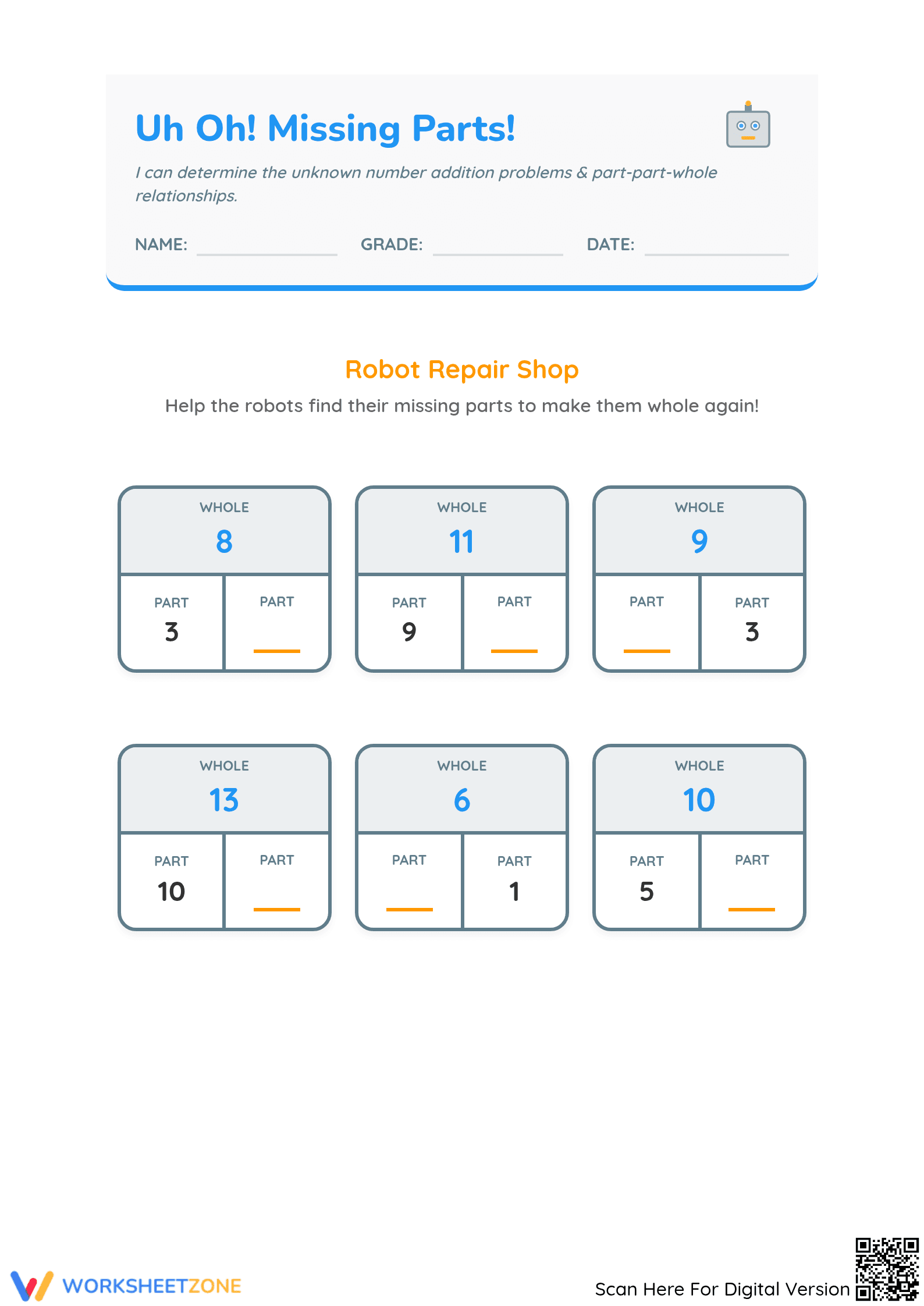
This missing parts worksheet helps first and second-grade students master part-part-whole relationships through a fun, robot-themed repair shop activity. By calculating unknown addends, learners strengthen their mental math fluency and algebraic thinking. This engaging resource provides immediate practice for students to visualize how numbers combine to form a whole, ensuring a solid mathematical foundation.
At a Glance
- Grade: 1–2 · Subject: Math
- Standard:
CCSS.MATH.CONTENT.1.OA.D.8— Determine the unknown whole number in an addition or subtraction equation- Skill Focus: Part-Part-Whole Relationships
- Format: 3 pages · 14 problems · Answer key included · PDF
- Best For: Independent practice and math centers
- Time: 15–20 minutes
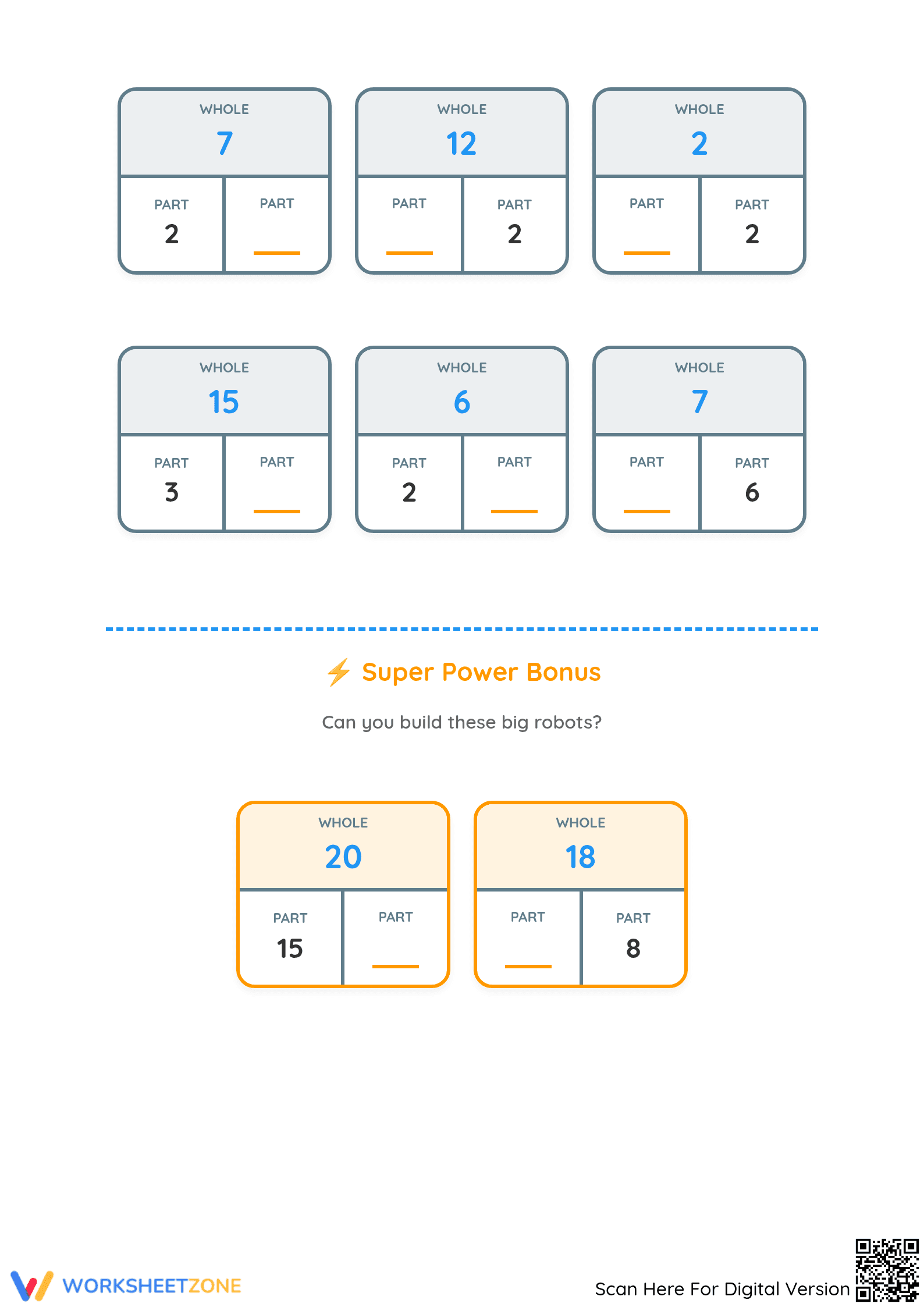
The packet contains 14 structured exercises set within a "Robot Repair Shop" theme across three printable pages. It features 12 standard part-part-whole boxes and a "Super Power Bonus" section with two larger challenges. Each task uses clear visual frames to help students distinguish between parts and the whole. A comprehensive answer key is included for rapid grading and student self-correction.
The zero-prep workflow is designed for maximum teacher efficiency. First, print the three-page PDF in approximately 30 seconds. Second, distribute the worksheets for independent work or use them in a small-group center (1 minute). Finally, use the provided answer key to review student work or allow for peer grading (under 1 minute). Total teacher preparation time is significantly under two minutes, making it an ideal sub-plan or emergency resource.
Primary standards alignment is focused on CCSS.MATH.CONTENT.1.OA.D.8: “Determine the unknown whole number in an addition or subtraction equation relating three whole numbers.” The worksheet also supports foundational algebraic thinking and addition/subtraction fluency. Both standard codes can be copied directly into lesson plans, IEP goals, or district curriculum mapping tools to document student progress toward grade-level mastery.
Use this worksheet as a formative assessment after a lesson on addition and subtraction relationships to observe how students handle the missing part concept. Alternatively, assign the "Super Power Bonus" section to early finishers to challenge their fluency with larger sums up to 20. Observe if students use counting-on strategies or inverse operations to find the missing robotic parts during the activity.
This resource is perfect for first and second graders developing basic arithmetic skills, as well as students needing Tier 2 intervention for number sense. It pairs naturally with part-part-whole mats, unifix cubes, or a digital number line lesson to provide concrete scaffolds before moving to this abstract representation. The friendly robot theme encourages persistence through mathematical problem solving.
This missing parts worksheet is meticulously designed to align with the CCSS.MATH.CONTENT.1.OA.D.8 standard, focusing on the critical skill of determining unknown whole numbers in algebraic equations. Research from RAND AIRS 2024 emphasizes that visual models like part-part-whole frames are essential for bridging the gap between concrete manipulation and symbolic computation in early elementary mathematics. By providing 14 themed problems that range from basic sums to a challenging "Super Power Bonus" reaching 20, this resource ensures that students develop the cognitive flexibility required for higher-order problem solving. The inclusion of a robot theme leverages engagement strategies highlighted by EdReports 2024, which notes that contextualized practice increases time-on-task for primary learners. This complete, three-page printable pack serves as a high-quality instructional tool for both direct instruction and independent practice, offering educators a reliable method to track student progress toward mastery of core mathematical relationships and number fluency.


