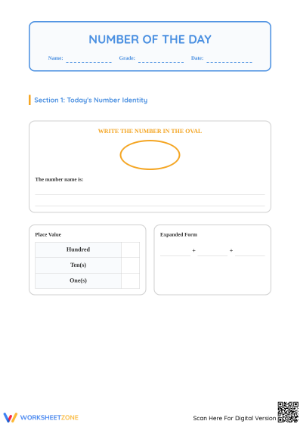
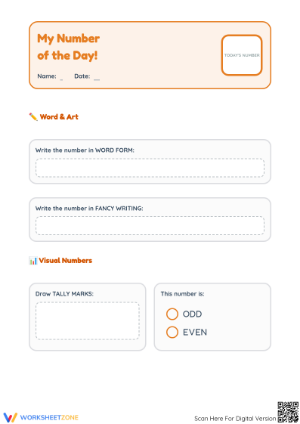
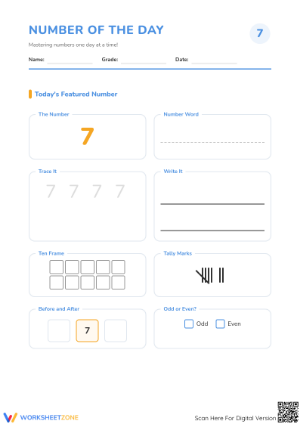
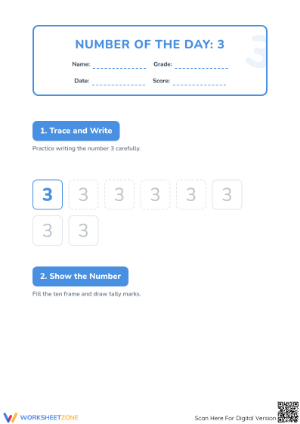
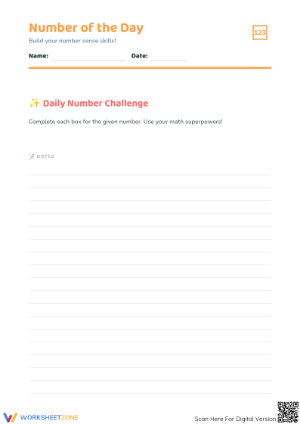
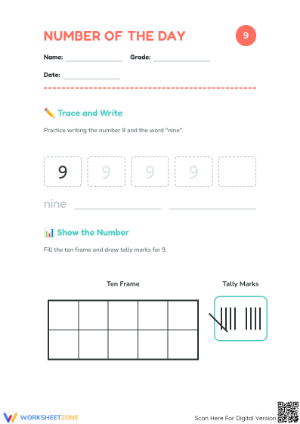
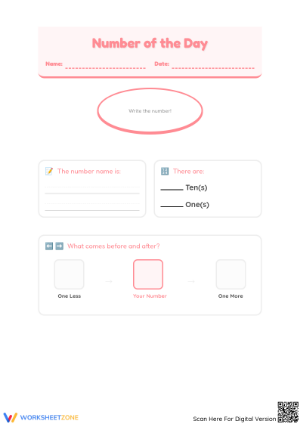
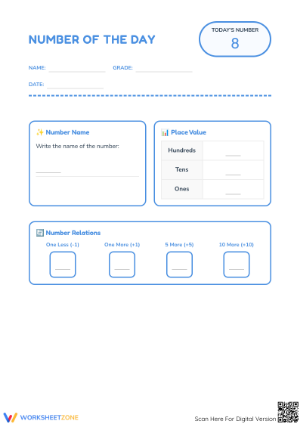
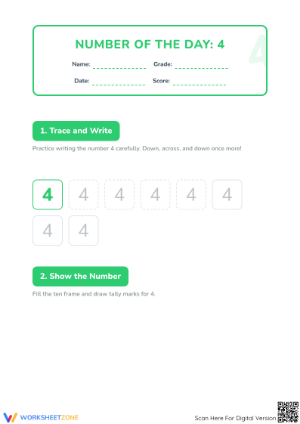
Number of the day printable worksheets for 1st grade give teachers a repeatable warm-up structure that builds number sense incrementally across the school year, starting with single-digit work in September and extending naturally into two-digit territory by winter. Each worksheet asks students to interact with the same number in six or seven different ways — word form, base-ten blocks, ten frame, tally marks, number line placement, and one-more/one-less/ten-more/ten-less relationships — so the representations stay varied while the routine stays predictable.
The Specific Skills Each Worksheet Builds
The daily format covers more ground than it appears to from a distance. Writing the numeral and its word form in the same sitting connects symbolic and linguistic representations — Grade 1 students who can say "thirty-seven" confidently will stall when asked to write it, and this repeated pairing is exactly what closes that gap. The base-ten block section asks students to draw rods and units, which forces decomposition rather than mere recognition. The ten frame section, when used correctly, moves students away from counting by ones toward subitizing: seeing five filled dots and three more as eight without touching each dot individually.
The one-more/one-less/ten-more/ten-less section is where the sharpest mathematical thinking surfaces. Students who handle one-more easily will often stall on ten-more, and watching exactly where that stall happens reveals what they understand about place value structure. The number line placement task is less about precision and more about anchoring — can a student identify that 43 belongs between 40 and 50, sitting closer to 40 than to 50?
Why Multiple Representations Matter at This Grade Level
Grade 1 is the year students shift from counting-all strategies to understanding quantity structure. A child who counts out 34 blocks one by one to verify a number is working well below a child who says "three tens and four ones" and moves on. The format here accelerates that transition by presenting the same number through concrete (base-ten drawings, ten frames), pictorial (tally marks, number line), and abstract (numeral, word form) representations on a single worksheet. Students make those connections themselves, without separate lessons for each representation — which matters in a Grade 1 schedule where the math block often runs only 45 to 50 minutes.
Frequent Errors to Catch Before They Harden Into Habits
Digit reversal is the most common error at this level. A student who writes "21" for twenty-one is not always being careless — many first graders genuinely encode the spoken number ("twen-ty-one") as they hear it, writing the two first. It helps to also check the base-ten block section for the same number: a student who draws two rods and one unit for 21 understands the value but reverses the digits in written form, and that is a different problem than a student who draws one rod and two units. Those two errors require different responses from the teacher.
On the ten-more/ten-less section, the pattern that appears most reliably is students adding or subtracting one to the tens digit while also shifting the ones digit, as if both columns must change together. Given 46, a student will write 57 for ten more rather than 56. This is useful diagnostic information — it tells you the student has not yet internalized that only the tens column changes. The ten frame section produces a subtler error: students fill dots starting in the middle of the frame or in the bottom row first rather than left to right across the top row. When the filled configuration no longer maps cleanly to five-and-some-more, the ten frame loses its purpose as a benchmark tool entirely.
How to Fit These Worksheets Into the Real Schedule of Your Day
The most common placement is the first six to eight minutes after morning meeting — students return to their seats and find the worksheet already on the desk. The predictable format requires zero explanation, which lets the teacher take attendance, handle the lunch count, and do a visual scan of who is using the 120-chart for reference and who is counting on fingers. That scan is its own formative data before a single paper is collected.
The number of the day printable worksheets for 1st grade format also works well as a reentry task after recess, when students need a few minutes of quiet, structured work before a math lesson can start. It's calm enough that it doesn't restart the playground energy, but it demands enough thinking to shift students back into a math mindset. Teachers running center rotations use these as the independent station because the format never changes — students complete them without requesting help, which is essential when the teacher is occupied with a guided group at the back table.
Standard Alignment
These worksheets address CCSS.MATH.CONTENT.1.NBT.B.2 directly — the standard requiring Grade 1 students to understand that the two digits of a two-digit number represent amounts of tens and ones. The base-ten block and place value sections target this standard every single day. The one-more/one-less/ten-more/ten-less section addresses CCSS.MATH.CONTENT.1.NBT.C.5, which asks students to mentally find ten more or ten less than any two-digit number without counting. In standards-based districts, daily use of this routine produces measurable growth on these benchmarks without requiring separate instructional time — the standard is practiced as part of the morning entry activity.
Adjusting the Routine for the Full Range of Learners in Your Room
For students still working with numbers below 20, keeping the number of the day in the single-digit and early teen range lets them build accuracy with the format before larger numbers become a distraction. A number line strip taped to the desk and a printed 120-chart nearby allow these students to locate ten-more and ten-less without the calculation itself blocking completion of the rest of the worksheet.
For students who are ready for greater challenge, the number of the day printable worksheets for 1st grade format extends naturally by asking them to write an equation equaling the number of the day using three addends, or to represent the number two ways using tens and ones — for example, showing 30 as 3 tens and 0 ones but also as 2 tens and 10 ones. High-readiness students in Grade 1 often finish the standard sections in under three minutes; these extensions keep the routine productive rather than an exercise in waiting for the rest of the class.
Frequently Asked Questions
How long should the routine take once students know the format?
Most students settle into six to eight minutes by the fourth or fifth week of consistent use. If the routine runs past ten minutes regularly, the ten-more/ten-less section is almost always where time is being lost. Consider providing a hundred chart for reference until that mental operation becomes automatic — removing that single barrier often brings the whole routine back on pace.
Is it worth collecting and grading these every day?
No. Circulating while students work gives more usable information than a stack of marked papers returned two days later. First graders don't revise their thinking based on written feedback on old work the way older students can. Catching a digit-reversal pattern in the moment and addressing it on the spot — a quick demonstration on the nearby whiteboard — is what actually changes the behavior before it becomes automatic.
How do these worksheets connect to the 100th day of school?
If the number of the day tracks the school-day count, the 100th day becomes a natural landmark rather than an isolated event. Students have been building toward that number all year, and 100 on the worksheet lands with real meaning. The number of the day printable worksheets for 1st grade set is well suited to this approach because the base-ten block section makes it visually unmistakable that 100 is ten full rods — a concept that has been reinforced daily since the first week of school.
Can these be used as homework?
They travel home well because the format is constant — parents can support their child without needing to read new instructions each night. The honest limitation is that the most valuable part of the routine is watching the student's process, not reading the finished product. Treat take-home copies as review rather than a replacement for classroom use, where the teacher's real-time observation does the actual instructional work.













 Interactive Worksheet Maker
 Quiz Maker
 Word Search Maker
 Crossword Puzzle Maker
 Word Scramble Generator
 Sentence Scramble Generator
 Handwriting Worksheet Generator
 Name Tracing Generator
 Fill In The Blank Generator