




























Views
Downloads
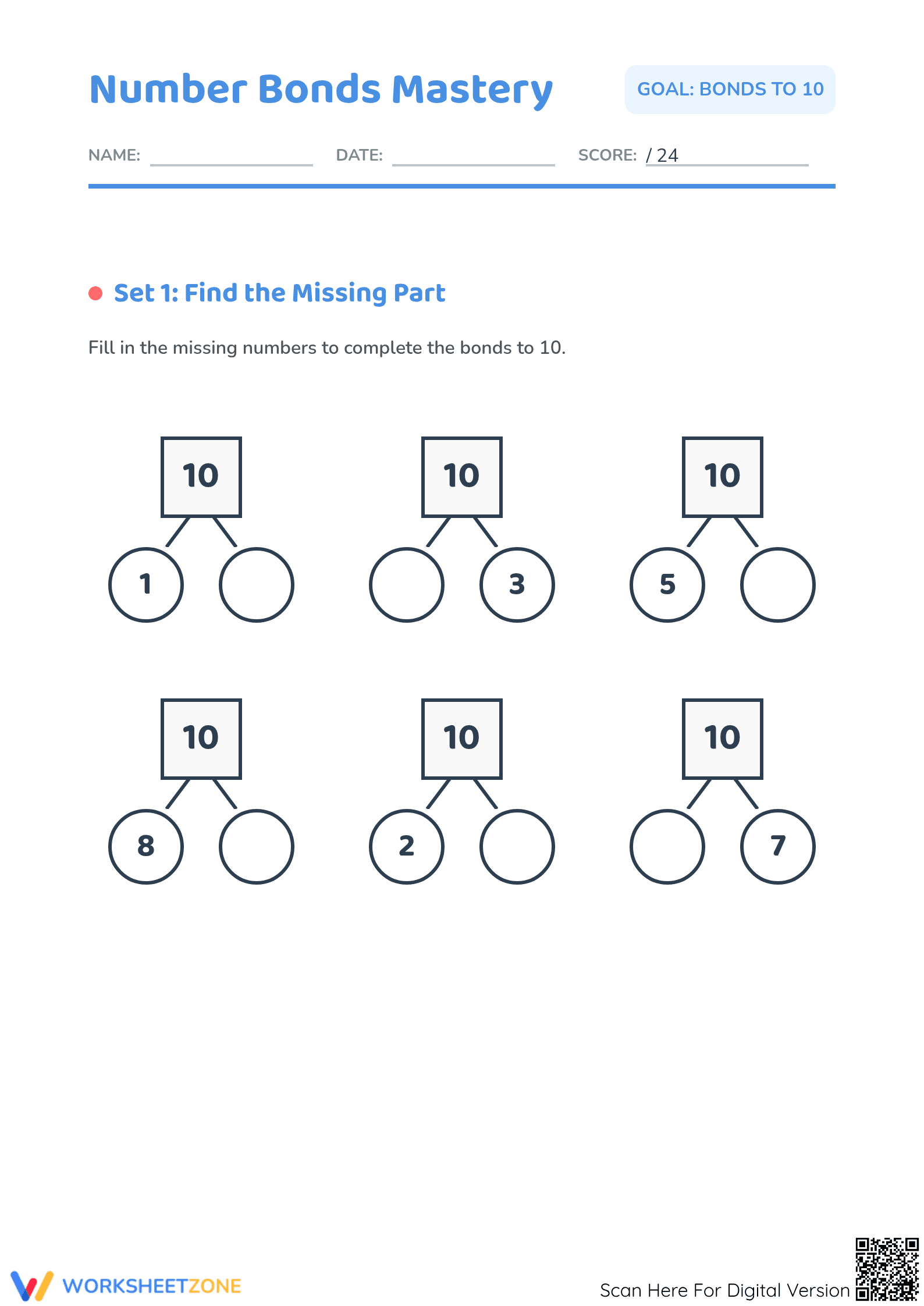


Printable Number Bonds to 10 Worksheet | Grade 1 Math

Paste this activity's link or code into your existing LMS (Google Classroom, Canvas, Teams, Schoology, Moodle, etc.).
Students can open and work on the activity right away, with no student login required.
You'll still be able to track student progress and results from your teacher account.
This printable Grade 1 Math worksheet provides a comprehensive approach to mastering number bonds to 10. By focusing on part-part-whole relationships, students develop the mental fluency required for foundational arithmetic. This resource ensures that learners can confidently identify missing components in addition pairs, setting the stage for more complex mathematical reasoning in later grades.
At a Glance
- Grade: 1 · Subject: Math
- Standard:
CCSS.MATH.CONTENT.1.OA.C.6— Fluently add and subtract within 10 using various mental strategies- Skill Focus: Number Bonds to 10
- Format: 2 pages · 15 problems · Answer key included · PDF
- Best For: Daily math warm-ups or independent practice
- Time: 15–20 minutes
This 2-page PDF features 15 structured diagrams across four distinct difficulty sets. The resource includes missing-part problems, "tricky" bonds to challenge misconceptions, and a dedicated challenge section. The final set integrates fact families, requiring students to translate visual bonds into formal addition sentences. A complete answer key is provided for rapid grading and student self-correction.
The workflow for this resource is designed for maximum efficiency in a busy classroom. First, print the 2-page document (30 seconds). Second, distribute the sheets for a morning warm-up or independent center activity (1 minute). Third, review the results using the included answer key (1 minute). Total teacher preparation and assessment time remains under three minutes, making it an ideal choice for emergency sub plans or supplemental practice.
The primary standard addressed is CCSS.MATH.CONTENT.1.OA.C.6, which requires students to demonstrate fluency for addition and subtraction within 10. The worksheet also supports 1.OA.D.8 by asking students to determine the unknown whole number in an addition equation. Both standard codes can be copied directly into lesson plans, IEP goals, or district curriculum mapping tools to ensure instructional alignment across the academic year.
Use this worksheet as a formative assessment during a unit on addition strategies or as a retrieval practice tool after direct instruction. One effective tip is to observe whether students use "counting on" strategies or if they recall the bonds from memory. This observation helps teachers identify which students require additional concrete support with manipulatives. This task typically takes 15 to 20 minutes to complete depending on student mastery levels.
This resource is tailored for first-grade students but serves as an excellent intervention tool for second-graders needing fluency support. It pairs naturally with ten-frame manipulatives or a "Number Bonds to 10" anchor chart to provide multi-modal support for students struggling with abstract numerical concepts. The clear layout and progressive difficulty ensure that all learners can engage with the material at their own pace.
This Grade 1 worksheet targets fluency with number bonds to 10, a foundational skill for mental arithmetic and place-value understanding. By visualizing part-part-whole relationships through interactive diagrams and fact families, students build the cognitive scaffolds necessary for multi-digit addition. According to the RAND AIRS 2024 analysis of primary mathematics curricula, early mastery of number combinations within 10 is the strongest predictor of later success in algebraic thinking and numerical flexibility. The resource aligns with CCSS.MATH.CONTENT.1.OA.C.6, emphasizing the decomposition of numbers and the relationship between addition and subtraction. Research by Fisher & Frey (2014) supports the use of such graphic organizers to bridge the gap between concrete manipulatives and abstract symbolic notation. Educators can use this printable tool to monitor student progress toward foundational standards while providing a low-threshold, high-ceiling task that supports diverse learners in the first-grade classroom environment.


