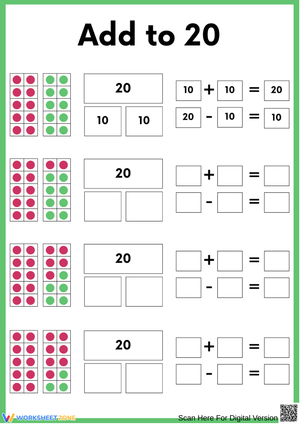
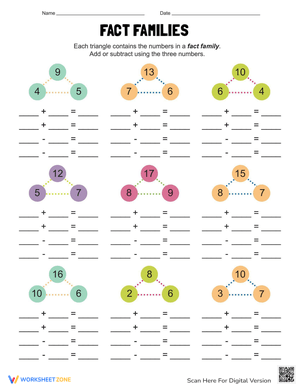
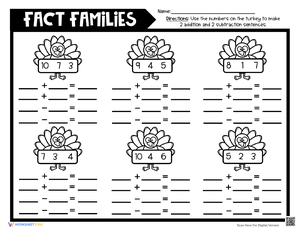
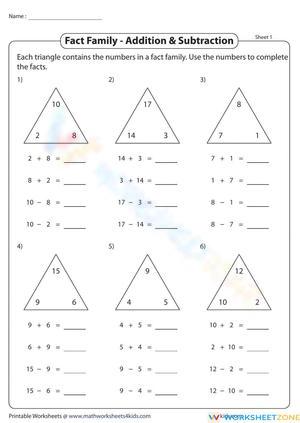
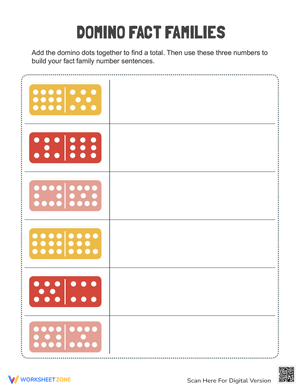
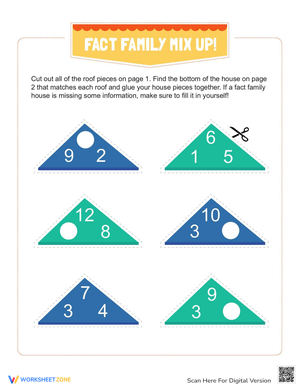
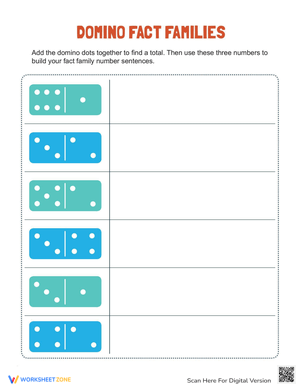
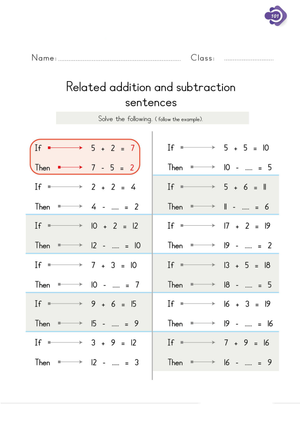
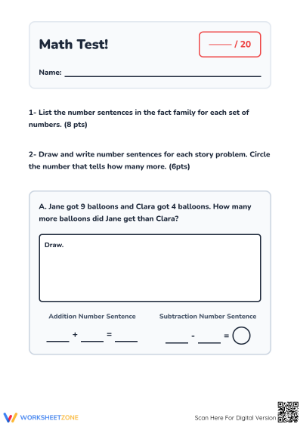
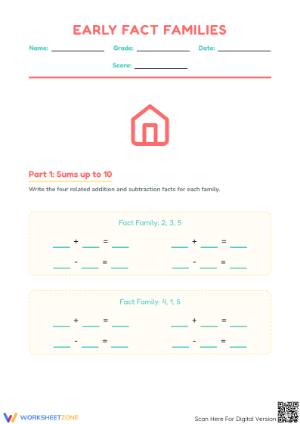
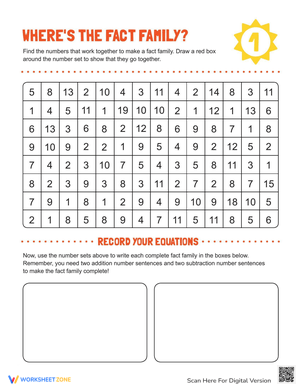
These 1st grade fact family printable worksheets give teachers a ready-to-use set of practice activities built around three visual formats: fact family houses, number triangles, and part-part-whole sentence frames. The set covers number combinations through sums of 20 and moves from guided equation-completion to tasks where students generate all four related facts independently. Each worksheet targets one format at a time, which keeps students focused on the math rather than on decoding new directions.
What Students Practice Across the Set
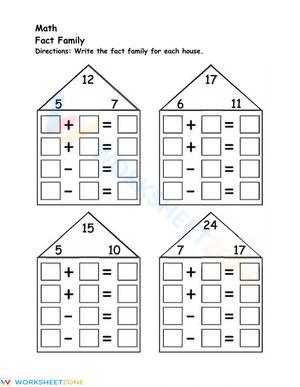
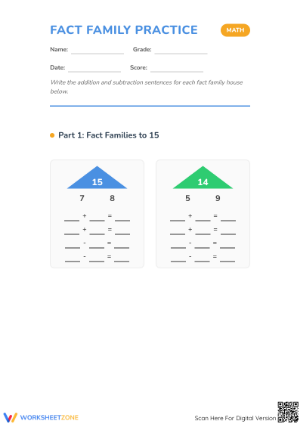
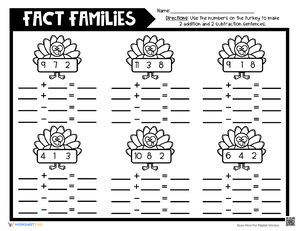
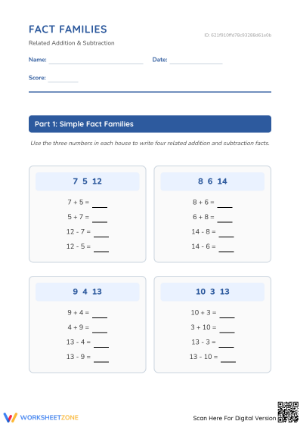
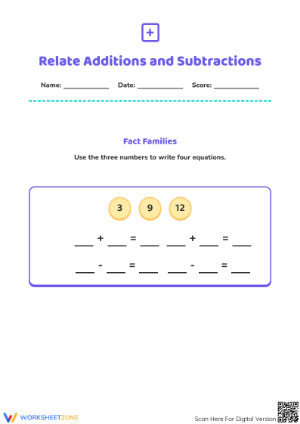
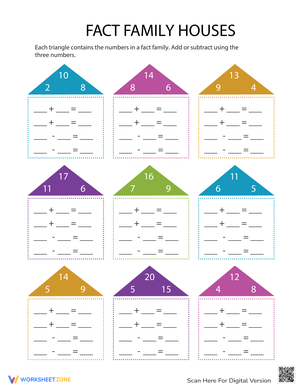
The fact family house worksheets place three numbers in the roof and leave four equation frames blank in the main body. Students fill in both addition sentences and both subtraction sentences using only those three numbers. The triangle worksheets operate differently: one number is shaded out, and students must determine the missing value before writing the equations. That single step — finding the missing number first — is what makes the triangle format effective for building inverse-operation thinking rather than just equation-copying. Part-part-whole sentence frames bridge the gap between number bond diagrams and formal equation writing, which teachers often need in the first weeks of fall when students have seen number bonds in kindergarten but haven't yet written four-equation families. A cut-and-sort set asks students to match individual equations to the correct number family, separating the task of recognition from the task of generation.
Common Student Mistakes Teachers Should Anticipate and Address
The most consistent error in first-grade fact family work is stopping at three equations. Students will write 5 + 3 = 8, then 3 + 5 = 8, then 8 - 3 = 5 — and stop. The second subtraction sentence (8 - 5 = 3) doesn't feel meaningfully different to them; it looks like a near-duplicate. Pointing to the two completed subtraction sentences on a model and asking, "Which part are we taking away each time?" redirects faster than re-teaching the whole concept from scratch.
A second pattern appears when students transfer commutativity logic to subtraction incorrectly. They know addition can flip (4 + 6 = 6 + 4), so some students write 3 - 8 = 5 alongside 8 - 3 = 5. They understand the three numbers belong together; they don't yet have a firm sense that the largest number has to lead a subtraction sentence. Having students identify which number lives "in the roof" of the house before writing anything is a low-effort habit that catches this before it becomes an ingrained error.
How to Build These Worksheets Into Your Lesson Plans
Spreading practice across a week works better than clustering it. A Monday warm-up using the house format, a mid-week center rotation with the triangle worksheets, and a Friday formative check using the cut-and-sort activity gives students distributed repetition without making fact families feel like a daily slog. The triangle format works especially well for a two-minute whole-class number talk under a document camera — display one worksheet, cover a corner with a sticky note, and take quick responses before students scatter to their seats.
Once students have had a guided introduction to each format, the 1st grade fact family printable worksheets in this set work well as independent center activities through the fall. The house and sentence-frame worksheets are accessible by late September for most first graders. The triangle worksheets and cut-and-sort activities are better saved for small-group rotations until students can generate all four equations without support.
Standard Alignment
These worksheets address CCSS.MATH.CONTENT.1.OA.B.3 (applying properties of operations to add and subtract) and CCSS.MATH.CONTENT.1.OA.B.4 (understanding subtraction as an unknown-addend problem). In classroom terms, 1.OA.B.4 is the center of fact family work — it asks students to reframe 10 - 6 = ? as "what do I add to 6 to reach 10?" rather than a counting-back problem. The triangle format directly supports this because students must find the missing part before they can write any equations. The set also touches CCSS.MATH.CONTENT.1.OA.C.6, which covers adding and subtracting within 20 using mental strategies. Students who see 13 - 7 as a related fact to 7 + 6 = 13 are doing exactly the mental strategy work that standard describes, and consistent fact family practice is one of the more direct paths there.
Differentiating These Worksheets Across Ability Levels
Students working below grade level on number combinations can use the house worksheets with families that sum to 10 or below, while the rest of the class works through sums to 20. No alternate materials are needed — the same worksheet format with smaller numbers reduces demand without changing the structure. The cut-and-sort worksheets are also a useful entry point for students who struggle to produce equations independently, since the equations are already written and students are categorizing rather than generating from scratch.
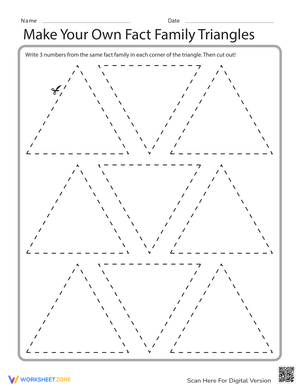
For students who have the four-equation structure solid, blank triangle templates paired with two dice extend the work without adding complexity: students roll, find the sum, record the three numbers, and generate the full family independently. The 1st grade fact family printable worksheets in this set include these blank templates alongside the structured formats so they're ready when students are. A student who begins mentally verifying subtraction by recalling the related addition fact is working beyond what the structured worksheets target and is ready for a wider number range or a multi-step context.
Frequently Asked Questions
Does sequence matter — should the house format come before the triangle format?
In practice, yes. The house format provides all three numbers and asks students to write the equations, so the demand is organizational rather than problem-solving. The triangle format hides one number and requires students to find it first, which means actually using the inverse relationship rather than just representing it. Most teachers introduce the house for two or three days, then shift to triangles once students have the equation-writing structure down. Moving too quickly to triangles means students are managing an unfamiliar format and an unfamiliar missing-number step at the same time — which is more cognitive pressure than is useful at this stage.
How many practice sessions does a first grader typically need before fact families are solid?
Five to eight structured sessions spread across two to three weeks is a reasonable range for most students. What matters more than session count is whether errors are being caught and addressed during practice. A student who works through the 1st grade fact family printable worksheets and consistently writes three equations instead of four needs correction before the next session — otherwise practice is cementing the incomplete understanding rather than the full concept.
What if a student knows their addition facts but still struggles with the related subtraction?
Memorized addition facts and understanding the inverse relationship are not the same thing. A student who can recall 7 + 6 = 13 without hesitation may still pause at 13 - 7 = ? because they haven't yet connected those two facts as members of the same family. The triangle worksheets surface this gap reliably, since they present equations with the missing value in different positions — not just a missing answer, but a missing minuend or subtrahend. When students hit that wall, returning to the house format with a smaller number set and physically moving counters between the two groups often closes the gap faster than more equation practice alone.













 Interactive Worksheet Maker
 Quiz Maker
 Word Search Maker
 Crossword Puzzle Maker
 Word Scramble Generator
 Sentence Scramble Generator
 Handwriting Worksheet Generator
 Name Tracing Generator
 Fill In The Blank Generator