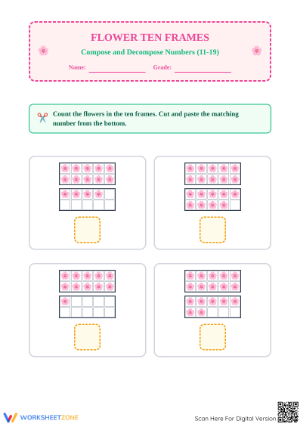
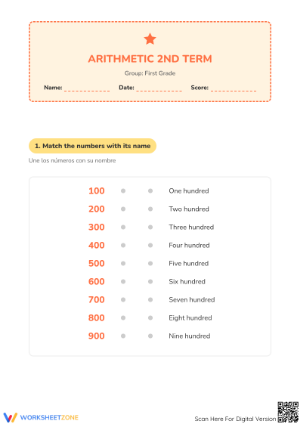
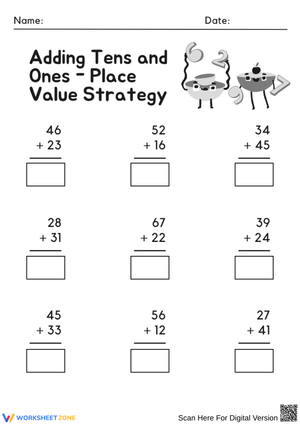
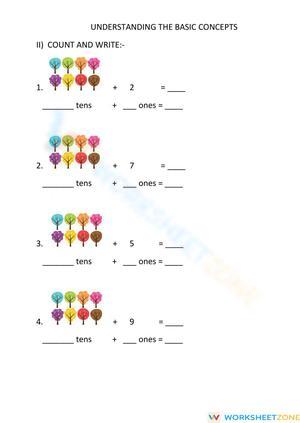
These place value worksheets for 1st grade give teachers a concrete, print-ready path from counting single objects to reading two-digit numbers as composed quantities — the shift that makes addition and subtraction finally make sense. Each worksheet targets a specific skill within the base-ten system, so teachers can assign exactly what a student needs without sorting through a mixed-format packet.
What's Inside the Set
The worksheets cover the core skill progressions first graders move through as they build base-ten understanding. Each worksheet stays focused on one concept:
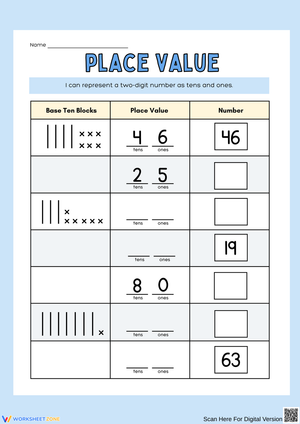
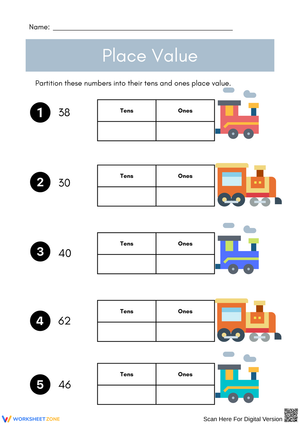
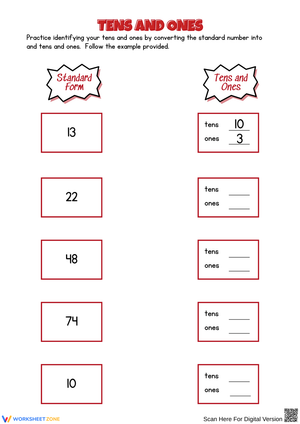
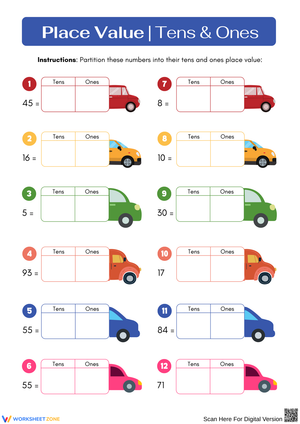
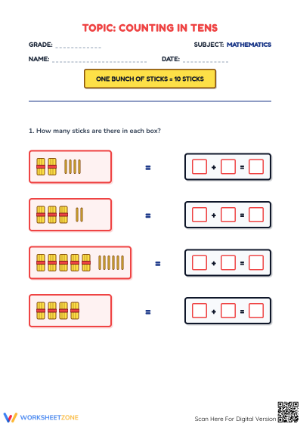
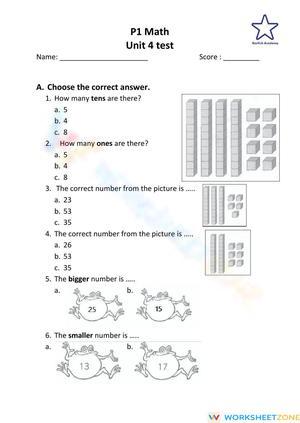
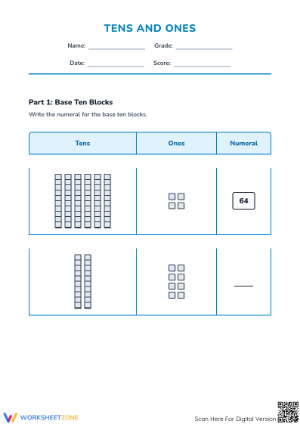
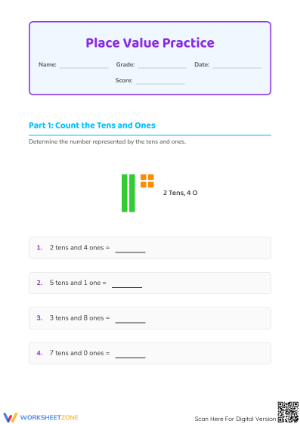
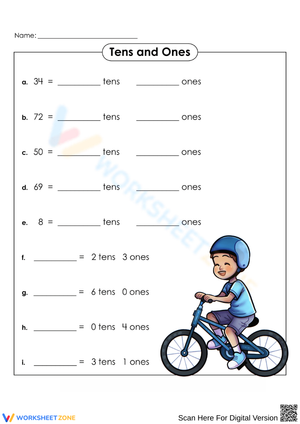
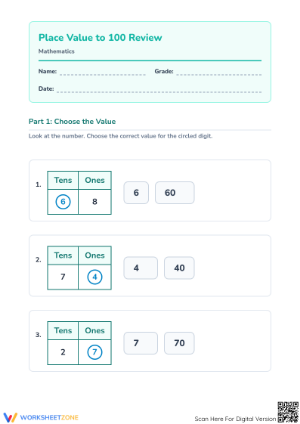
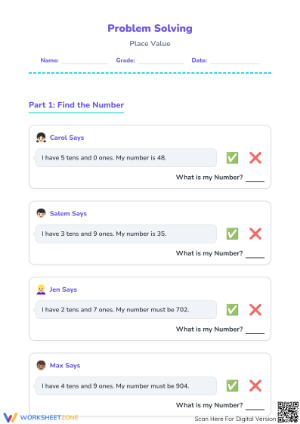
- Tens and ones charts — students write how many tens and ones make up a given two-digit number, working directly with the positional language of the base-ten system.
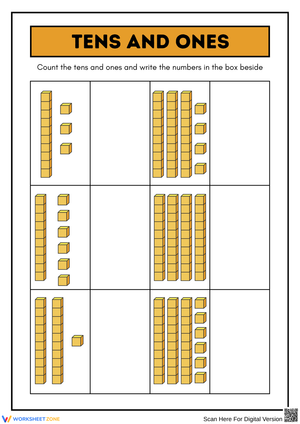
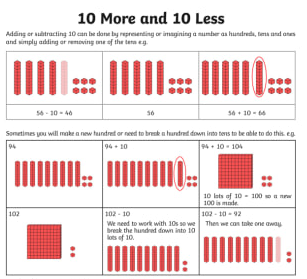
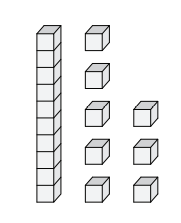
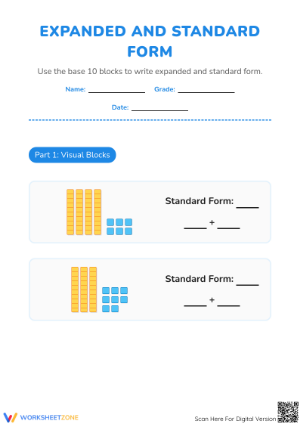
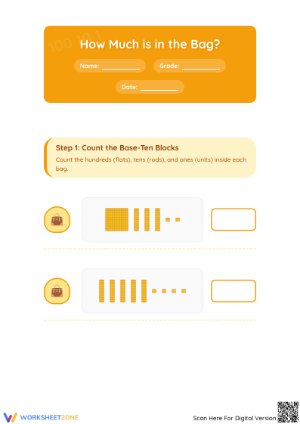
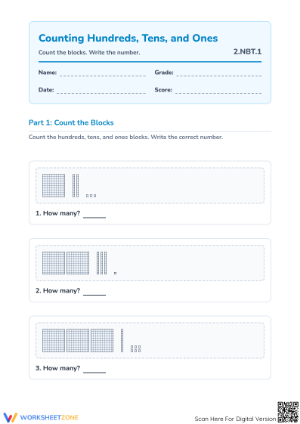
- Base-ten block representations — students count drawn rod-and-unit diagrams and write the matching number, or reverse the task by drawing blocks to represent a written number.
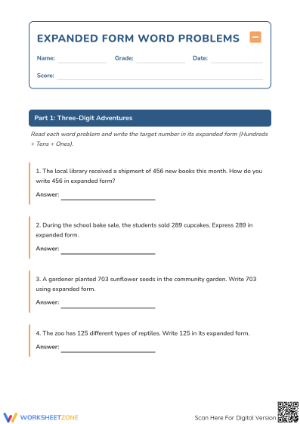
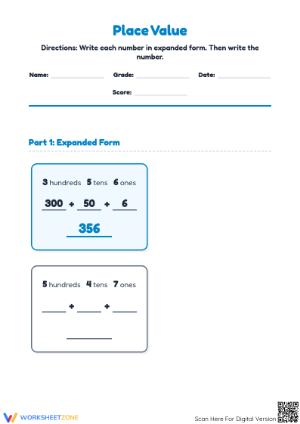
- Expanded form — students write two-digit numbers as a sum (47 = 40 + 7), making the value each digit contributes explicit rather than implied.
- Missing addend problems — students complete equations like 60 + ___ = 68, building flexibility with number structure and laying groundwork for later addition strategies.
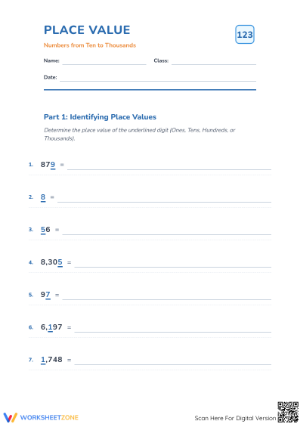
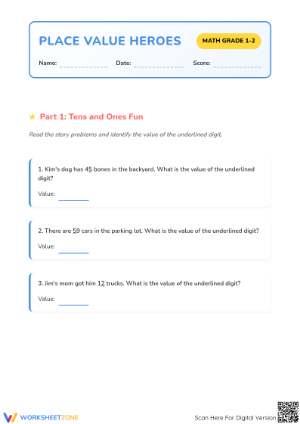
- Digit identification and number sequences — students name the value a digit holds within a two-digit number and complete sequences that reinforce counting patterns within the base-ten structure.
The number range spans 0 to 120 to match Grade 1 expectations. Worksheets that stay within numbers up to 50 appear first in the set, giving students room to build confidence before the numbers grow toward 120.
Mistakes Students Make That These Worksheets Surface Quickly
The most common error in tens-and-ones work is digit transposition. A student who reads 73 will write "3 tens and 7 ones" rather than "7 tens and 3 ones" — not because of carelessness, but because they are reading digits left-to-right without attaching positional meaning to them. This pattern shows up clearly in completed tens-and-ones charts, making it easy to identify before it hardens into a misconception that travels into second-grade work.
Expanded form surfaces a different confusion. Students who understand that 47 contains a 4 and a 7 will still write 4 + 7 = 47 instead of 40 + 7 = 47. They are splitting the digits, not the values. That distinction — digit versus value — is the conceptual core of 1.NBT.B.2, and seeing it in completed worksheets is one of the fastest diagnostic signals available. If half the class makes this error, the pictorial and abstract phases likely moved forward before the concrete understanding was solid.
Standard Alignment
The primary standard addressed here is 1.NBT.B.2, which requires first graders to understand that the two digits of a two-digit number represent amounts of tens and ones — not just a string of symbols. 1.NBT.B.2a specifies that 10 is a bundle of ten ones, a concept the base-ten block and bundling worksheets address directly. In most Grade 1 pacing guides, this cluster falls mid-year, after students have built linear counting fluency to 120 and before the class moves into two-digit addition in the 1.NBT.C domain. Worksheets placed at this juncture give teachers a clear check on whether the conceptual foundation is ready for the procedural work ahead.
Building These Worksheets Into Your Lesson Plans
Worksheet practice lands better after students have worked with physical manipulatives. A sequence that works consistently in first-grade classrooms: students bundle snap cubes into groups of ten and count bundles alongside loose ones (concrete), then draw rod-and-unit diagrams on whiteboards or place value mats (pictorial), then complete a worksheet with no visual support (abstract). Moving directly to paper without the first two phases often produces finished worksheets that mask genuine confusion rather than revealing it.
For lesson timing, these worksheets fit into the final 8 to 10 minutes of a math block as a consolidation task, into Monday morning warm-ups to reactivate last week's learning, or into independent math centers while the teacher pulls a small group. Collected as exit slips, they work as fast formative data — a stack of twenty takes under five minutes to sort into three piles: ready, almost, and needs reteaching. That sorting habit is what makes place value worksheets for 1st grade genuinely useful for small-group planning, not just for keeping students occupied.
Differentiating the Set Across Learner Readiness Levels
Students who are not yet secure with numbers beyond 20 do better on tens-and-ones charts limited to numbers up to 50, with base-ten block images already drawn and sentence frames printed on the worksheet. Removing the drawing task keeps cognitive demand focused on the concept rather than on production work.
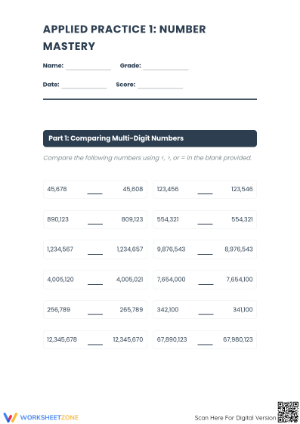
On-level students work through the full worksheet range — tens and ones charts, expanded form, and missing addend problems — with numbers extending through 99. For students who are ready for more, place value worksheets for 1st grade that include numbers from 100 to 120, two-digit comparison using inequality symbols, and multi-step decomposition problems extend the work without pulling outside Grade 1 standards. That matters for teachers in mixed-readiness classrooms who want to challenge advanced students without formally moving them into second-grade content before the year ends.
Frequently Asked Questions
What place value skills should first graders have by end of year?
By the close of Grade 1, students should read any two-digit number as a count of tens and ones, represent numbers up to 120 using drawings or base-ten materials, write numbers in expanded form, and compare two-digit numbers using >, =, and <. These expectations are laid out in the 1.NBT.B domain of the Common Core State Standards for Mathematics.
How do I help a student who keeps transposing tens and ones?
Return to physical bundling before returning to paper. Have the student count loose cubes, rubber-band groups of ten, and then record what they built — bundles and leftovers — on a simple tens-and-ones mat. The act of constructing the tens themselves reattaches meaning to position in a way that reading a printed digit does not. Once the student handles this reliably with objects, move to picture-based worksheets before returning to chart work with no visual support. Short sessions of 5 to 8 minutes repeated over several days produce more durable learning than a single longer intervention.
Why does this concept get introduced mid-year rather than at the start of Grade 1?
First graders need a solid linear count to 120 before base-ten structure makes intuitive sense. Introducing tens and ones too early — when students are still building one-to-one correspondence and rote counting sequences — often results in digit-labeling without real understanding, which is exactly the transposition error described above. By mid-year, students have enough number experience that bundling ten cubes and calling it "one ten" registers as a genuine insight rather than a confusing rule. That developmental timing is one reason consistent use of place value worksheets for 1st grade across the second half of the year, rather than concentrated in a single unit, produces stronger retention.













 Interactive Worksheet Maker
 Quiz Maker
 Word Search Maker
 Crossword Puzzle Maker
 Word Scramble Generator
 Sentence Scramble Generator
 Handwriting Worksheet Generator
 Name Tracing Generator
 Fill In The Blank Generator