




























Views
Downloads

Printable Counting to 20 Worksheet | Grade K Math

Paste this activity's link or code into your existing LMS (Google Classroom, Canvas, Teams, Schoology, Moodle, etc.).
Students can open and work on the activity right away, with no student login required.
You'll still be able to track student progress and results from your teacher account.
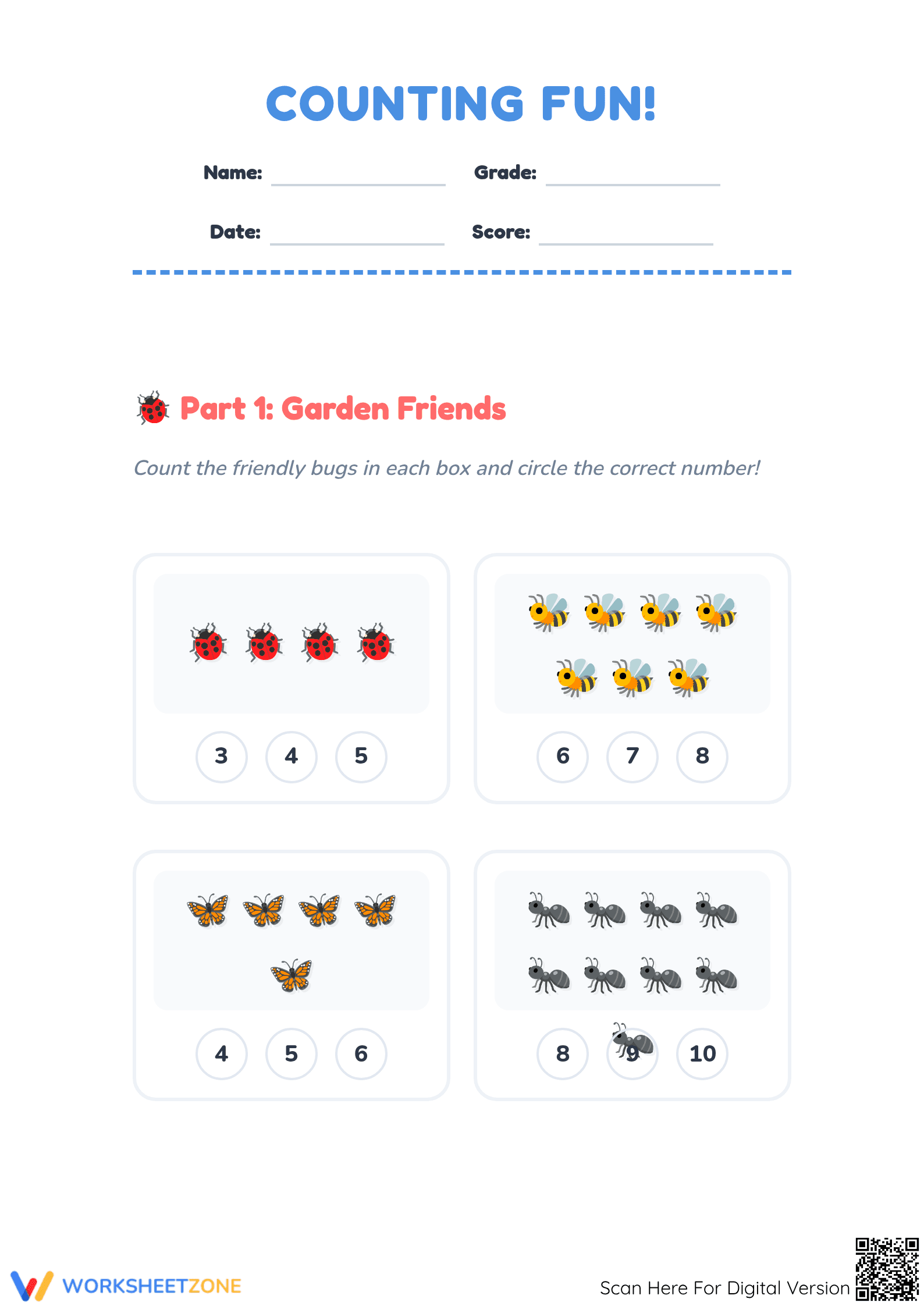
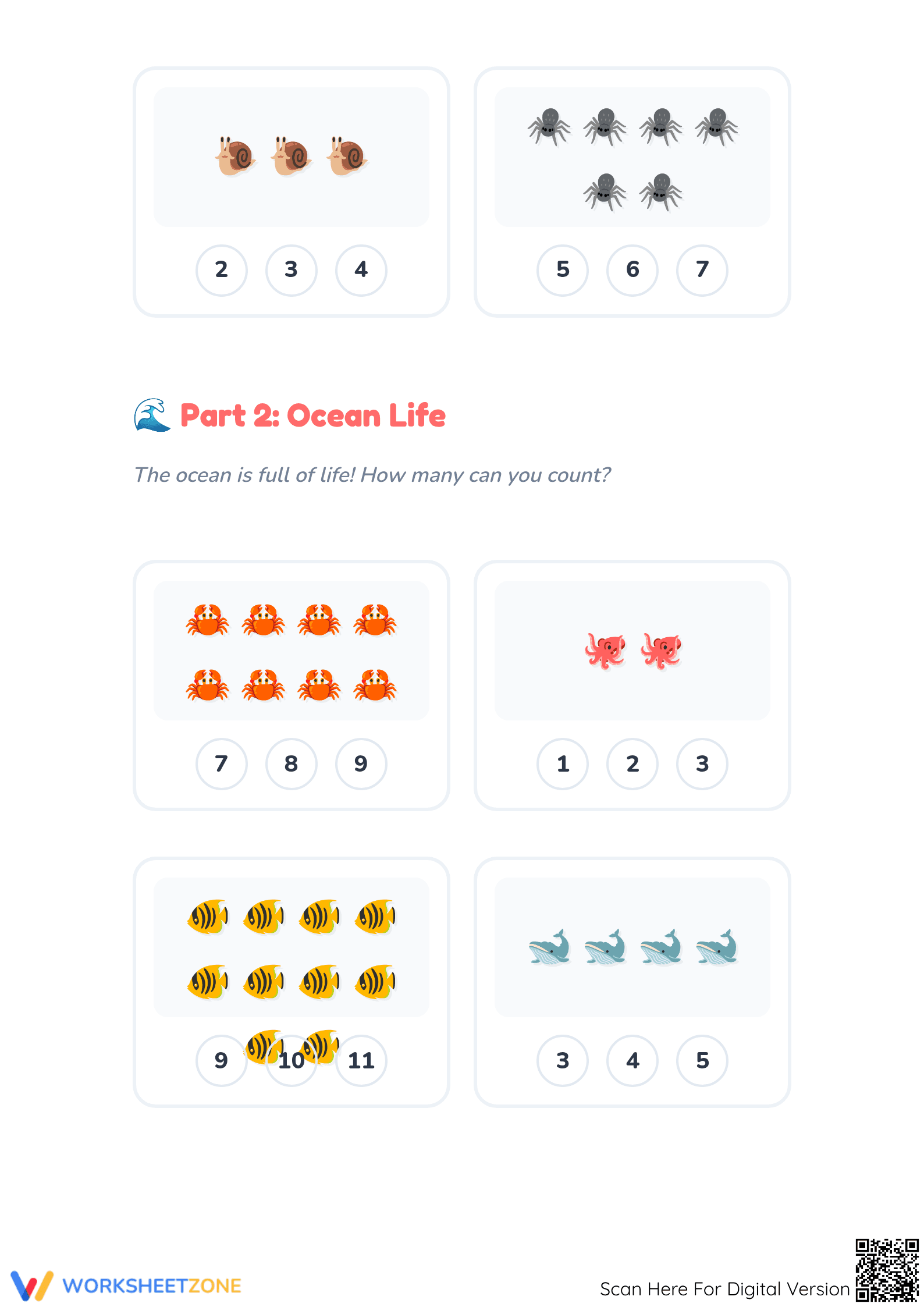
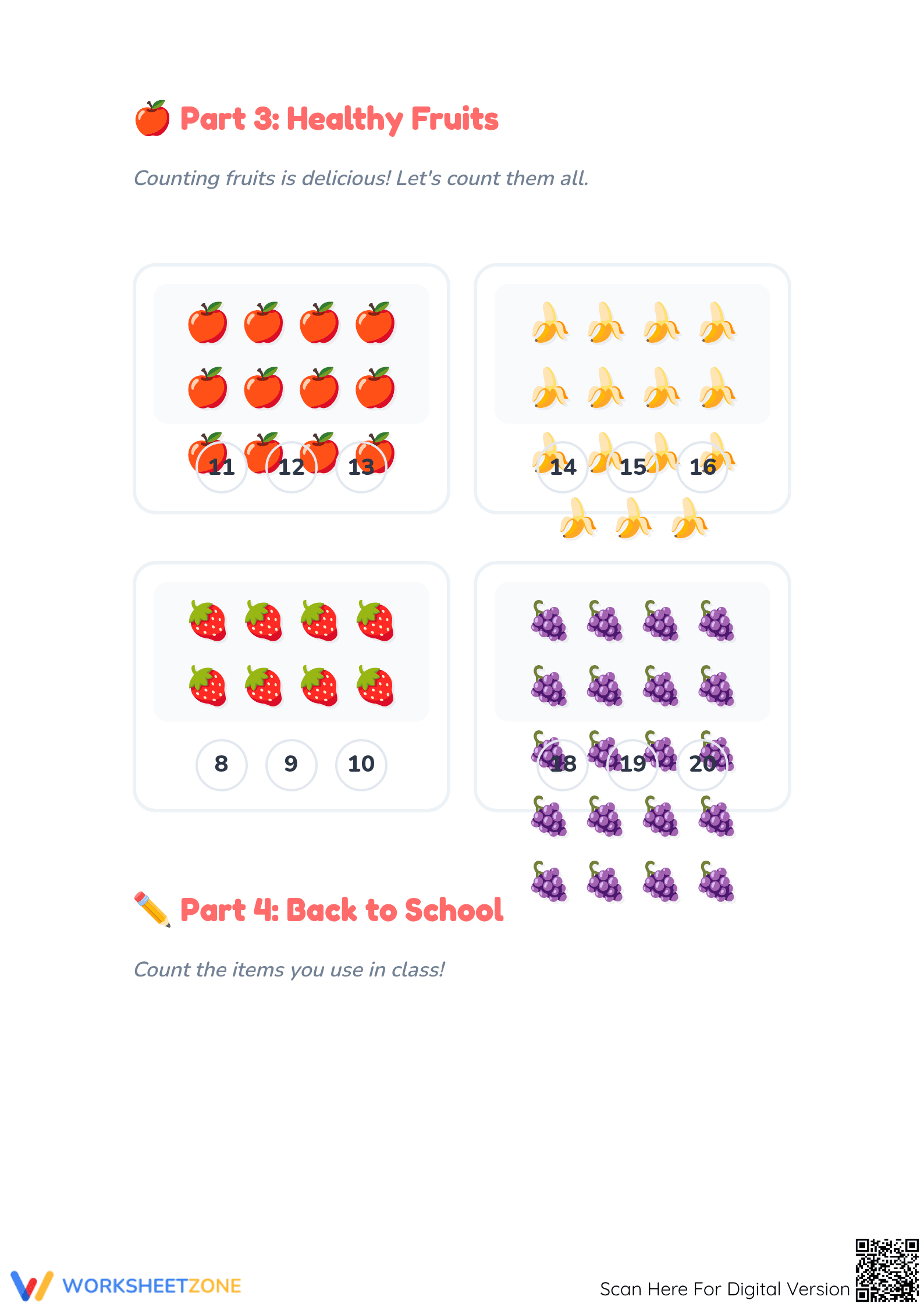
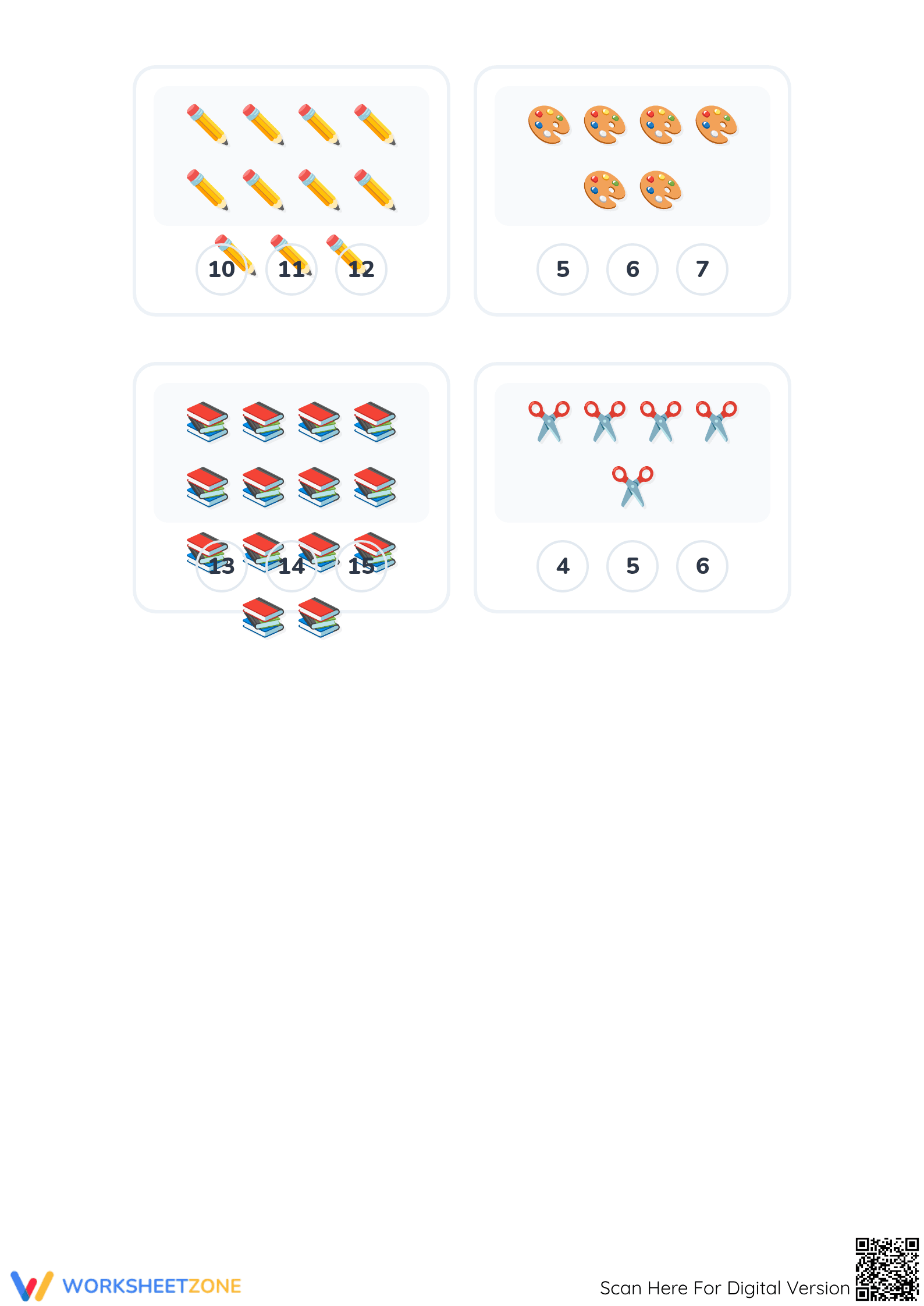
This worksheet provides focused practice for Kindergarten and first-grade students on the foundational skill of counting. Across four themed pages, learners will count sets of objects up to 20 and identify the corresponding numeral. It’s an ideal resource for building number sense and one-to-one correspondence.
At a Glance
- Grade: K–1 · Subject: Math
- Standard:
CCSS.MATH.CONTENT.K.CC.B.5— Count up to 20 objects to answer "how many?"- Skill Focus: Counting objects and identifying numerals up to 20
- Format: 4 pages · 16 problems · Answer key included · PDF
- Best For: Independent practice, math centers, or homework
- Time: 15–20 minutes
What's Inside
This four-page PDF includes 16 counting problems divided into four fun themes: "Garden Friends," "Ocean Life," "Healthy Fruits," and "Back to School." Students count colorful illustrations and circle the correct number from three choices. A full answer key is included for easy grading.
Skill Progression
The worksheet follows a gradual release model to build student confidence.
- Guided Practice: The first page features numbers up to 10, perfect for a teacher-led warm-up.
- Supported Practice: The next two pages increase the range, asking students to count sets of objects up to 20 with clear visual support.
- Independent Practice: The final page allows students to independently apply their counting strategies to numbers within the 1-20 range, demonstrating skill mastery.
This progression mirrors the "I Do, We Do, You Do" structure, ensuring all learners can access the material.
Standards Alignment
This resource is directly aligned with CCSS.MATH.CONTENT.K.CC.B.5, which requires students to count objects to answer "how many?" questions for sets up to 20. It also provides foundational practice for Grade 1 standard CCSS.MATH.CONTENT.1.NBT.A.1. These standard codes can be copied directly into lesson plans or curriculum maps.
How to Use It
Use this worksheet after a lesson on counting strategies, as independent work in a math center, or for homework. It also serves as a quick formative assessment. To assess, observe if students are touching each object as they count. Most will complete the sheet in 15-20 minutes.
Who It's For
Designed for Kindergarteners learning to count to 20 and first graders needing review, this worksheet's clear visuals support all learners. For extra help, pair with manipulatives. For a challenge, ask students to write the numeral instead of circling it.
Grounded in the principles of explicit skill practice, this worksheet directly addresses CCSS.MATH.CONTENT.K.CC.B.5, which focuses on counting objects to answer "how many?". Developing this automaticity in counting is a critical precursor to later arithmetic skills, a finding supported by extensive research on early numeracy. According to the NAEP framework, a strong foundation in number properties and operations begins with the ability to accurately count and represent quantities. This resource provides the structured, repetitive practice that helps students build that foundation. By engaging with 16 distinct problems, learners move from concrete object counting to abstract number recognition, a key transition highlighted in early childhood math education. The worksheet's design facilitates the development of one-to-one correspondence, a cornerstone of numerical understanding, preparing students for more complex operations like addition and subtraction.


