




























Views
Downloads




Printable Base Ten Blocks Game | Grade 1 Math

Paste this activity's link or code into your existing LMS (Google Classroom, Canvas, Teams, Schoology, Moodle, etc.).
Students can open and work on the activity right away, with no student login required.
You'll still be able to track student progress and results from your teacher account.
This printable Grade 1 math worksheet builds place value mastery through an interactive classroom game. Students practice translating base-ten block representations into two-digit numbers to complete a cooperative loop. This activity reinforces how tens and ones compose numbers up to 99, ensuring active participation and immediate peer feedback.
At a Glance
- Grade: Grade 1 · Subject: Math
- Standard:
CCSS.MATH.CONTENT.1.NBT.B.2— Understand that two-digit numbers represent amounts of tens and ones- Skill Focus: Base-ten block representation
- Format: 4 pages · 30 cards · Answer key not included · PDF
- Best For: Whole-class place value review
- Time: 15–20 minutes
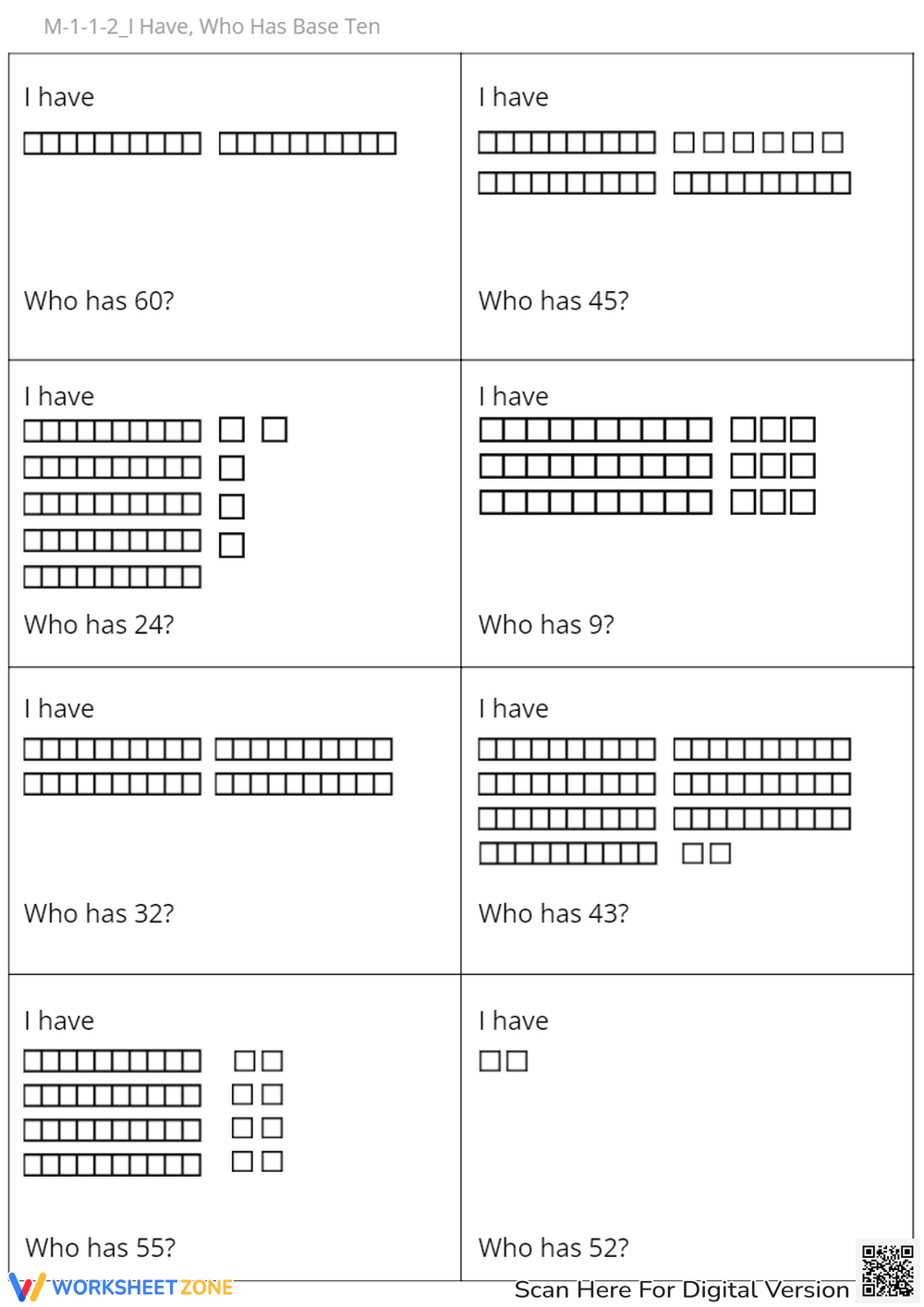
This resource contains 30 unique game cards spread across 4 printable pages. Each card features a clear visual representation of a two-digit number using standard base-ten rods and unit cubes, paired with a question asking for a different number. The cards form a continuous loop, allowing the game to start and end with any student. The clean, high-contrast layout ensures readability for young learners.
Implement this activity with a simple three-step workflow. First, print the 4 pages and cut the cards along the guidelines, taking less than 2 minutes of prep time. Second, distribute one card to each student in the classroom. Third, have the starting student read their card aloud, initiating a chain reaction where classmates listen, match their base-ten visuals, and respond. This structure makes it an excellent, low-stress option for substitute teacher plans.
Standards Alignment
This activity aligns directly with the Common Core State Standard CCSS.MATH.CONTENT.1.NBT.B.2, which requires students to understand that the two digits of a two-digit number represent amounts of tens and ones. By visually decoding the rods and units on each card, students reinforce their conceptual understanding of place value. Both standard codes can be copied directly into lesson plans, IEP goals, or district curriculum mapping tools.
How to Use It
Use this game as a warm-up activity before direct instruction to activate prior knowledge, or as a formative assessment at the end of a place value unit. While students play, observe their ability to quickly count tens and ones without recounting individual units. The entire game loop typically takes 15 to 20 minutes to complete, making it a highly efficient review tool.
Who It's For
This resource is designed for first-grade students learning foundational place value concepts, but it also serves as an excellent intervention tool for second-grade students needing extra support. It pairs naturally with physical base-ten blocks or a digital interactive whiteboard display. The cooperative nature of the game supports English language learners by providing auditory and visual reinforcement simultaneously.
According to the NAEP mathematics framework, developing a strong conceptual understanding of place value in early grades is a critical predictor of future success in multi-digit arithmetic. This game utilizes visual representations of base-ten blocks to help students bridge the gap between concrete models and abstract numerical symbols. Research from Fisher & Frey (2014) highlights that cooperative, structured speaking tasks like "I Have, Who Has" enhance student engagement and reinforce academic vocabulary through peer-to-peer interaction. By aligning directly with the standard code CCSS.MATH.CONTENT.1.NBT.B.2, this resource ensures that students practice identifying tens and ones in a structured, low-stakes environment. The game loop provides multiple opportunities for students to hear and see the target math concepts, solidifying their understanding of two-digit numbers.


