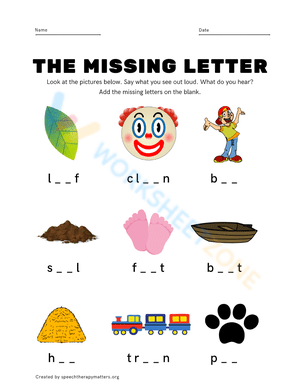
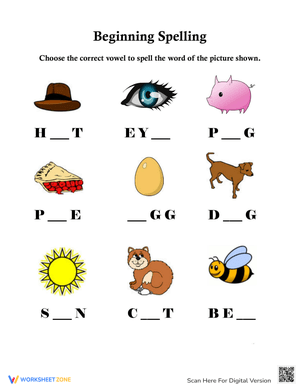
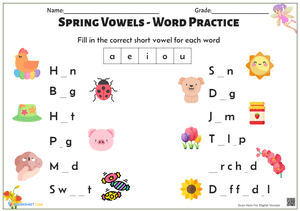
1st grade missing vowels printable worksheets give teachers a focused, low-prep tool for one of phonics' trickiest milestones — hearing the medial vowel in a spoken word and mapping that sound to a letter. Each worksheet centers on short vowel patterns in CVC words, asking students to listen, identify, and write the missing vowel to complete a partially spelled word. The picture cues built into most worksheets in the set do real work: they give students a meaning anchor before they attempt the phonics task.
Why the Medial Vowel Is the Last to Lock In
Phonics research on phoneme isolation consistently shows that children hear initial consonants earliest, final consonants next, and medial vowels last. That developmental sequence explains why missing vowel practice belongs in first grade specifically — most students arrive able to identify the first sound in cat but still fumble when asked what sits between the /k/ and the /t/. These worksheets target that exact gap. By asking students to fill in only the vowel, the format strips away the parts students already know and presses directly on the part that needs work.
What These Worksheets Ask Students to Do
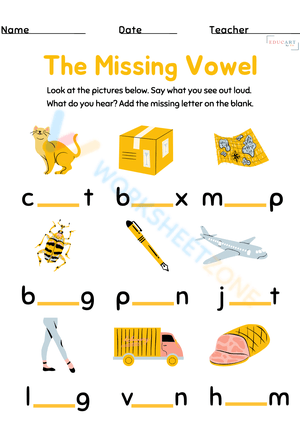
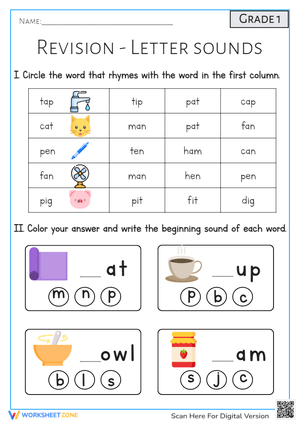
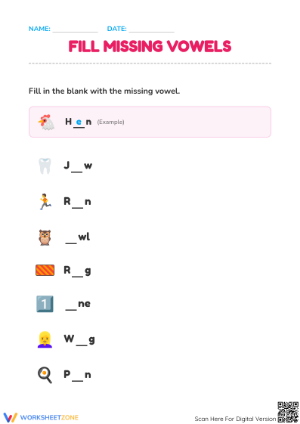
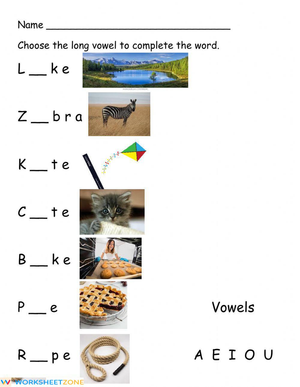
The core task across the set is consistent: students look at a picture, say the word it represents, stretch the sounds, and determine which vowel belongs in the blank. That sequence combines phonemic awareness, phoneme-grapheme correspondence, and visual self-checking in a single workflow. Here is what students practice across each worksheet:
- Medial vowel isolation: Students identify the vowel sound sandwiched between two consonants in words like bat, ten, lip, fog, and cup.
- Phoneme-grapheme mapping: Students connect a heard sound to its written letter — not just recognizing the letter in isolation but placing it in the right position inside a word.
- Short vowel discrimination: On mixed-vowel pages, students distinguish among all five short vowel sounds, a skill that requires finer auditory attention than single-vowel practice.
- Early encoding: Writing the missing letter, rather than circling it from a list, asks students to retrieve and produce the grapheme — a higher cognitive demand than recognition alone.
- Meaning confirmation: After completing the word, students can check the picture to verify the result makes sense — a self-monitoring habit that transfers directly into early reading.
Frequent Student Errors Worth Watching For
The most predictable confusion in this work is short /e/ and short /i/ swapped. Students who confidently write a in c_t will pause and guess on p_n because the mouth positions for /ɛ/ and /ɪ/ feel similar to many six-year-olds. A student who hears "pen" and writes i is not being careless — they are reflecting a genuine auditory discrimination gap that needs direct instruction, not simply more practice pages. Catching this pattern early, before it calcifies into a spelling habit, is one of the clearest diagnostic uses of this format.
A second error pattern appears when picture cues are ambiguous. A drawing meant to represent a cap sometimes reads as a hat to students, which sends them to the wrong vowel entirely. Teachers monitoring small-group work should check whether errors cluster around specific pictures or specific vowel sounds — the distinction matters for deciding what to reteach.
Lesson-Planning Ideas to Get the Most From These Worksheets
These worksheets fit most cleanly after oral sound work rather than as a stand-alone introduction. Before distributing a page, spend three to five minutes at the whiteboard: say a word, tap the sounds with your finger, and ask students to identify the vowel they hear in the middle. That brief oral rehearsal reduces cognitive load when students sit down to write, because they are applying a sound-letter connection they have already made rather than discovering it for the first time on paper.
Specific placements that work well across the school day:
- Morning phonics warm-up: A single-vowel worksheet during the first ten minutes settles students into print work while revisiting the pattern introduced the day before.
- Literacy center rotation: Place one worksheet beside a set of picture-word sorting cards so students rehearse the words before writing. Keeping the routine identical across rotations lets students work independently without needing extra directions.
- Small-group intervention: Use a targeted worksheet with a group of three to four students. Complete the first two items together orally, then have students finish the page while you watch who pauses, erases, or writes without glancing at the picture.
- Exit task: Assign four to five items at the end of a phonics lesson to see whether students can apply what was just modeled. Reading only that quick check is faster and more informative than grading a full worksheet later.
- Sub plans: Because the task is self-explanatory with picture support, a substitute can manage the routine if directions are brief and a completed example is posted on the board.
Fast finishers can be directed to read their completed words to a partner and mark each vowel with a different color — a minute of extra practice that reinforces the letter-sound connection without requiring additional prep from the teacher.
Differentiating These Worksheets Across Ability Levels
Students who struggle to hear medial vowels need a narrower target before working independently. Start them on a page focused on a single vowel — short a only, for example — and add oral rehearsal before each item. Keeping a visible vowel reference card with each short vowel letter, a key word, and a small picture reduces the retrieval demand so students can concentrate on auditory discrimination rather than letter recall.
Students working at grade level handle mixed-vowel pages with picture support. They are ready to discriminate among all five short vowels and can generally move through a worksheet independently after the oral warm-up. For students ready for a larger challenge, remove the picture cues on some items and ask them to generate a second word with the same vowel pattern after completing each one — bat finished, then "what other word has the same middle sound?" That extension turns a completion task into a generative phonics exercise. A shorter worksheet completed carefully, with students saying each word aloud before turning the page in, almost always gives teachers better information than a longer one filled in quickly without self-monitoring.
Standard Alignment
These worksheets address CCSS.ELA-LITERACY.RF.1.3.B, which requires first graders to decode regularly spelled one-syllable words. They also connect to RF.1.3.A, which targets knowledge of vowel representations in spoken words. In classroom terms, these standards land in the first half of first grade, when students are consolidating CVC decoding and beginning to apply short vowel patterns in both reading and spelling. Teachers following a structured literacy scope and sequence typically introduce single short vowels one at a time before moving to discrimination among all five — which maps directly onto how this set of worksheets is organized.
Frequently Asked Questions
Are these worksheets appropriate for kindergarteners?
Some kindergarteners in the second half of the year are ready for single-vowel practice, particularly if they have strong phonemic awareness and can already isolate initial and final consonant sounds. For most kindergarteners, the task works better as guided practice with heavy oral support rather than independent work. 1st grade missing vowels printable worksheets are built around the expectation that students already recognize all five short vowel letters — typically a mid-to-late kindergarten benchmark rather than an early-year skill.
What is the difference between single-vowel and mixed-vowel pages?
Single-vowel worksheets keep one short vowel consistent throughout — every word on the page shares the same missing vowel, which reduces the discrimination demand and builds fluency with one sound before comparing it to others. Mixed-vowel worksheets require students to distinguish among two or more short vowels in the same exercise, which is harder but much closer to what real decoding demands. The most effective sequence is single-vowel first, then discrimination practice once each individual vowel is secure.
How many items per session is appropriate?
Eight to twelve items is a workable range for independent practice. If 1st grade missing vowels printable worksheets are being used as a quick progress check, five to six items targeting a specific vowel is enough to see a clear pattern in what students know and where they are still guessing. Fewer items completed with genuine self-monitoring — students saying each word aloud and checking the picture before writing — give teachers more useful data than a full page filled in at speed.
Can these be used as take-home practice?
Yes, provided families understand the routine. Send a brief note explaining that students should say the word before writing the vowel, not simply write a letter based on the image alone. When caregivers know to prompt "what sound do you hear in the middle?" the at-home practice extends classroom phonics work rather than becoming a guessing exercise. 1st grade missing vowels printable worksheets work best as take-home review for vowel sounds already taught in class — not as the introduction to a new pattern.












 Interactive Worksheet Maker
 Quiz Maker
 Word Search Maker
 Crossword Puzzle Maker
 Word Scramble Generator
 Sentence Scramble Generator
 Handwriting Worksheet Generator
 Name Tracing Generator
 Fill In The Blank Generator