


























Views
Downloads
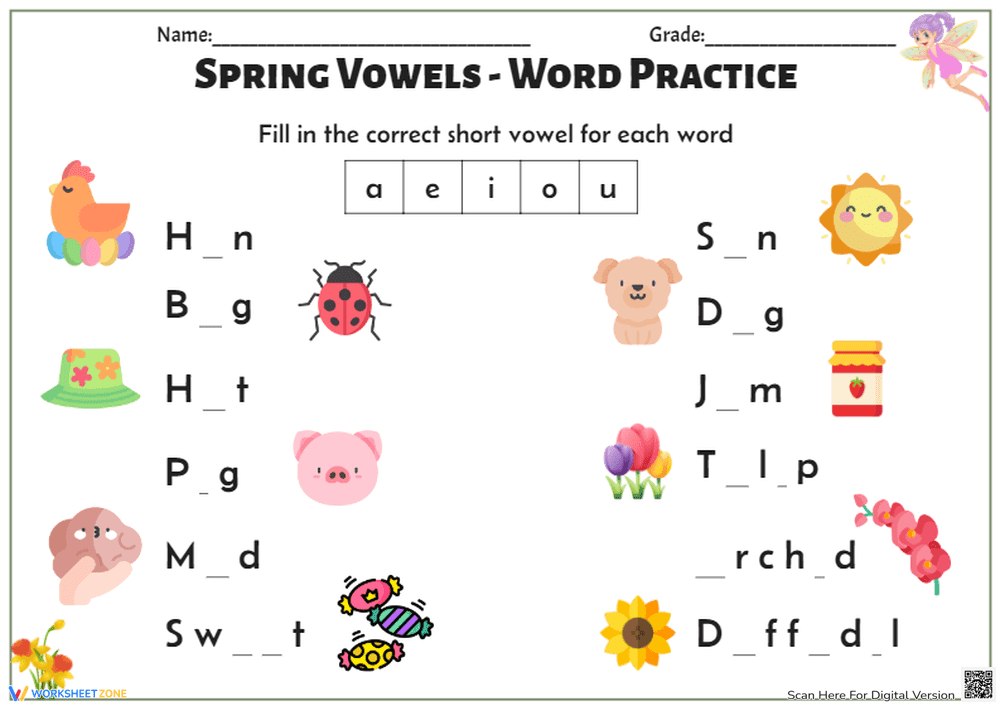

Spring Vowels Word Practice | Grade 1-3 Printable
Paste this activity's link or code into your existing LMS (Google Classroom, Canvas, Teams, Schoology, Moodle, etc.).
Students can open and work on the activity right away, with no student login required.
You'll still be able to track student progress and results from your teacher account.
This Spring-themed phonics worksheet helps students master short vowel sounds through 12 engaging word completion tasks. By filling in missing letters for seasonal vocabulary like "sun" and "tulip," learners strengthen their phonemic awareness and spelling accuracy. It provides an immediate way to assess vowel recognition in a festive, seasonal context.
At a Glance
- Grade: 1-3 · Subject: ELA Phonics
- Standard:
CCSS.ELA-LITERACY.RF.1.3.B— Decode regularly spelled one-syllable words by identifying vowel sounds- Skill Focus: Short vowel identification
- Format: 1 page · 12 problems · Answer key included · PDF
- Best For: Morning work or seasonal literacy centers
- Time: 10–15 minutes
The resource features a single-page layout with a clear vowel bank (a, e, i, o, u) at the top. Students encounter 12 Spring-themed illustrations paired with incomplete word stems. The tasks range from simple CVC words like "dog" to more complex multi-syllable words like "daffodil," providing a gentle challenge. A full answer key is provided for quick grading.
This worksheet is designed for a 2-minute teacher setup. Simply print the PDF (30 seconds), distribute it to your literacy groups (30 seconds), and use the included answer key for a rapid 1-minute review at the end of the session. It serves as an ideal "grab-and-go" activity for substitute folders or unexpected schedule gaps during the busy spring season.
The primary focus is `CCSS.ELA-LITERACY.RF.1.3.B`, which requires students to decode regularly spelled one-syllable words. It also supports `CCSS.ELA-LITERACY.L.1.2.E` by encouraging students to use conventional spelling for words with common spelling patterns. Both standard codes can be copied directly into lesson plans, IEP goals, or district curriculum mapping tools.
Use this as a formative assessment after a direct instruction lesson on short vowels. Observe if students can distinguish between "i" and "e" in words like "pig" and "hen." Alternatively, place it in a seasonal literacy center for independent practice. Expected completion time is 10 to 15 minutes depending on the student's reading level and familiarity with the vocabulary.
This is perfect for first and second-grade students developing foundational reading skills, as well as third graders needing a quick seasonal review. It pairs naturally with a Spring-themed anchor chart or a read-aloud about garden life to provide context for the vocabulary words used, such as "orchid" and "daffodil."
Phonics instruction remains a cornerstone of early literacy, as emphasized in the RAND AIRS 2024 report, which highlights the necessity of explicit practice with vowel sounds to build decoding automaticity. This worksheet targets CCSS.ELA-LITERACY.RF.1.3.B by requiring students to actively select and place short vowels within familiar word structures. By connecting phonemic tasks to seasonal vocabulary, the resource leverages contextual cues to support memory retention and engagement. Research from Fisher & Frey (2014) suggests that such scaffolded practice—moving from a provided word bank to independent completion—is essential for the gradual release of responsibility. Educators can use the 12 specific tasks to identify persistent vowel confusion in individual learners, making it a valuable tool for data-driven instruction. This printable resource ensures that foundational spelling skills are reinforced through structured, repeatable exercises that align with national standards for primary literacy development.


