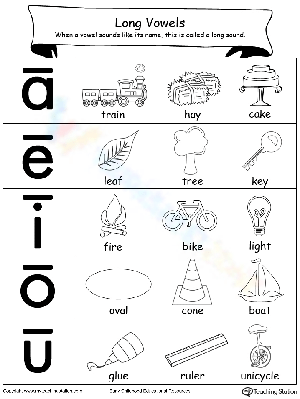
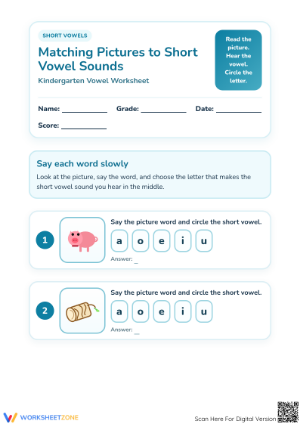
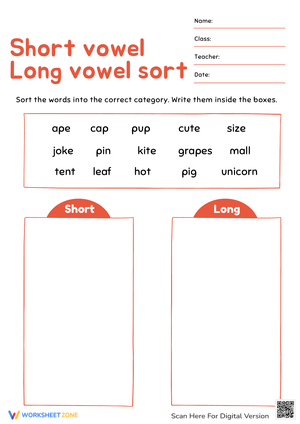
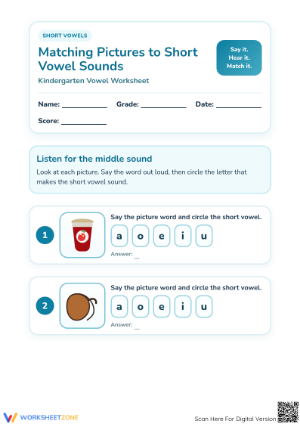
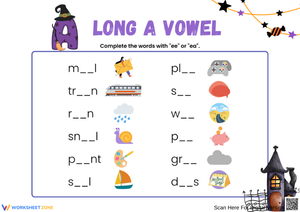
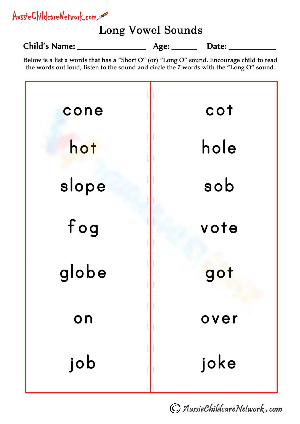
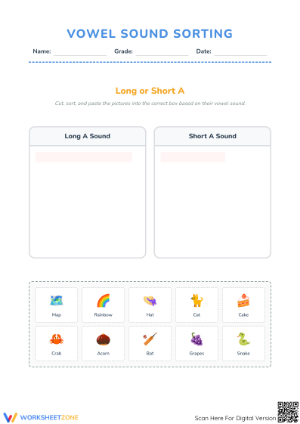
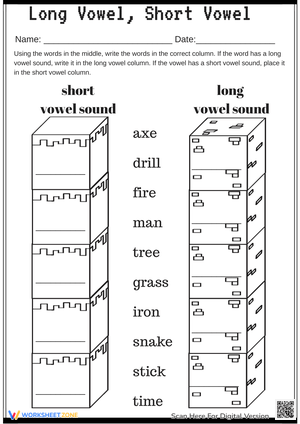
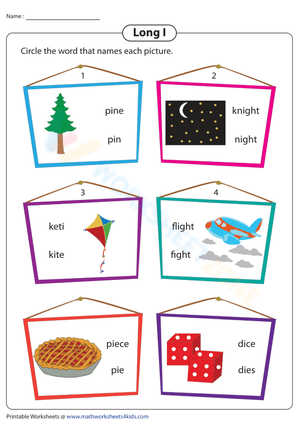
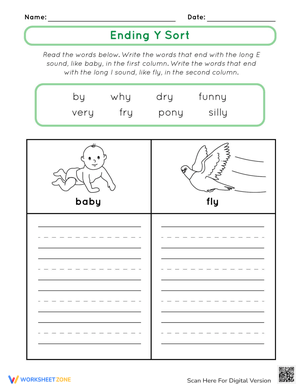
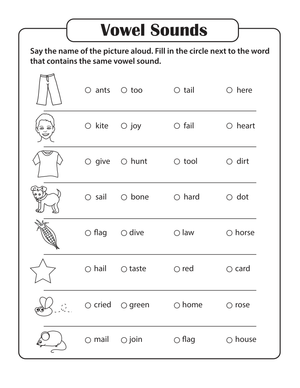
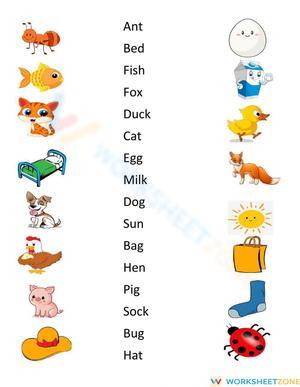
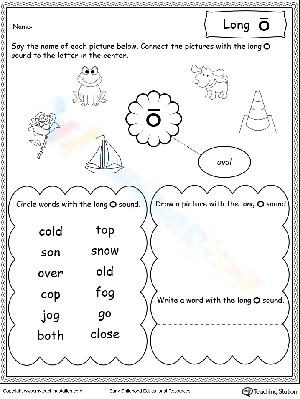
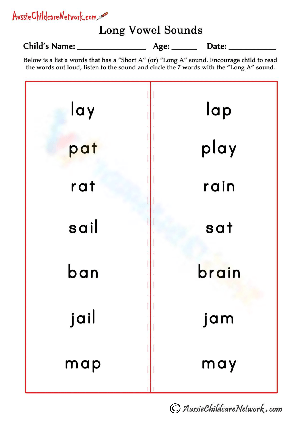
These long and short vowels printable worksheets for 1st grade give teachers a focused collection of phonics practice tools for one of early reading's most pivotal decision points: the moment a child must hear whether a vowel is clipped or open and then match that sound to the correct spelling pattern. Each worksheet addresses a distinct piece of vowel work — short CVC words, the silent-e transformation, picture-to-word sorts — at a difficulty range that fits first-quarter introduction through end-of-year consolidation. Teachers pull individual worksheets based on exactly where their students are in the phonics sequence rather than moving through a fixed order.
What Students Practice Across the Set
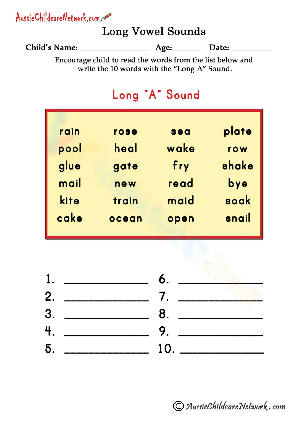
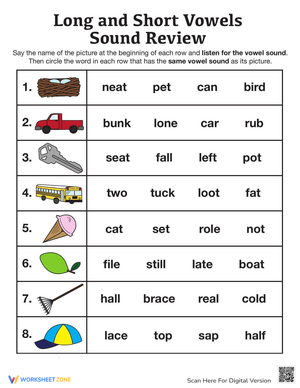
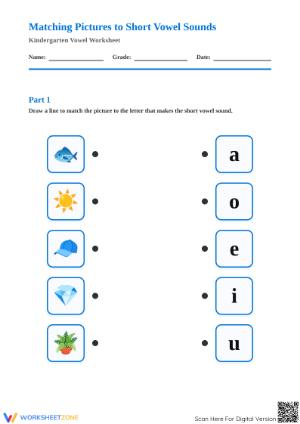
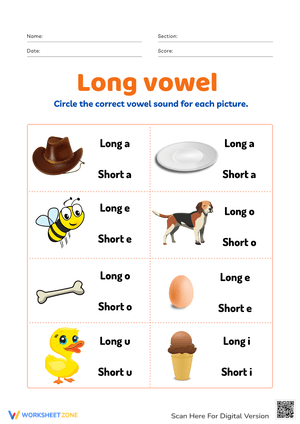
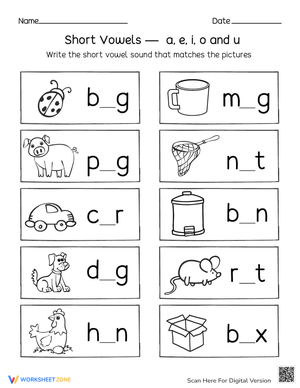
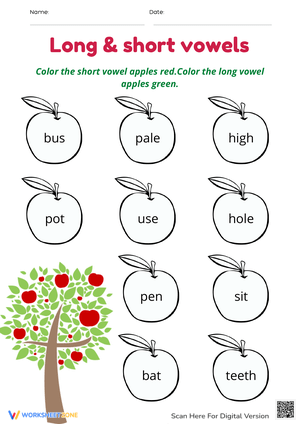
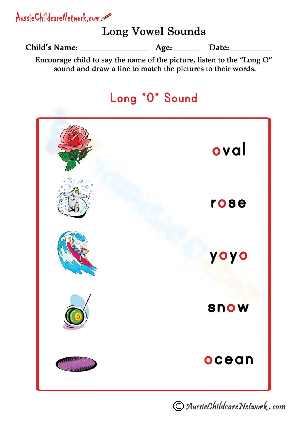
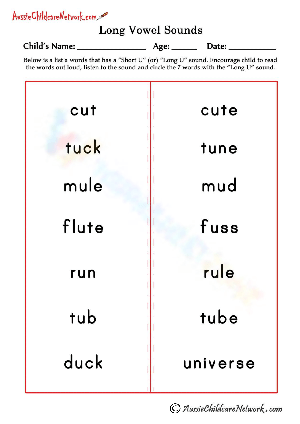
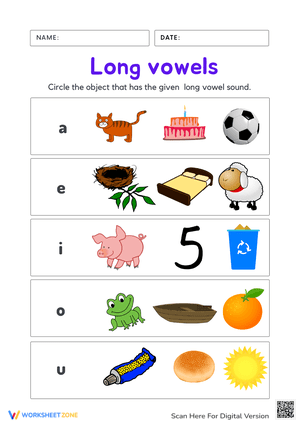
Students sort words and pictures into short-vowel and long-vowel categories, a task that forces phonemic discrimination work before spelling rules even enter the picture. The CVC short-vowel worksheets ask students to mark the vowel, say the word aloud, and write it — a sequence that moves from auditory to visual to kinesthetic inside a single activity.
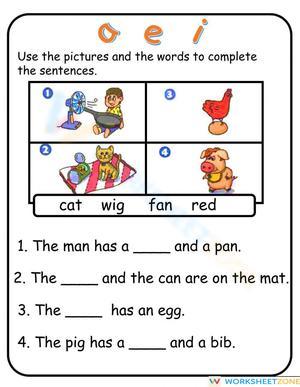
The magic-e transformation worksheets are the most instructionally dense. Students read a short-vowel CVC word, add the silent e, rewrite the long-vowel result, and sketch a quick picture for each — cap / cape, hop / hope, kit / kite — side by side. That format makes the vowel shift visible in a way a verbal explanation alone cannot replicate. Several worksheets also include fill-in-the-blank sentences where students choose between a short-vowel word and its long-vowel counterpart based on context, connecting phonics work directly to meaning-making rather than pattern-matching in isolation.
Why Vowel Discrimination Is Hard at This Stage
First grade is when the phonics sequence moves from the relatively consistent CVC pattern — where the short vowel is almost always correct — into the messier territory of silent-e words, vowel digraphs, and long-vowel spelling variants. The problem is that spoken language doesn't mark these distinctions audibly in any obvious way. A child who hears the word "cape" has no acoustic signal telling them to add an e; they have to have internalized a conditional rule: if there's an e at the end, the vowel in the middle says its name. Holding that conditional while simultaneously decoding consonants is genuine cognitive load for a six-year-old, and it's why repeated practice across varied formats matters more in this unit than in almost any other part of early phonics.
There's also a developmental reason short vowels come before long vowels in the instructional sequence: short vowels carry the highest-frequency early words — sit, get, hop, cut, man — so students gain real reading mileage quickly. Long vowels expand the word-recognition repertoire significantly but require that conditional rule. Students who learn it through one worksheet type often can't transfer it until they've applied the same rule through sorting, transformation, and sentence-level tasks, which is exactly the variety this set provides.
Mistakes Students Make That These Worksheets Help Surface
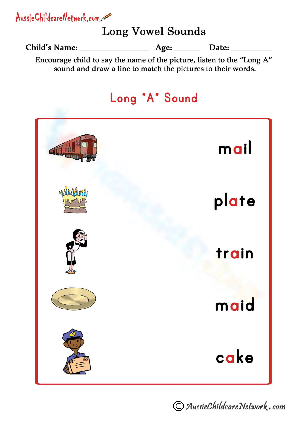
The most predictable sorting error is vowel reversal driven by consonant-first decoding. A student will confidently place "cape" under the short-vowel column because they hear the initial /k/, process the word quickly, and never attend to the medial vowel. The picture-sort worksheets catch this because the image prompts the correct pronunciation, and a mismatch between what the picture shows and where the student placed the card becomes visible — and correctable — before the error solidifies into a habit.
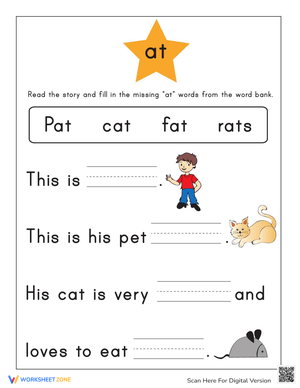
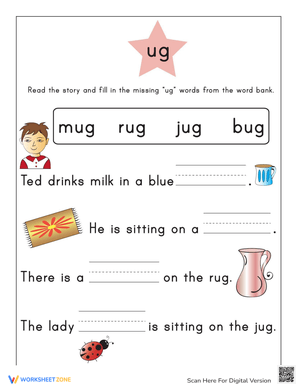
A subtler problem surfaces on fill-in-the-blank activities: students who have memorized "magic e makes the vowel long" still select "pin" when the sentence calls for "pine," because they're reading consonants and guessing from partial phonics cues rather than confirming meaning. The sentence-level context forces them back to meaning, not just decoding, and that collision is instructionally useful — it's the moment to stop a small group and ask, "Does that actually make sense?" Students also commonly spell long-vowel words without the silent e, writing "lak" for lake or "kap" for cape. The transformation worksheets, which require students to physically write both the short and long version in sequence, train the hand-eye connection that spelling work later rewards.
Working These Worksheets Into Your Instructional Week
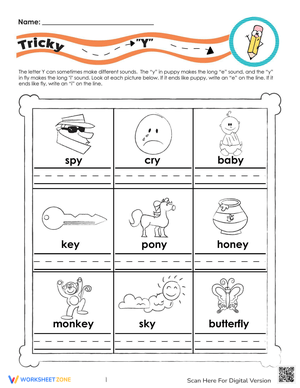
The place long and short vowels printable worksheets for 1st grade fit most naturally is the phonics literacy center — the rotation students visit two or three times a week while the teacher runs guided reading groups. One worksheet per rotation is enough; moving through multiple activities in a single center visit fragments attention more than it deepens practice. The picture-sort and color-coding worksheets work especially well at the start of a vowel unit because students complete them with minimal text, freeing working memory for the auditory task at the heart of the lesson.
The fill-in-the-blank and sentence-level worksheets are better placed mid-unit or as a Monday warm-up after a weekend gap. The retention drop from Friday to Monday is real for first graders, and a brief, familiar worksheet format reactivates phonics knowledge before the whole-group lesson begins. Completed worksheets also serve as quick formative checks — scanning a finished sort or transformation page takes about thirty seconds per student and tells you immediately who needs a small-group reteach before the unit moves forward.
Standard Alignment
These worksheets address CCSS.ELA-LITERACY.RF.1.2 — phonological awareness, specifically distinguishing long and short vowel sounds in spoken single-syllable words — and CCSS.ELA-LITERACY.RF.1.3b, which targets decoding regularly spelled one-syllable words using common long-vowel patterns, including the silent-e. In classroom terms, RF.1.2 is the active standard early in the year when students are working purely with sound; RF.1.3b becomes primary once instruction connects those sounds to print. The picture-sort and auditory worksheets align to the RF.1.2 phase, while the magic-e transformation and sentence-level worksheets map directly to RF.1.3b territory.
Adjusting the Set for Readers at Different Levels
For students who struggle to distinguish vowel sounds in isolation, remove the text entirely. Use the picture-sort worksheets and have students say each image name aloud before placing it — the auditory loop without the print demand keeps focus on phonemic awareness rather than decoding. Once they sort accurately by sound alone, introduce the matching word card so they begin connecting what they hear to what they see. Long and short vowels printable worksheets for 1st grade that include both a picture and the corresponding word allow this transition to happen inside a single activity type rather than requiring a mid-lesson switch.
For students who have already internalized the basic silent-e rule, the sentence-level fill-in-the-blank worksheets are the right next step — they require vowel knowledge within connected text rather than in controlled isolation. A further extension is to have these students write three sentences using a set of target words from the week's sort, which shifts the work from recognition to production and deepens the spelling-reading connection.
Frequently Asked Questions
When in the school year should these worksheets be introduced?
Short-vowel CVC worksheets belong in the first six to eight weeks, aligned with when most district phonics programs formally introduce each short-vowel sound. The magic-e and long-vowel transformation worksheets typically enter in the second quarter, once students demonstrate accurate decoding of CVC words. Most pacing guides target solid short-vowel control by late October and begin long vowels in November, though that timeline shifts depending on the program and the cohort.
Are these worksheets appropriate for homework?
The picture-sort and color-coding worksheets travel home well because they're self-explanatory — a caregiver can look at the page and understand the task without teacher instructions. The transformation worksheets are better kept in school, at least during initial instruction, because students who haven't yet internalized the magic-e rule need immediate corrective feedback rather than fifteen minutes of independent practice that reinforces an error.
How do I know a student is ready to move from short-vowel to long-vowel work?
The clearest signal is accuracy on a short-vowel CVC word sort — if a student sorts ten CVC words with 90% accuracy across two consecutive sessions, the foundation is solid. A second checkpoint is dictation: call out five short-vowel words and ask students to write them. Students who encode CVC words accurately are ready for long and short vowels printable worksheets for 1st grade that introduce the silent-e contrast, because the short-vowel anchor is secure enough to make the comparison meaningful rather than confusing.
How many worksheets should I assign per week during active instruction?
Two to three worksheets per week is a sound baseline when students are actively learning a new vowel pattern. One worksheet that introduces the concept, one that practices it through a different format — sort versus transformation versus fill-in-the-blank — and a third used for review or as a quick assessment is a rhythm that works well without consuming disproportionate instructional time or asking more of first graders than they can sustain.












 Interactive Worksheet Maker
 Quiz Maker
 Word Search Maker
 Crossword Puzzle Maker
 Word Scramble Generator
 Sentence Scramble Generator
 Handwriting Worksheet Generator
 Name Tracing Generator
 Fill In The Blank Generator