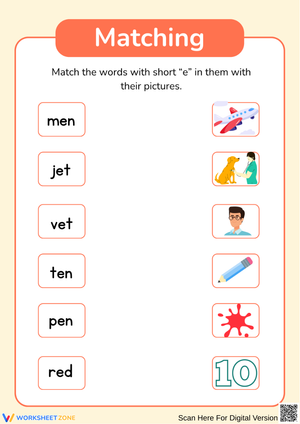
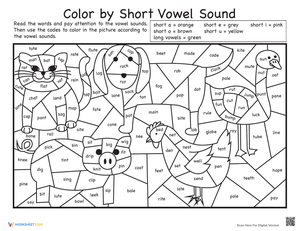
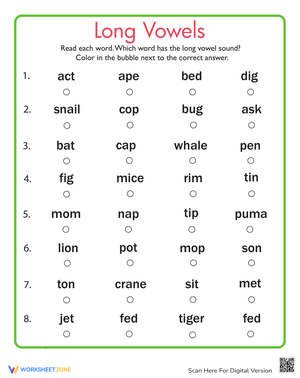
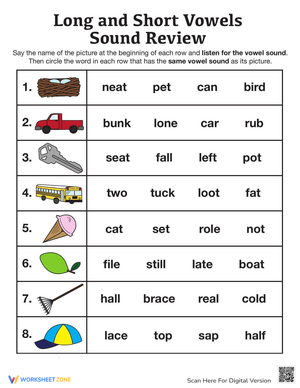
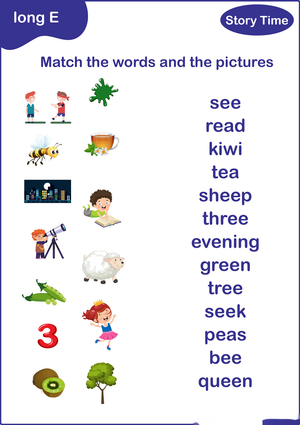
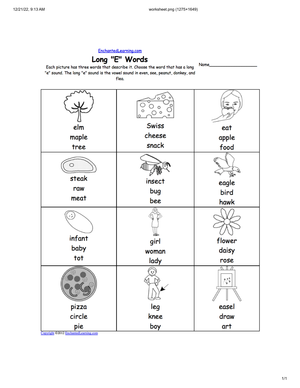
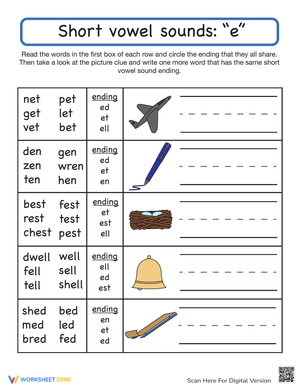
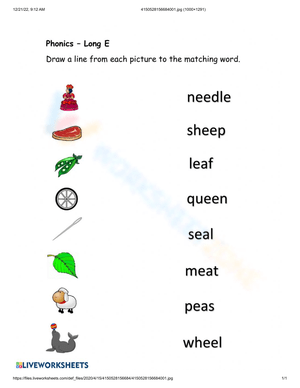
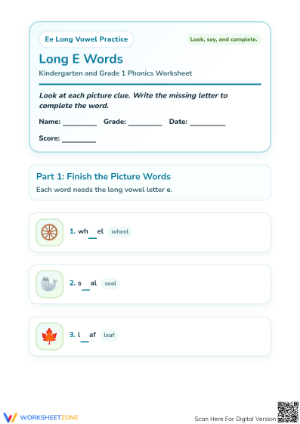
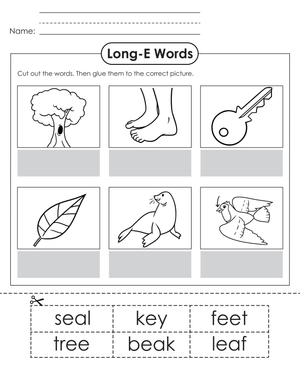
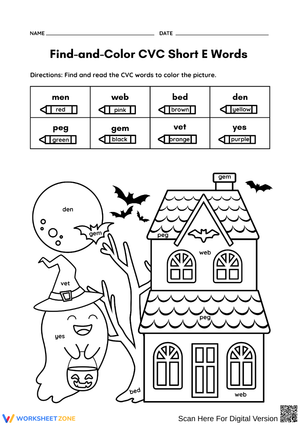
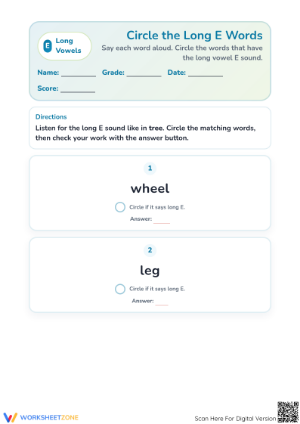
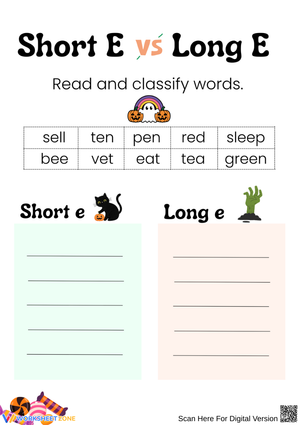
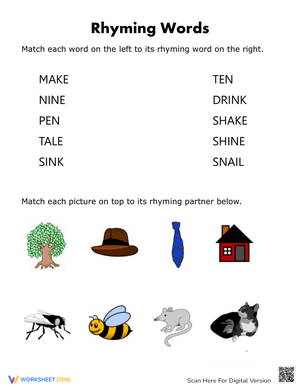
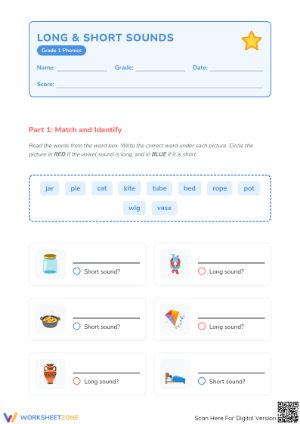
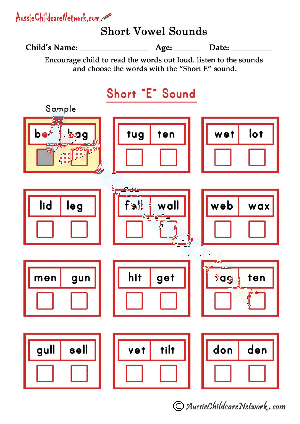
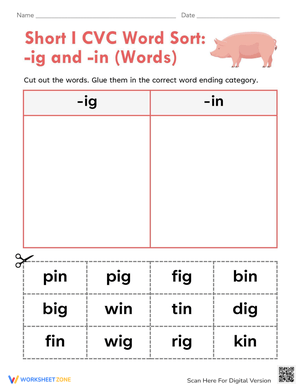
These long e and short e printable worksheets for 1st grade give teachers a targeted phonics set built around one of the trickiest letter-sound relationships first graders face: the same letter producing two distinct sounds, with the long version spelled at least three different ways. The set covers CVC short-e words alongside ee, ea, and CVCe long-e patterns — the full range students need to move through early reader texts without stalling at every other word.
What's Inside the Set
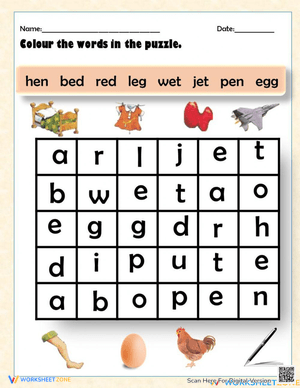
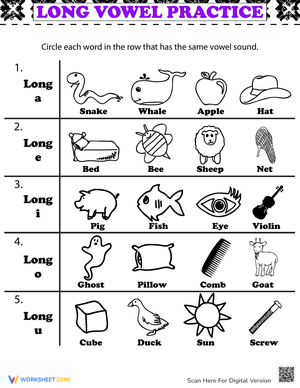
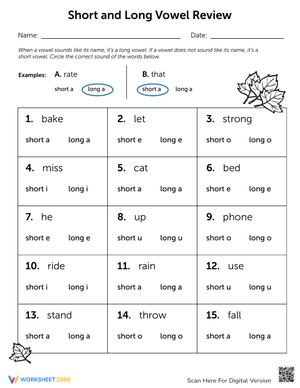
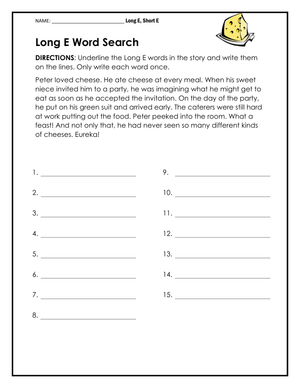
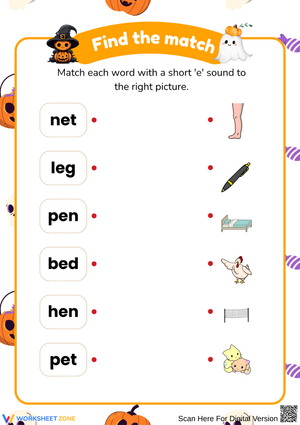
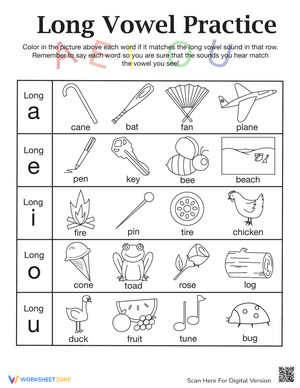
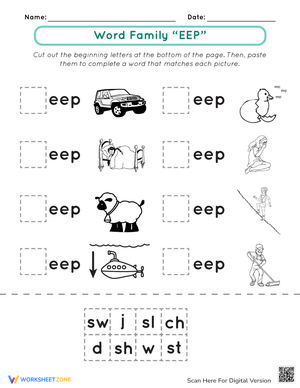
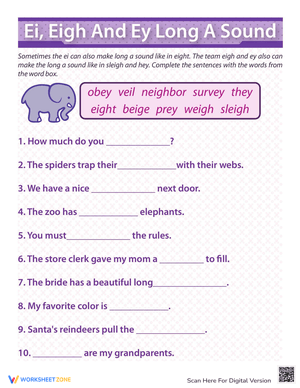
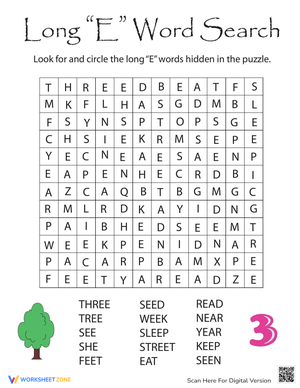
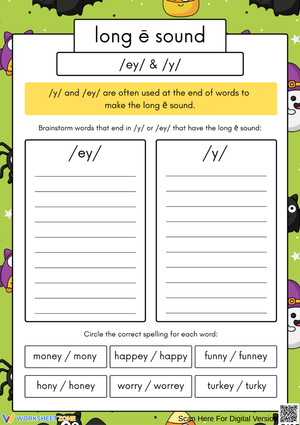
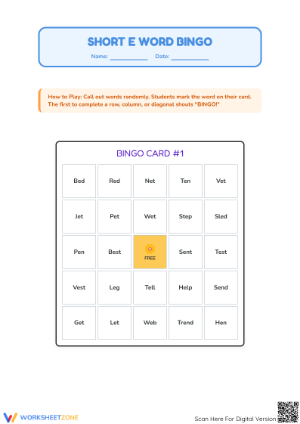
Each worksheet isolates a specific skill within the short-e and long-e contrast. Cut-and-paste word sorts ask students to place words or pictures into labeled columns — separating "hen" from "heel," "net" from "neat." Color-by-sound worksheets present a grid of illustrated words; students identify the vowel sound and apply a designated color to each image, which gives teachers an immediate visual scan of who is secure and who is still guessing. Word family worksheets group short-e rimes (-et, -en, -ed) alongside long-e rimes (-ee, -ea) so students see and say the pattern across multiple words in rapid succession. Sentence-completion worksheets present a frame with two choices — often a minimal pair like "fed" and "feed," or "men" and "mean" — requiring students to use both phonics knowledge and context to select the right word. Read-and-draw worksheets close the loop: students decode a sentence containing target vowel-team words and sketch a picture to confirm they understood what they read, not just that they mouthed the sounds.
Mistakes Students Make That These Worksheets Help You Catch
The most persistent error is not confusing short e with long e — it is treating the vowel team as invisible. A student who correctly reads "net" will encounter "neat" and read it as "net" anyway, because she identified the n and the t and stopped there. The second vowel went unread. This consonant-anchoring pattern — decoding the frame of the word and assuming the vowel sound — is the single most common mistake we see in student work at this stage. Long e and short e printable worksheets for 1st grade that ask students to circle or underline the vowel team before reading the full word interrupt this habit at the source. A second error to watch for: once students learn "ee," they overgeneralize it, writing "steem" for "steam" or "neet" for "neat." They know long e needs two letters but default to the team they encountered first. Sorting activities that place "ee" and "ea" words side by side — rather than teaching each vowel team in isolation — make this distinction visible rather than abstract.
Standard Alignment
These worksheets align directly to CCSS.ELA-LITERACY.RF.1.3.C, which asks first graders to know final-e and common vowel-team conventions for representing long vowel sounds. In classroom terms, this standard sits at the center of the phonics block in mid-to-late first grade — after CVC decoding is secure but before students move into r-controlled vowels or diphthongs. A teacher who uses long e and short e printable worksheets for 1st grade during that instructional window gives students the high-frequency, targeted repetition RF.1.3.C requires before vowel-team patterns transfer to independent reading. The picture-sorting and sentence-completion worksheets also address RF.1.2.A — distinguishing long from short vowel sounds in spoken single-syllable words — by bridging auditory discrimination and print recognition within the same task instead of treating them as separate lessons.
Fitting These Worksheets Into Your Phonics Block
The cut-and-paste sort earns its place as an introduction activity — give it on the day you explicitly teach a new vowel team so students apply the pattern immediately while it is still fresh. Color-by-sound worksheets are built for morning work or the four-minute warm-up before the reading block; they require no setup, and the finished papers tell you quickly who needs a check-in before small groups begin. For literacy centers, laminate the word-sort and sentence-completion sheets and pair them with dry-erase markers — students work through the same worksheet repeatedly across a week without consuming paper, and the reusability makes formative data easy to collect over multiple days. Small-group guided practice is where the read-and-draw worksheet earns its place: sit with three or four students, ask each one to read aloud before drawing, and you will hear exactly where the decoding breaks down.
One technique worth building into your introduction lesson: hand students a small mirror before the sort begins. The mouth position for short e — jaw slightly dropped, lips relaxed — looks and feels different from long e, where the lips pull back into a wide horizontal stretch. First graders who watch themselves say "bed" and then "bead" create a physical-kinesthetic anchor for the contrast that auditory drilling alone rarely produces. It takes three minutes, costs nothing, and students who use it consistently make fewer vowel-team errors on later worksheets.
Adapting the Worksheets for a Range of Learners
Students still sorting out short vowels across all five letters benefit from starting with picture-only sorts rather than word sorts. Cover the printed word beneath each image and ask students to name the picture, exaggerate the vowel sound aloud, and then place it in the correct column. Once they are consistent with the auditory sort, uncover the word and repeat — now they are confirming their ear against the print rather than decoding from scratch. For students who have the basic contrast secure, extend the challenge by introducing "ea" words that carry a short-e sound: "bread," "head," and "spread" are kept out of first-grade phonics sequences by design, but a student who moves through the standard sort without errors is ready to grapple with why "read" rhymes with "bead" in one sentence and "bed" in another. That single conversation builds more long-term vowel flexibility than three additional worksheets at the same level.
Students acquiring English alongside phonics instruction often find the mirror technique especially grounding because the visual cue is language-independent. Pairing them with a partner during the cut-and-paste sort — one student says the word aloud while the other confirms the sound before both decide together — keeps oral language active without calling attention to who needs extra support.
Frequently Asked Questions
Should I introduce "ee" or "ea" first?
Most phonics sequences introduce "ee" before "ea" because it appears in higher-frequency early reader words — "see," "bee," and "tree" show up in Level A and B texts before "leaf" or "team" do. That sequence is worth respecting: once students are confident with "ee," a second sort pairing "ee" and "ea" words side by side makes a natural follow-up lesson, and the worksheets in this set support that two-step progression without requiring you to purchase separate materials for each vowel team.
When in the school year do first graders typically reach vowel teams?
Most structured literacy programs arrive at vowel teams in late winter or early spring of first grade — generally after students are solid on short vowels, consonant blends, and digraphs. Depending on the program, that window usually falls between Unit 4 and Unit 6. These worksheets fit that placement and also serve well as review for second graders who need to revisit the patterns before moving into more complex vowel work.
Can these worksheets double as formative assessments?
The color-by-sound and word-sort formats work well as quick formative checks — a completed worksheet takes about ninety seconds to scan and shows clearly which students are sorting accurately and which are guessing. Long e and short e printable worksheets for 1st grade that combine pictures with printed words are particularly readable as informal assessments because errors cluster visually: a student who places all the "ea" words in the short-e column has a different instructional need than one who scatters errors randomly across both teams, and each pattern points toward a specific next step.












 Interactive Worksheet Maker
 Quiz Maker
 Word Search Maker
 Crossword Puzzle Maker
 Word Scramble Generator
 Sentence Scramble Generator
 Handwriting Worksheet Generator
 Name Tracing Generator
 Fill In The Blank Generator