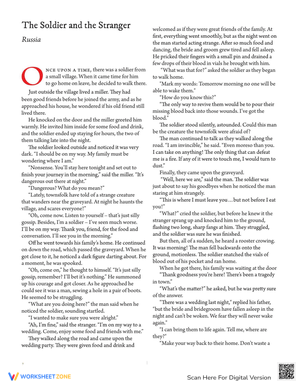
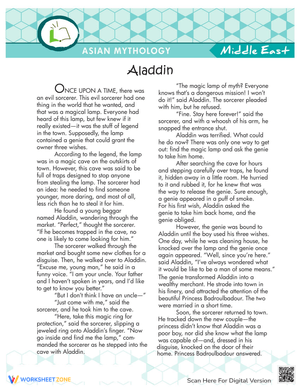
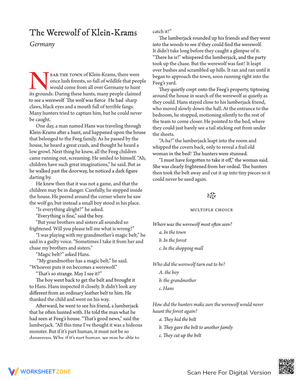
A folktales worksheets set organized around genuine genre analysis gives students the structural vocabulary to do more than retell a story — they leave the unit able to explain why traditional tales are built the way they are and what that construction reveals about the cultures that shaped them. The resources here move students through sub-genre identification, archetypal character analysis, the rule of three as a narrative device, and the distinction between moral and theme. They work as unit anchors in reading workshop, as targeted review before a genre assessment, or as structured independent practice following a shared read-aloud.
The Specific Skills Each Worksheet Targets
The set builds four core analytical competencies. Students:
- classify stories by sub-genre — fable, myth, legend, fairy tale — and justify each classification with two specific text features
- identify archetypal characters and explain what each figure represents in the story's cultural context
- locate and annotate the rule-of-three pattern, then explain how the third iteration differs from the first two
- distinguish between the stated moral and the inferred theme in written form
Sub-genre classification is the entry point, and the justification requirement is what gives it analytical weight. Students who have been loosely calling animal stories "fables" since second grade discover quickly that they have been working from impression rather than definition once they have to name two supporting text features in writing.
The rule of three gets explicit treatment here because students read past it until it is foregrounded. The annotation task — mark each occurrence, then explain what changes across the three iterations — produces surprisingly sharp observations in discussion. When students begin to articulate that the third brother succeeds not because of luck but because the pattern demands escalation and resolution, they are doing the structural thinking that carries into analysis of more complex genres later.
Moral versus theme is the hardest distinction in the set. A moral is a stated lesson — what a character learns or what the narrator announces. A theme is an idea about human experience that the reader infers from the arc of the whole story. Students write both in sequence and explain the difference. Students who can hold that distinction clearly are ready for the literary analysis expected on upper elementary assessments.
Building These Worksheets Into Your Unit Planning
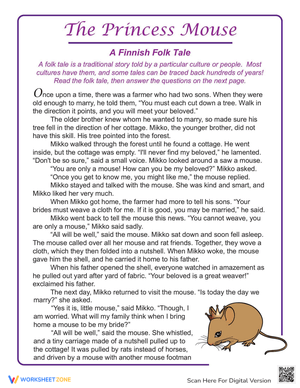
The most effective unit structure organizes traditional tales by theme rather than by sub-genre. Pairing a West African Anansi story, a Norse myth, and a Japanese folk tale around a shared theme — cleverness versus authority, or the cost of greed — makes the cross-cultural parallels visible in ways a sub-genre sort does not. Students mark the geographic origin of each story on a world map as the unit progresses, which anchors the cultural context and creates a natural handoff point for a social studies block.
For reading workshop with independent rotations, one worksheet per week works well as a low-stakes formative check. A short Aesop fable as the Monday morning warm-up, followed by the corresponding worksheet during the rotation block, takes roughly 20 minutes and produces a clean read on who is moving from plot summary to lesson inference — and who still needs direct instruction on that move. The folktales worksheets collection spans enough sub-genres to run four to six weeks in this rotation without repeating a story type, which means students keep encountering new cultural contexts across the full length of the unit.
Common Errors That Surface in Student Work on This Genre
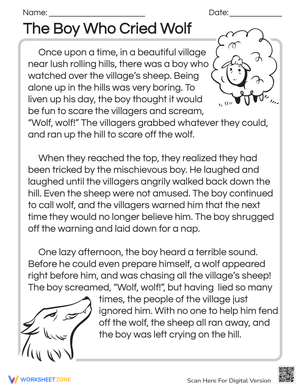
The most consistent mistake is treating moral identification as plot retell. A student who writes "the moral is that the tortoise ran the race and won because the hare fell asleep" has described the ending, not extracted a lesson. The worksheets address this directly: students must state the moral in one sentence that contains no character names. That constraint produces better responses than redirection, because it forces the abstraction step rather than inviting students to slide back into narration.
Sub-genre confusion has a predictable shape. Students who have heard the word "fable" since first grade will classify nearly any short folk story as one, particularly if animals are present. A myth featuring a talking raven gets labeled "fable" with full confidence. The classification tasks require students to match the story to a brief definitional checklist — purpose, character type, explanatory function — which exposes the overgeneralization quickly and gives teachers a concrete reference point for a re-teaching conversation.
There is also a quieter error in how students process vague settings. Folktales use deliberately imprecise time and place — "long ago, in a kingdom at the edge of the world" — and students often conclude that setting is therefore irrelevant to analysis, since it cannot be located on a map or a timeline. Several worksheets ask students to explain the purpose of the vague setting rather than just identify it, which reframes deliberate imprecision as craft and builds the habit of asking why a text is constructed the way it is.
Standard Alignment
The folktales worksheets collection addresses reading literature standards at second, third, and fourth grade levels. CCSS.ELA-LITERACY.RL.2.2 asks students to recount stories from diverse cultures and identify the central message or moral — the entry point for this work, where students first practice moving from plot comprehension to lesson inference. RL.3.2 extends this to name fables, folktales, and myths explicitly and adds the expectation that students trace how key details convey the moral, not just name it; the moral-tracing tasks in this set address that distinction directly. At fourth grade, RL.4.9 requires comparison of similar themes and event patterns across stories from different cultures, which is where the cross-cultural pairing tasks sit most precisely. Teachers in states with modified or CCSS-parallel frameworks find these same skills under their traditional literature reading standards at matching grade bands.
Differentiating the Work Across a Range of Readers
For students still working on basic comprehension, the most productive adjustment is narrowing the task. Remove the sub-genre classification and cultural context components and focus the worksheet on a single inference: what does the story teach, and which specific moment makes that clearest? Pairing this reduced task with a brief plain-language story summary — rather than the full source text — lowers the decoding demand without removing the analytical expectation.
Students working at grade level handle the full sequence: classification with justification, archetypal character identification, rule-of-three annotation, and the written moral-versus-theme distinction. For students reading two or more grade levels above benchmark, the meaningful extension is cross-cultural comparison — pairing two variants of the same tale from different cultural traditions and writing a paragraph explaining what differences in plot or character reveal about each culture's values. That task requires close reading, cultural reasoning, and paragraph-level argumentation, and the responses it generates tend to be the most substantive writing the unit produces.
Frequently Asked Questions
What grade levels do these worksheets cover?
This folktales worksheets collection covers second through fifth grade, with tasks distributed by analytical complexity rather than strictly by grade level. Basic moral identification and sub-genre classification work well at second and third grade. The rule-of-three annotation, moral-versus-theme distinction, and cross-cultural comparison tasks are pitched at third through fifth grade, where students have enough reading experience to make the structural observations the tasks require.
Can these worksheets be used with a read-aloud rather than independent reading?
Yes — for second grade it is often the better approach. Reading the story aloud first reduces decoding load and keeps the focus on comprehension and analysis. The worksheet tasks work just as well after a shared reading as after an independent one. A common approach: read aloud, hold a brief class discussion, then send students to complete the worksheet independently as a check on what the discussion actually surfaced versus what students can articulate on their own.
How long does each worksheet take to complete?
Most students finish in 20 to 30 minutes. The moral-versus-theme worksheets run longer because students compose and justify two separate written responses. The sub-genre classification worksheets move faster and fit comfortably in a 15-minute warm-up at the start of a reading block. For students who need additional time on written responses, 35 minutes covers the full task on the more demanding worksheets in the set.












 Interactive Worksheet Maker
 Quiz Maker
 Word Search Maker
 Crossword Puzzle Maker
 Word Scramble Generator
 Sentence Scramble Generator
 Handwriting Worksheet Generator
 Name Tracing Generator
 Fill In The Blank Generator