


























Views
Plays
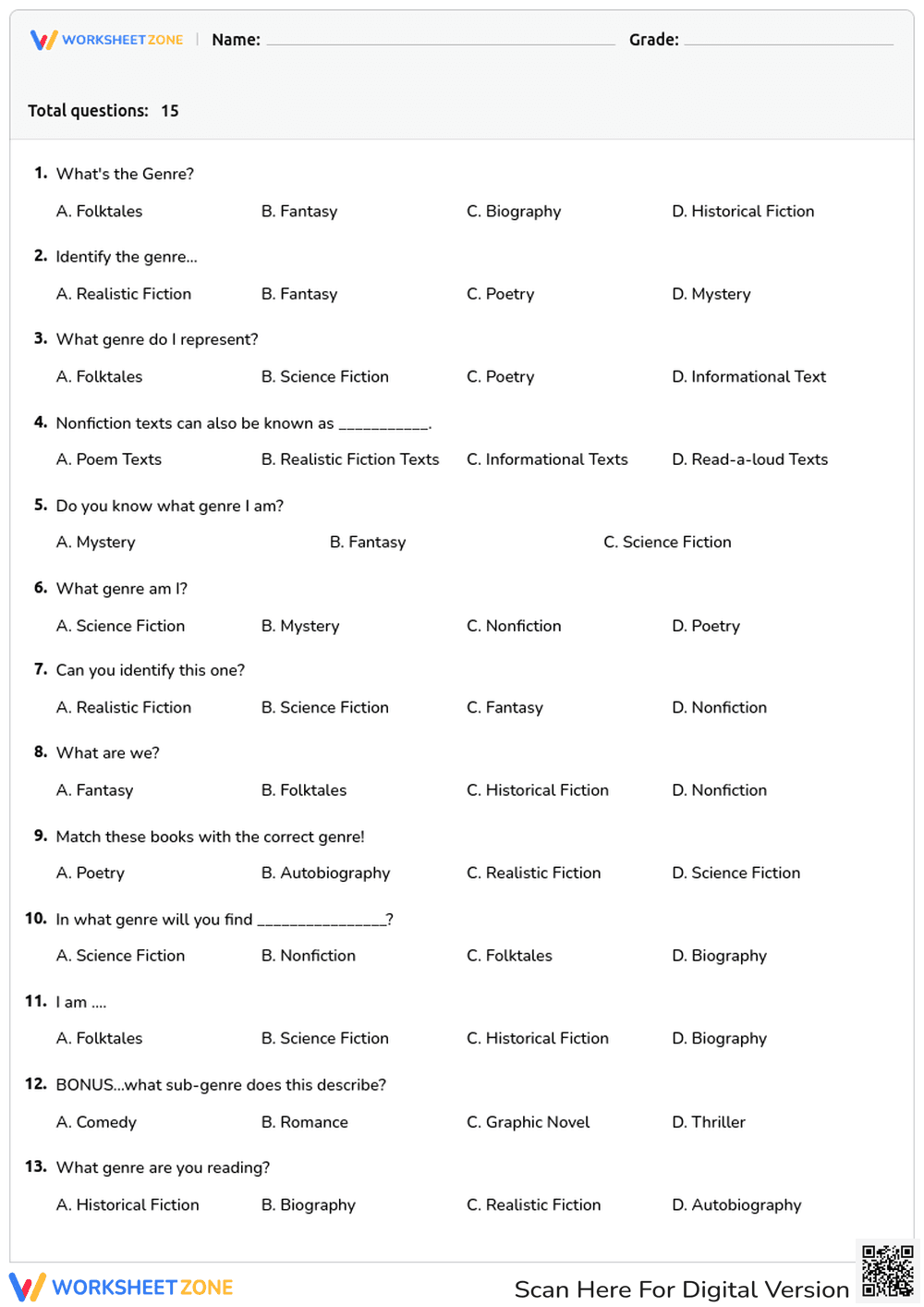


Grade 3 Literary Genres — Printable No-Prep Worksheet
Paste this activity's link or code into your existing LMS (Google Classroom, Canvas, Teams, Schoology, Moodle, etc.).
Students can open and work on the activity right away, with no student login required.
You'll still be able to track student progress and results from your teacher account.
This Grade 3 ELA worksheet provides a straightforward assessment of literary genres, helping students distinguish between fiction, nonfiction, poetry, and folktales. By evaluating 15 multiple-choice questions, learners demonstrate their ability to categorize texts, building a strong foundation for advanced reading comprehension.
At a Glance
- Grade: 3 · Subject: ELA
- Standard:
CCSS.ELA-LITERACY.RL.3.10— Read and comprehend literature, including stories and poetry- Skill Focus: Identifying Literary Genres
- Format: 2 pages · 15 problems · Answer key included · PDF
- Best For: Quick assessment or independent practice
- Time: 15–20 minutes
Inside this resource, educators will find a two-page multiple-choice quiz featuring 15 targeted questions. Students match genre definitions with correct labels, such as historical fiction, biography, science fiction, and mystery. The clear layout minimizes distractions, while the included answer key ensures fast grading. There are no complex instructions, making it immediately accessible.
This resource is designed for a smooth, zero-prep classroom experience. The workflow is highly efficient:
- Print (1 minute): Download the PDF and print the two-page student assessment and answer key.
- Distribute (1 minute): Hand out as a warm-up, exit ticket, or center activity.
- Review (3 minutes): Use the key to quickly score the 15 questions.
With a total prep time under two minutes, this worksheet is an excellent addition to any sub plan.
This worksheet is aligned to CCSS.ELA-LITERACY.RL.3.10, requiring students to read and comprehend literature, including stories, dramas, and poetry, independently and proficiently. By mastering genre identification, students build the schema necessary to tackle diverse texts. Both standard codes can be copied directly into lesson plans, IEP goals, or district curriculum mapping tools.
Teachers can deploy this worksheet after direct instruction on literary genres to measure initial understanding. It serves as an excellent formative assessment; if students struggle to differentiate between realistic and historical fiction, teachers can plan a targeted mini-lesson. Alternatively, it functions well as an independent reading center activity. Most students will complete the 15 questions within 15 to 20 minutes.
Designed primarily for third-grade students, this resource also serves as a review tool for fourth graders. The multiple-choice format provides built-in scaffolding for English Language Learners and students with IEPs by offering clear options rather than requiring open-ended responses. It pairs perfectly with a classroom anchor chart detailing fiction versus nonfiction characteristics.
Mastering genre identification is a critical step in developing proficient readers who can confidently read diverse texts across all subjects. This worksheet directly supports CCSS.ELA-LITERACY.RL.3.10 by ensuring students can read and comprehend literature through the explicit recognition of specific text types. According to Fisher & Frey (2014), explicit instruction and subsequent assessment of text structures and genres significantly improve overall reading comprehension, as students learn to anticipate the organization, tone, and purpose of the material they are reading. When students can quickly identify whether a text is a biography, a traditional folktale, or science fiction, they immediately activate the appropriate background knowledge required for deep, meaningful comprehension. This 15-question assessment provides the exact targeted practice needed to solidify this essential literacy skill, giving educators reliable, actionable data to guide their future reading instruction and intervention strategies.


