What Two Truths and a Lie Worksheets Actually Do
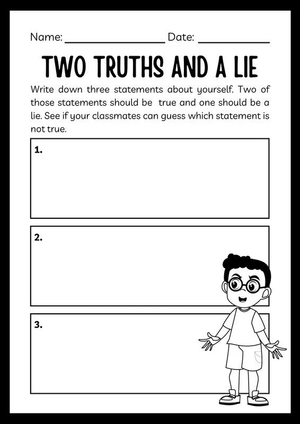
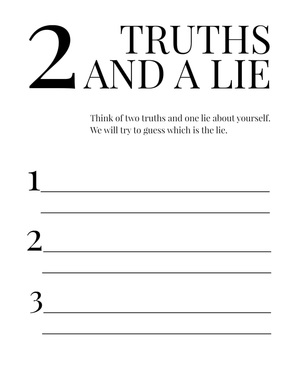
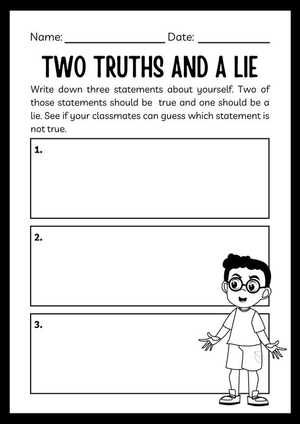
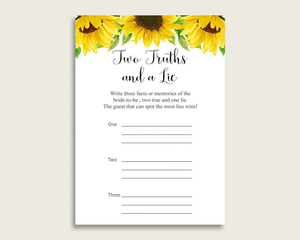
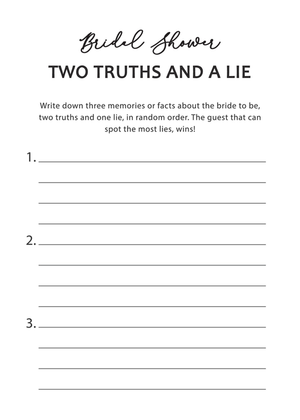
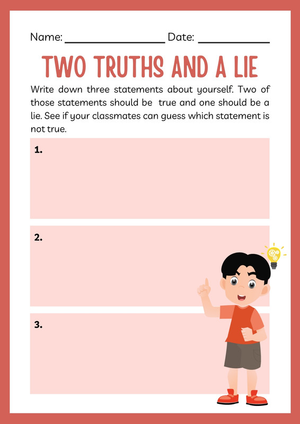
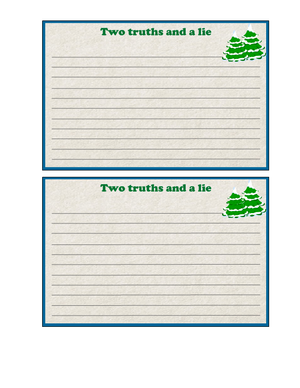
A Two Truths and a Lie worksheet gives students a simple structure: write three statements about yourself, make two of them true and one false, then let classmates guess which one is the lie. The page does the organizing, so you don't have to explain the rules five times. Students draft their three sentences, share them aloud or in a small group, and the rest of the table votes on the invented statement.
Because the whole task fits on one sheet, it works as a back-to-school icebreaker, a transition between lessons, or a warm-up before a writing unit. You hand out the page, give students a few minutes to think, and the room fills with quiet drafting followed by guessing. It's low prep for you and low pressure for students who are still learning the names of the people around them.
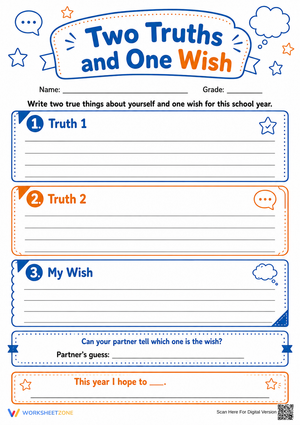
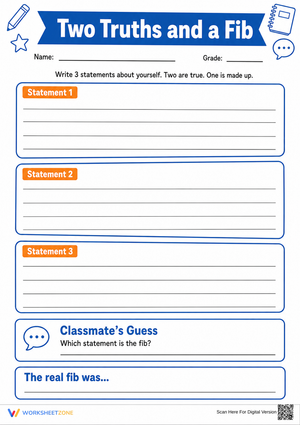
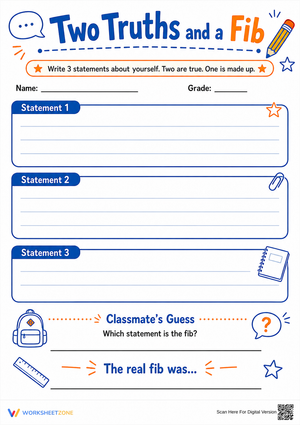
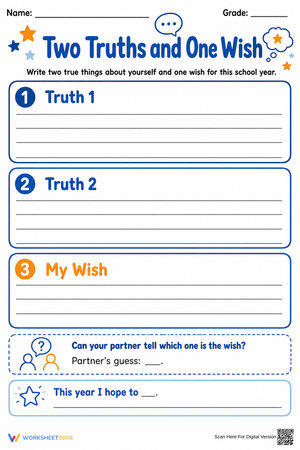
A strong template does more than leave three blank lines. Look for a page that separates the two true statements from the false one during planning, gives space for a guess and a reason, and leaves room for a short reflection at the end. That extra structure is what turns a quick game into something you can actually assess.
Why It Works as a First-Week Icebreaker
The first week sets the tone. Students are sizing up classmates and reading you for how much risk feels safe. Two Truths and a Lie lowers that risk because everyone writes the same three sentences and everyone gets a turn. Nobody is singled out to share something about themselves cold, which is the moment a lot of students quietly dread.
According to TeacherVision, Two Truths and a Lie is a back-to-school icebreaker in which each student offers three statements, two accurate and one invented, while classmates try to identify the false one. Because the format asks for only three short sentences per student, it stays one of the lowest-prep ways to build community in the opening days of the year.
There's a practical bonus for you, too. As students share, you get a fast, informal roster of interests, who plays travel soccer, who just moved from another state, who's into manga, that you can reference later to connect with reluctant participants and personalize examples throughout the unit.
Running the Activity Step by Step
A clean run takes about 10 to 15 minutes and follows a predictable rhythm. Once students know the sequence, you can reuse it all year with almost no setup.
- Hand out the worksheet and read one teacher example aloud so the false-statement idea is concrete.
- Give students three to five minutes to draft two true statements and one false one.
- Have students share in pairs, table groups, or with the whole class.
- Ask listeners to vote or explain which statement they think is false and why.
- Reveal the lie, then invite a quick follow-up question about one of the true statements.
The reasoning step is where the real learning sits. When you ask what made them pick that one, students have to point to evidence in a classmate's wording, which turns a guessing game into short, structured listening practice.
Timing keeps it from dragging. Set a visible timer for the drafting stage, and cap each sharing round so momentum holds. If a group finishes early, ask them to write a fourth statement that would be the hardest lie to catch and explain why.
Tying It to ELA Speaking and Writing Skills
It's easy to treat this as a filler game, but the worksheet maps onto real skills: writing clear sentences, supporting a claim with evidence, and listening closely enough to infer. That's why it earns a place in an ELA warm-up rotation and not just the first day.
The activity quietly rewards specificity. A vague true statement like I like sports reads as filler and gets spotted fast, so within a single round students learn that concrete, surprising details, such as catching a foul ball at a Dodgers game in third grade, make the lie harder to find and the sharing more memorable. That instinct toward precise, sensory detail is exactly the muscle narrative and descriptive writing units depend on, which is why teachers who run the game two or three times early in the year often see stronger opening sentences when the first real essay lands.
You can also make the thinking visible. After the reveal, ask two or three students to say the exact word or phrase that tipped them off. Naming that evidence out loud models the close reading you want during a real text discussion, and it takes less than a minute.
Variations to Keep It Fresh
Reusing the worksheet all year works best when you change the frame. Swap the theme and the same three-sentence structure feels new every time.
- Content review: statements about a novel's character, a historical event, or a science concept from the current unit.
- Seasonal: summer memories in September, goals in January, reflections in May.
- Vocabulary: require one target word from the week in each statement.
- Whole-class version: students stand, and the class narrows guesses by asking yes-or-no questions before voting.
Rotating variations keeps the novelty that makes students lean in, while the underlying skills, clear sentences and evidence-based guessing, stay constant. Keep a short menu of three or four variations inside your plan book, and you'll never scramble for a five-minute community builder again.
Frequently Asked Questions
1. How do teachers introduce this without students feeling put on the spot?
Model it first with your own three statements, let students write privately before anyone shares, and allow hobby-based statements instead of personal ones. Sharing in small groups before any whole-class reveal also takes the pressure off.
2. What grade levels is this worksheet appropriate for?
It works from early elementary through high school. Younger students use sentence starters and pictures; older students write more nuanced or content-tied statements, so the same structure scales across K-12. Pair a drawing option for K-1 with a content-tied version for secondary classes, and one worksheet covers your whole building.
3. Can it be adapted for remote or hybrid classrooms?
Yes. Students post three statements in a chat or shared document, and classmates guess by typing a number. Breakout rooms mirror the small-group version, and a screen-shared teacher example keeps the rules clear.
4. How long does a typical activity take?
Plan for about 10 to 15 minutes: a few minutes to draft and the rest to share and guess. As a brain break between lessons, you can run a shortened version with just a handful of volunteers.
5. How can teachers connect this to specific ELA skills?
Frame the two true statements as descriptive-writing practice and the guessing as evidence-based inference. Ask students to justify each guess with a detail from the sentence, and you've turned an icebreaker into speaking, listening, and writing practice.












 Interactive Worksheet Maker
 Quiz Maker
 Word Search Maker
 Crossword Puzzle Maker
 Word Scramble Generator
 Sentence Scramble Generator
 Handwriting Worksheet Generator
 Name Tracing Generator
 Fill In The Blank Generator