Search for who am I worksheets and you get two related but different resources, and knowing which one you need saves planning time. One set uses riddle-style clues that ask students to identify a hidden animal, object, or character. The other uses reflection prompts that ask students to describe themselves. The Worksheetzone collection carries both, spanning Preschool through Grade 12, with most sheets aimed at Kindergarten through Grade 4.
Two who am I worksheet types
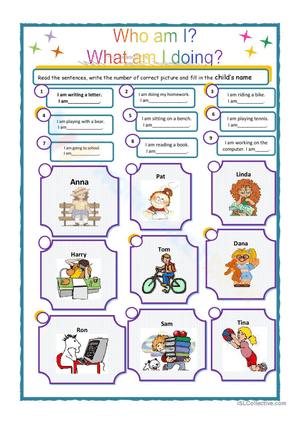
The first type is an inference or riddle worksheet. Students read a short list of descriptive clues, then name the mystery subject: a penguin, a pencil, a storybook character. These come as multiple-choice tasks, fill-in-the-blank prompts, and riddle cards with picture support for younger readers. They give you quick, low-prep practice on reading closely and reasoning from evidence.
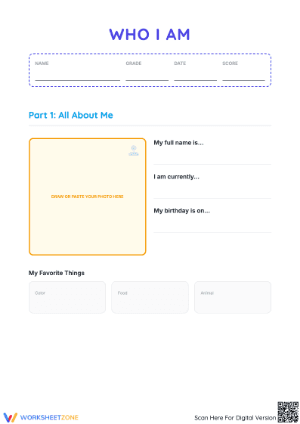
The second type is a self-identity worksheet with prompts like "Who I Am" and "The Essence of Me." Students write about their interests, family, values, and goals. Teachers use these as first-week icebreakers and display them on lockers, cubbies, or desks for open houses and parent-teacher conferences. Same title, very different classroom purpose, so it helps to check the format before you print a stack.
Grade-band guidance for choosing the right worksheet
Because the collection stretches from Preschool to Grade 12, matching the sheet to the reader matters more than grabbing the first printable. Use the format and clue count as your guide rather than the title alone.
The clearest signal of difficulty is not vocabulary but the number of clues a student must hold at once. A K-2 riddle usually resolves on two or three concrete, picture-supported clues, so working memory load stays low. Grades 3-4 riddles typically stack four to six clues where no single line gives the answer, which forces students to cross-reference details. By grades 5-9, "Who Am I" tasks shift to character analysis and historical figures, where clues are abstract traits instead of physical features.
- Preschool-Grade 2: simple animal and object riddles with picture clues and a small answer bank.
- Grades 3-4: multi-clue deductive riddles that require combining evidence before answering.
- Grades 5-9: character-trait and historical-figure riddles that lean on inference about personality and motive.
Classroom Implementation
These sheets work well beyond independent seatwork. A few reliable routines:
- Inference stations: place a stack of riddle cards at a small-group station and have students justify each answer with the clue that proved it.
- Morning meeting warm-ups: read one riddle aloud and take answers with a "because" sentence stem.
- Formative exit checks: hand out one four-clue riddle and collect the reasoning, not just the answer.
The "prove it with a clue" move is what shifts a riddle from a guessing game into real comprehension work. When students point to the line that settled their answer, you get a clean window into who is inferring and who is guessing. Keep the used cards in a labeled folder by grade band, and you build a reusable inference station that costs nothing to run for the rest of the year.
Frequently Asked Questions
1. What grade levels are Who Am I worksheets best suited for?
The collection runs from Preschool through Grade 12, but the bulk targets Kindergarten through Grade 4. Match by format: picture-supported riddles for K-2, multi-clue deductive riddles for grades 3-4, and character or historical-figure tasks for grades 5-9.
2. How do Who Am I riddle worksheets teach inference skills?
Each clue acts as a piece of text evidence, and the answer is a conclusion students must support. Combining several clues to rule out wrong answers is the same close-reading and evidence-citing skill described in CCSS Reading Anchor Standard R.1.
3. Can these worksheets be used for both reading practice and SEL activities?
Yes. The riddle versions build inference and deductive reasoning, while the identity-reflection versions support self-awareness and classroom community. Many teachers use both types across a single unit to cover reading and social-emotional goals at once.
4. How can teachers differentiate Who Am I worksheets for different reading levels?
Adjust clue count and specificity. Give struggling readers two concrete clues plus a picture answer bank, and challenge advanced students to write original riddles. A single template can serve three reading levels with small changes.
5. What is the best way to introduce these worksheets at the start of the school year?
Begin with an identity-reflection sheet as a first-week icebreaker and display the results at open house. Once community is established, roll in riddle sheets for daily inference warm-ups and small-group stations.















 Interactive Worksheet Maker
 Quiz Maker
 Word Search Maker
 Crossword Puzzle Maker
 Word Scramble Generator
 Sentence Scramble Generator
 Handwriting Worksheet Generator
 Name Tracing Generator
 Fill In The Blank Generator