


























Views
Downloads

Two Truths and One Wish | Essential Grade 3-8 Icebreaker
Paste this activity's link or code into your existing LMS (Google Classroom, Canvas, Teams, Schoology, Moodle, etc.).
Students can open and work on the activity right away, with no student login required.
You'll still be able to track student progress and results from your teacher account.
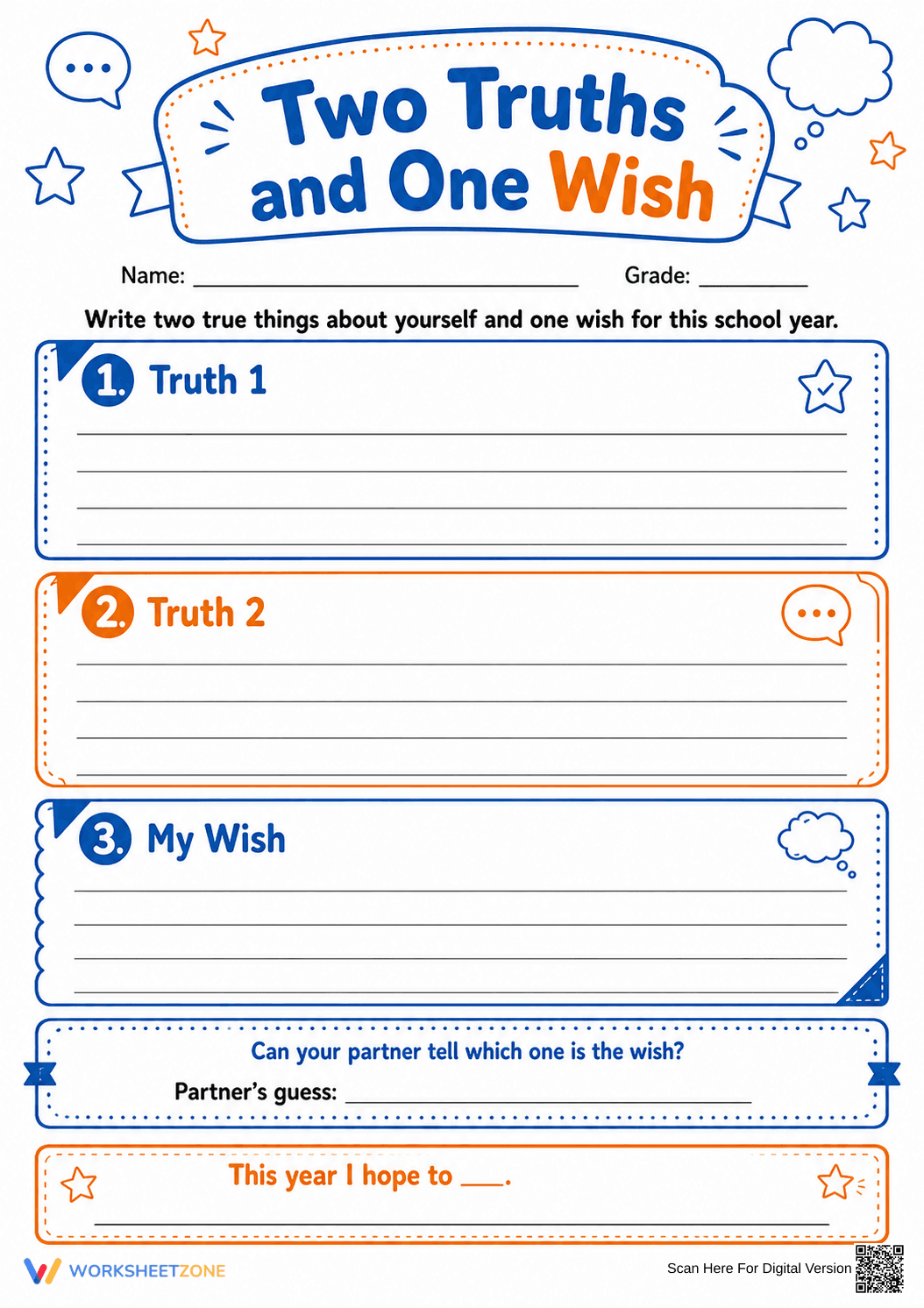
This Grade 3-8 icebreaker worksheet facilitates immediate classroom community building by combining creative writing with peer interaction. Students draft two factual statements and one future goal, allowing them to share personal history while setting a positive tone. The structured layout ensures every student has a clear framework for self-expression and collaborative play.
At a Glance
- Grade: 3–8 · Subject: ELA / SEL
- Standard:
CCSS.ELA-LITERACY.SL.3.1— Engage in collaborative discussions and express ideas clearly while building on others' talk- Skill Focus: Narrative writing and peer interaction
- Format: 1 page · 5 tasks · Answer key not required · PDF
- Best For: First week of school icebreaker
- Time: 15–20 minutes
What's Inside
The worksheet features a clean layout with five interaction zones. It includes three primary writing panels for truths and the wish, each with ruled lines to support legible handwriting. A dedicated partner-response section encourages active listening, while the final reflection strip provides space for goal-setting. The bright design keeps students engaged without distracting from the writing tasks.
Zero-Prep Workflow
This resource is designed for a zero-prep environment. First, print the single-page PDF for your class size (30 seconds). Second, distribute the sheets and provide a brief verbal model of a truth versus a wish (1 minute). Finally, allow students to complete the writing and circulate for partner guessing (15 minutes). Total teacher preparation time is under 2 minutes, making it an ideal first-day activity.
Standards Alignment
The primary standard addressed is `CCSS.ELA-LITERACY.SL.3.1`, which requires students to engage effectively in a range of collaborative discussions, building on others' ideas and expressing their own clearly. Additionally, it supports `CCSS.ELA-LITERACY.W.3.10` by providing practice in writing for a specific audience and purpose. Both standard codes can be copied directly into lesson plans, IEP goals, or district curriculum mapping tools.
How to Use It
Use this worksheet during the first morning of school to break the ice and lower student anxiety. It works best after a teacher introduction where you share your own examples. As a formative assessment, observe how students distinguish between concrete facts and abstract wishes to gauge their grasp of narrative logic. Completion typically takes 15 to 20 minutes.
Who It's For
This activity is designed for students in Grades 3 through 8, with enough writing space to accommodate various developmental levels. It is particularly effective for English Language Learners (ELLs) as it provides clear prompts and a predictable structure. Pair this resource with a classroom 'All About Me' anchor chart or a short personal narrative reading passage to extend the lesson into a full unit.
According to Fisher & Frey (2014), establishing a positive classroom climate through structured peer-to-peer interactions is foundational for academic success. This worksheet leverages the 'Two Truths and One Wish' format to facilitate low-stakes writing and high-engagement speaking opportunities. By requiring students to distinguish between factual statements and future aspirations, the activity addresses CCSS.ELA-LITERACY.SL.3.1, which focuses on collaborative discussion and building on the ideas of others. Research from the RAND AIRS 2024 report suggests that social-emotional learning tools integrated into the first week of instruction significantly improve student belonging. This resource provides a structured framework for students to share personal narratives while practicing active listening skills during the partner-response phase. The inclusion of a reflection strip ensures that the activity moves beyond simple entertainment into meaningful goal-setting, providing teachers with immediate insight into student motivations and writing proficiency levels at the start of the academic year.


