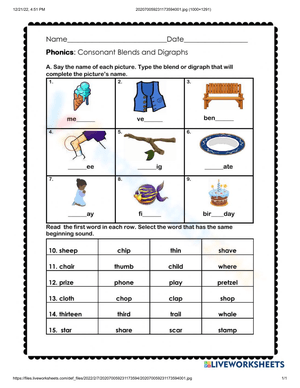
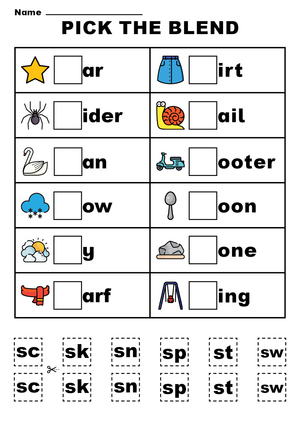
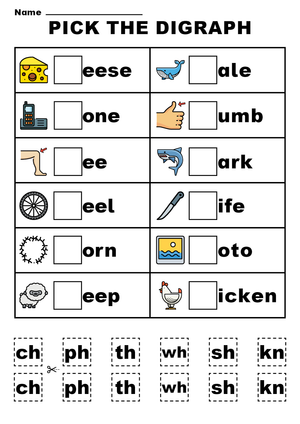
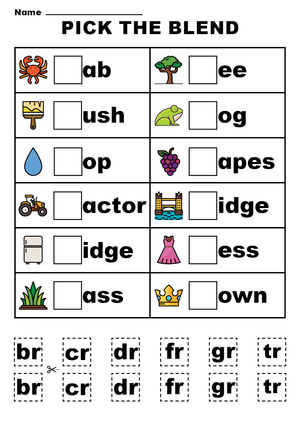
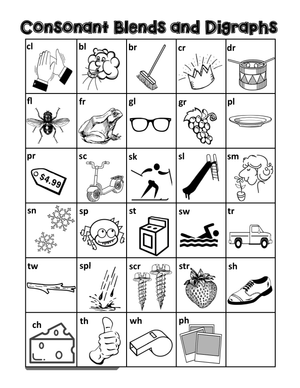
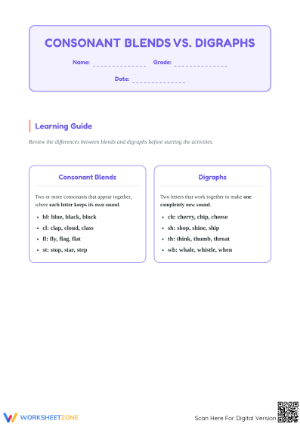
Before a single worksheet lands on a student's desk, it helps to have a quick, classroom-ready explanation ready for the moment a student asks why shop sounds different from stop. A consonant blend keeps each individual sound audible. In blue, students can still hear /b/ and /l/ as two distinct sounds pressed close together. A digraph works differently: two letters combine to represent one single phoneme. Digraphs like sh, ch, th, ph, and tch do not blend two sounds together, they replace them with one new sound entirely.
This distinction matters more than it might seem at first glance. When students treat digraphs as if they were blends, they try to sound out each letter separately, which slows decoding and introduces errors. When they treat blends as if they were digraphs, they lose the ability to hear and manipulate the individual phonemes needed for spelling. Worksheets that isolate these two skills, rather than mixing them together in one generic phonics sheet, give teachers a much clearer picture of which skill a student actually needs to practice.
A Teaching Sequence That Builds Decoding Accuracy
A workable sequence starts with digraph identification: students sort picture cards or word cards by their beginning digraph sound, then move into reading short digraph words in isolation before embedding them in sentences. Blends should follow a similar arc, but with an important caution. Reading researcher Louisa Moats (2010) cautions that blends should not be taught as one fused sound, since that adds unnecessary memorization load for students. Worksheets that ask students to segment blend words into their component sounds, rather than memorize the blend as a chunk, align with this guidance and keep the cognitive demand appropriately low.
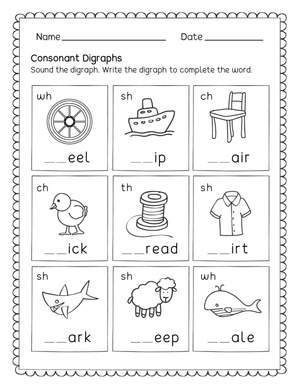
Common instructional practice has students segment digraph words as one unit, such as sounding out shop as /sh/ /o/ /p/ rather than /s/ /h/ /o/ /p/. Worksheets built around this practice, where students circle or underline the digraph as a single unit before decoding the rest of the word, reinforce the correct mental model from the first exposure rather than requiring correction later.
Formative Assessment Ideas for Blends and Digraphs
Worksheets do double duty as quick formative checks when teachers separate decoding tasks from encoding tasks. A decoding-focused worksheet asks students to read blend and digraph words aloud or match words to pictures, checking whether they can accurately translate print to sound. An encoding-focused worksheet asks students to spell words containing blends and digraphs from dictation, checking whether they can translate sound back to print. Comparing performance on both types of worksheets in the same week often shows a gap: many students decode digraphs and blends more accurately than they can spell them, which signals that a class needs more encoding practice rather than repeated decoding drills.
Short, weekly digraph and blend worksheets, tracked over four to six weeks, give teachers a simple trend line for each student without requiring a formal assessment tool. A student who plateaus on blend spelling while continuing to improve on digraph spelling is a strong candidate for a short pull-out session focused specifically on segmenting blend sounds.
Classroom Implementation
Start each blends and digraphs unit with a five-minute warm-up using a worksheet that mixes review words from the prior week with two or three new target words. This keeps retrieval practice active while introducing new content gradually. During independent work time, rotate worksheet formats across the week: sorting on Monday, fill-in-the-blank on Tuesday, sentence dictation on Wednesday, and a mixed review on Thursday, with Friday reserved for a short check that mirrors the formative assessment approach above.
Digraphs and blends are frequently taught as if they belong to the same category of phonics skill, but the demands they place on a young reader are fundamentally different: a digraph asks a student to accept one new symbol-sound pairing, while a blend asks a student to hold two separate phonemes active at once and sequence them correctly. Recognizing this difference lets teachers choose worksheet formats that match the actual cognitive task rather than defaulting to one generic phonics sheet for both skills, a distinction supported by phonics instruction research summarized at fivefromfive.com.au.
For enrichment stations, pair worksheet practice with a word-building routine using letter tiles or magnetic letters, so students who finish early can physically manipulate the blend or digraph before writing it. For students who need more support, keep a folder of simplified worksheets with fewer words per page and larger print, so the format itself does not add difficulty on top of the phonics skill being taught.
Frequently Asked Questions
1. What is the difference between a blend and a digraph for early readers?
A blend keeps both individual sounds audible, as in the /b/ and /l/ in blue, while a digraph combines two letters into one single sound, as in the sh in shop. Worksheets that separate these two categories help students practice each skill without confusing the underlying sound structure.
2. When should teachers introduce blends and digraphs in the phonics scope and sequence?
Both skills are typically introduced after students have mastered short vowel CVC words and before they move into long vowel patterns. This placement gives students a stable single-sound foundation before adding the extra demand of two-letter sound units.
3. How can worksheets support small-group intervention for blends and digraphs?
Worksheets let an interventionist observe exactly where a student's decoding breaks down, whether on blends, digraphs, or both, and then assign targeted practice such as sorting, fill-in-the-blank, or dictation tasks that match the specific error pattern.
4. What are common student mistakes with blends and digraphs and how do worksheets help fix them?
Students often try to sound out digraphs as two separate letters instead of one unit, or drop one sound when reading a blend. Worksheets that ask students to circle the digraph as a single chunk, or segment blends into their component sounds during spelling, correct these habits with repeated, low-stakes practice.












 Interactive Worksheet Maker
 Quiz Maker
 Word Search Maker
 Crossword Puzzle Maker
 Word Scramble Generator
 Sentence Scramble Generator
 Handwriting Worksheet Generator
 Name Tracing Generator
 Fill In The Blank Generator